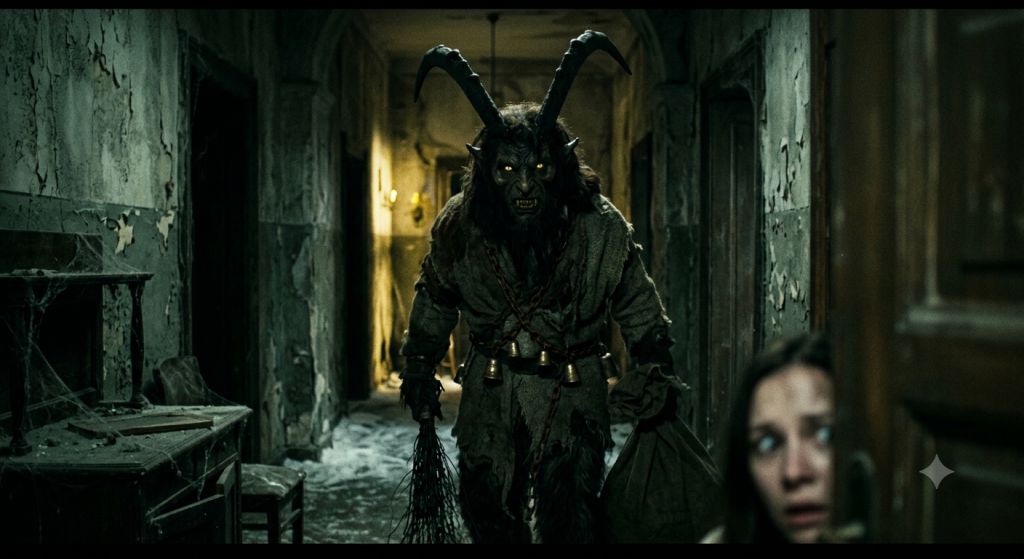
Grýla is the oldest and most terrifying figure in Icelandic Christmas tradition, a giantess of monstrous physical description who descends from her cave in the Icelandic highlands each December to hunt for naughty children, whom she collects in her enormous bag, takes back to her cave, and boils alive in a cauldron. She has been doing this, in the documented literary and folk tradition, since at least the thirteenth century, which makes her one of the longest continuously documented child-threatening supernatural figures in European history. She predates the Yule Lads, whose mother she is. She predates the modern Icelandic Christmas tradition entirely. She is, in the truest sense, the original dark figure of the Icelandic winter, from whom everything else in the Icelandic Christmas supernatural world descends.
The popular contemporary treatment of Grýla tends to present her as a colourful piece of Icelandic folklore, charming in her grotesqueness, a manageable piece of seasonal dark Christmas aesthetics. This treatment does not do her justice. Grýla in the older tradition is a figure of genuine horror, a being whose physical description in medieval sources is specifically designed to be maximally repulsive and maximally threatening, whose hunger for children is not metaphorical, and whose eight hundred years of continuous presence in Icelandic culture reflects something genuine about the Icelandic relationship with the midwinter darkness that is not easily translated into the language of seasonal charm.
The Medieval Sources
Grýla appears in Icelandic literary sources from the thirteenth century, and the range of contexts in which she appears tells you something important about her status in medieval Icelandic culture. She is not a marginal figure from the edges of the tradition. She appears in the work of Snorri Sturluson, the thirteenth century Icelandic historian, mythographer, and political figure whose Prose Edda and Heimskringla are among the most important documents in Old Norse literature. Snorri mentions Grýla in the Skáldskaparmál section of the Prose Edda as a troll woman, listing her among the names of giantesses in a kenning catalogue. The mention is brief but its presence in Snorri’s work establishes Grýla as a figure sufficiently established in the mainstream of Icelandic supernatural tradition to appear in a major literary work without explanation or introduction.
The earliest detailed description of Grýla appears in a twelfth or thirteenth century poem preserved in later manuscripts, which describes her physical characteristics in the elaborate and specific way that medieval Icelandic poetry applied to the description of supernatural beings. The description emphasises multiplicity: she has multiple tails, multiple bags hanging from each tail, multiple children in each bag. She has multiple noses, multiple ears, multiple eyes. Her hair is not simply long but specifically wild and unkempt in ways that mark her as belonging to the wild landscape rather than to the domestic interior. She smells of the mountain and the cold.
The fifteenth century Icelandic poem Grýlukvæði, the Grýla Poem, gives the fullest medieval account of her character and activities. This poem describes Grýla descending from the mountains at Christmas time specifically to hunt naughty children, provides the most detailed description of her appearance in the medieval tradition, and establishes the specific connection between her child-hunting and the Christmas season that the subsequent tradition has maintained. The poem is composed in a deliberately frightening register: its imagery is graphic, its descriptions of Grýla’s appetite are specific, and its function as a text to be recited to children who needed frightening into better behaviour is transparent.
The Grýlukvæði also provides the earliest documentation of Grýla’s bag as her primary hunting instrument. The bag in the poem is large enough to hold multiple children simultaneously, and the children inside it know what is happening to them: they can hear each other, they can call out, and they are aware of their situation as they are carried back to the cave. This awareness is one of the most disturbing elements of the medieval Grýla tradition, and it distinguishes her from supernatural child-threatening figures who simply cause children to disappear: Grýla’s victims are conscious throughout the process of their capture and transportation, which is a specific form of horror that the poem exploits deliberately.
Her Physical Description
The physical description of Grýla that the medieval and early modern sources provide is one of the most elaborate in the Icelandic supernatural tradition, and the specific details of her appearance are worth examining carefully because they are not arbitrary. Each element of her description serves a specific function in establishing her as a figure of maximum supernatural otherness.
The most consistently described feature is her tails. Medieval accounts give her fifteen tails. Each tail has a hundred bags attached to it. Each bag holds twenty children. The mathematical result — fifteen hundred bags, thirty thousand children — is not intended as a realistic assessment of Grýla’s child-eating capacity but as an expression of her limitlessness. She cannot run out of bag space. No matter how many children she has already taken, there is always room for more. The multiplication of tails and bags is the folk tradition’s way of making a threat feel genuinely infinite.
Her eyes are described as multiple, typically three or four, positioned on her head in configurations that do not correspond to normal animal or human anatomy. Multiple eyes in the Icelandic supernatural tradition are associated with supernatural perceptiveness: a being with multiple eyes cannot be approached unseen, cannot be deceived about what is happening in its vicinity, and cannot be escaped from by simply hiding. Grýla’s multiple eyes mean that the naughty child who thinks they can hide from her is mistaken.
Her noses are similarly multiple, and their multiplication serves a similar function to the multiple eyes: she can smell naughty children in the same way that a hunting dog can smell prey, and the specificity of the smell — the smell of naughty children, not of children in general — implies that naughtiness has a detectable physical quality that Grýla is specifically equipped to locate. The good child is invisible to her. The naughty child announces itself.
Her ears are long enough to hang down to her shoulders, which is a detail that appears in multiple independent descriptions and which, like the multiple eyes and noses, emphasises her sensory superiority over the humans she hunts. Long ears in the Icelandic tradition are associated with hearing over great distances, and Grýla’s ears mean that she can hear children misbehaving from her cave in the highlands.
Her overall aspect in the medieval descriptions is specifically designed to be maximally ugly rather than simply strange. This ugliness is not incidental: it is the physical expression of her moral character, the outward form of a being whose values and desires are the inversion of everything that the domestic, Christian, community-oriented Icelandic household represented. She is the outside made visible, the winter wilderness given a body and a hunger.
Her Husbands and Her Domestic Life
One of the most distinctive elements of the Grýla tradition is the specific information it provides about her domestic arrangements, which are treated with the same matter-of-fact detail that the folk tradition applies to other aspects of her character. Grýla has been married three times according to the tradition, and her marital history is presented as a sequence of domestic catastrophes that parallels, in grotesque form, the normal human experience of marriage and family.
Her first husband is not named in the surviving sources. Her second husband, Boli, appears in some versions of the tradition but is similarly obscure. Her current husband, the one associated with the Yule Lads, is Leppalúði, whose name translates approximately as the slovenly one or the lazy one. Leppalúði is one of the great supporting characters of the Icelandic Christmas supernatural tradition: a figure of spectacular uselessness who sits in the cave while Grýla does the child-hunting, contributes nothing to the family economy except his continued breathing, and is in every description the most indolent supernatural being in the Icelandic tradition.
The contrast between Grýla’s ferocious energy — descending from the mountains, hunting children, maintaining the cave, raising thirteen sons — and Leppalúði’s complete passivity is one of the more subtle elements of the tradition’s humour. Grýla has no need of Leppalúði. She is entirely capable of managing her supernatural child-eating enterprise without his participation. His presence in the tradition seems to serve primarily the function of making Grýla’s competence more visible by contrast: she is a figure who accomplishes everything while her husband accomplishes nothing, which is a recognisable domestic dynamic rendered in supernatural form.
Their thirteen sons are the Yule Lads, and the family unit of Grýla, Leppalúði, and the thirteen Lads represents the most elaborately developed supernatural family in the Icelandic Christmas tradition. The Lads inherit their mother’s interest in harassing humans but not her appetite for children: they steal food and cause mischief rather than kidnapping and eating, which makes them genuinely threatening to the household economy without reaching the existential threat level of Grýla herself. The Yule Cat, Grýla’s companion rather than her child in most versions, completes the family by adding an additional threat aimed at inadequately clothed humans.
The Cave and the Landscape
Grýla’s cave is located in the Icelandic highlands in the tradition, in the volcanic interior landscape of Iceland that was historically the most forbidding and the most dangerous part of an already forbidding and dangerous island. The Icelandic highlands are genuinely one of the most inhospitable inhabited landscapes in Europe: a lava desert of volcanic rock, glacial outwash plains, geothermal areas, and occasional extreme weather events that made the interior effectively impassable for most of the year and genuinely dangerous even for experienced travellers at the best of times.
The placement of Grýla in this specific landscape is not arbitrary. The Icelandic supernatural tradition consistently places its most threatening figures in the interior highlands: outlaws, trolls, and monsters inhabit the wild interior while the human community occupies the coastal and valley farmsteads. The division between the farmed landscape and the wild interior is one of the most fundamental in Icelandic cultural geography, and the Grýla tradition reinforces it by placing the source of the Christmas threat in precisely the landscape that represents maximum distance from the human community.
The descent from the highlands to the farms at Christmas thus has a specific geographic logic: Grýla comes from the most extreme environment in Iceland, crosses the landscape between the wild interior and the human settlement, and arrives at the farms specifically at the time of year when the darkness is greatest and the distance between the human community and the threatening exterior is, in some sense, smallest. Her arrival at Christmas is not coincidental. It is the expression of the midwinter season’s specific quality as the period when the boundaries that normally separate the human world from the wild world are most permeable.
The 1746 Law
The Icelandic law of 1746 that forbade parents from using Grýla and the Yule Lads to frighten their children is one of the most remarkable documents in the history of the Grýla tradition, and its specific language is worth examining in detail. The law, issued by the Danish-Icelandic authorities who governed Iceland at the time, stated that it was forbidden to frighten children with belief in Grýla and similar supernatural beings, and it attributed the practice to ignorance and superstition that was unbecoming of a Christian people.
The law reflects Enlightenment-era attitudes toward folk belief that were being articulated across Europe in the eighteenth century: the idea that supernatural threats used to manage children’s behaviour were a form of irrationality that educated Christian authorities had an obligation to suppress. The specific identification of Grýla as the primary target of the law confirms her central position in the Icelandic Christmas threatening tradition at this period, and the fact that the law was considered necessary confirms that the tradition was widespread and actively used.
The law’s failure was complete. The Grýla tradition continued through the eighteenth, nineteenth, and twentieth centuries without significant interruption, and the tradition of using her to manage children’s behaviour at Christmas persisted in Icelandic households long after the legal prohibition had been forgotten. The failure illuminates something important about the relationship between official regulation and folk tradition: laws passed against practices that serve genuine functions in community life tend to be ineffective, because the community continues to need the function even after the practice has been officially forbidden.
The specific function that Grýla served — as a sanction for bad behaviour that had genuine credibility in the imagination of Icelandic children — could not simply be replaced by legal decree. The authorities who passed the 1746 law did not provide an alternative sanction of comparable effectiveness, and without such an alternative the law simply left a gap in the practical management of children’s behaviour that the tradition rushed back to fill.
Grýla in the Modern Icelandic Imagination
The contemporary Grýla is a significantly softened version of her medieval predecessor, though she retains enough of her original character to remain genuinely threatening rather than simply colourful. The child-eating has not been removed from the tradition — she still boils children in her cauldron in the version that Icelandic parents and teachers describe to children — but the emphasis has shifted from the graphic physicality of the medieval descriptions to a more theatrical presentation of the threat.
Icelandic children’s books, films, and television programmes featuring Grýla present her in ways that are visually frightening but tonally managed: she is scary in the way that a roller coaster is scary, providing a controlled experience of fear within a frame that makes clear that the fear is temporary and the danger is not real. This is different from the medieval and early modern tradition, in which the fear was intended to be genuine and the possibility of actual supernatural harm was presented as real. The taming of Grýla from genuine threat to managed theatrical scare is part of the broader process by which the dark Christmas tradition has been domesticated in the modern period.
The domestication has not been complete, however. Grýla remains a figure of sufficient darkness that her use in advertising and commercial Christmas imagery is limited in Iceland in ways that Krampus’s use is not limited in the international market. She is not a figure that Icelandic businesses put on Christmas cards or use to sell products, because she carries enough of her original threatening character to make commercial appropriation feel wrong. This residual darkness is itself evidence of the depth of her roots in the tradition: figures that have been fully domesticated can be used for anything, and the limits on Grýla’s commercial use reflect the limits of her domestication.
Grýla and the European Tradition of the Child-Eating Supernatural
Grýla belongs to a broader European tradition of supernatural child-threatening figures whose threat involves the physical consumption of children rather than simply their removal or punishment. This tradition includes Baba Yaga of the Slavic world, who eats children who come to her hut on chicken legs; the ogres and child-eating witches of the broader European fairy tale tradition; and the various bogeyman figures of different cultures who take children away to unspecified but implicitly violent fates.
What distinguishes Grýla from many of these figures is the specificity and consistency of her documentation over a period of eight centuries. Most European child-threatening figures are attested primarily in the modern period, documented by nineteenth century folklore collectors who recorded traditions that may or may not have been as old as the collectors assumed. Grýla is attested in documents from the thirteenth century whose authenticity is not in doubt, which gives her a documented history considerably longer than most of her equivalents in other traditions.
The consistency of her tradition across eight centuries is equally distinctive. The physical description, the bag, the cave, the Christmas timing, and the child-eating appetite are all present in the medieval sources and all present in the contemporary tradition. Some elements have been added over time — the Yule Lads as her sons, Leppalúði as her husband, the Yule Cat as her companion — but the core of the figure has remained remarkably stable across a period that saw Iceland converted to Christianity, colonised by Denmark, struck by volcanic eruptions, famines, and epidemics, and transformed from a medieval pastoral society into a modern industrial one. The persistence of Grýla through all of this is the most compelling evidence of the depth of her roots in Icelandic culture.
For more on the Christmas folklore tradition, the Yule Lads article covers Grýla’s thirteen sons and their specific Christmas activities in proper detail. The Yule Cat article covers Grýla’s companion and the clothing threat that completes the Icelandic Christmas supernatural family. The Krampus article covers the Alpine figure whose tradition parallels Grýla’s in its combination of genuine supernatural threat and sustained official opposition. The Christmas hub page has every article in the cluster.
Never miss a myth
Thank you for being here. The site is brand new and every subscriber genuinely means something to me. If you're here, you care about this stuff as much as I do - and that's all the reason I need to keep going. New stories, videos and dark folklore from around the world, straight to your inbox. No algorithm. Just the stories, when they're ready.