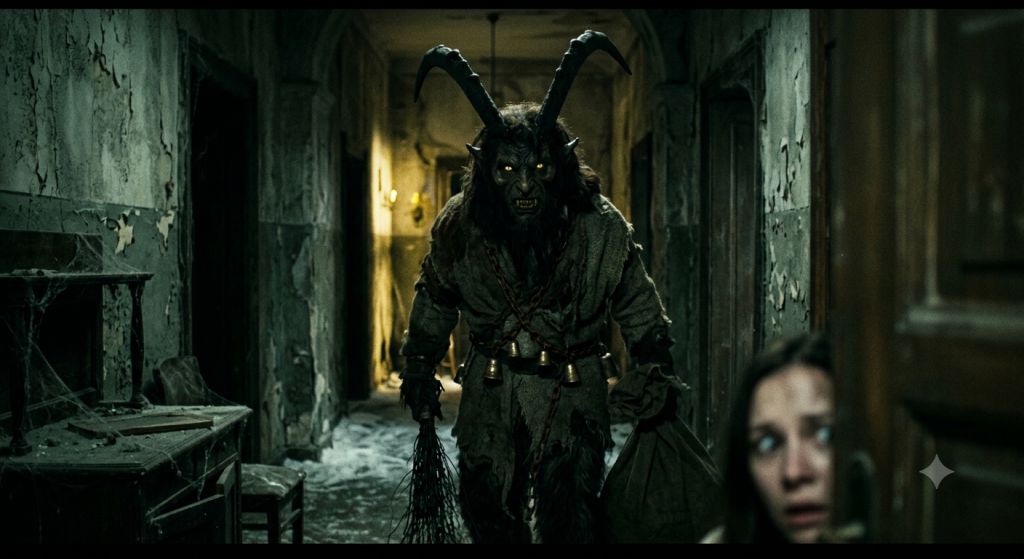
Hans Trapp is the Christmas threatening figure of the Alsace and Lorraine regions of northeastern France, the area that sits on the border between French and German cultural traditions and whose folklore reflects both. He appears at Christmas in the company of Saint Nicholas, serving the same function as Krampus in the Alpine tradition and Père Fouettard in other parts of France: the dark companion who represents the threatening dimension of the Christmas gift-giver, the one who handles the punishment while the saint handles the rewards.
Hans Trapp is unusual among Christmas threatening figures because he is based on a real historical person. Hans von Trotha, a fifteenth century Rhenish knight, was excommunicated by Pope Alexander VI for his conflicts with the Bishop of Speyer and his general conduct as a robber baron of considerable violence. The legend that grew around him in the Alsace region transformed this historical figure into a supernatural threatening presence condemned by God to wander the earth at Christmas frightening children as punishment for his sins.
The Historical Hans von Trotha
Hans von Trotha was a real figure in the political landscape of the late fifteenth century Rhineland, a minor noble whose conflicts with ecclesiastical authority were severe enough to result in excommunication. The specific details of his excommunication involve a dam he built on the river Lauter that flooded land belonging to the Bishop of Speyer, followed by a series of escalating conflicts that resulted in Pope Alexander VI formally condemning him in 1501.
The excommunication of a powerful local figure for conflicts with the Church was not unusual in the fifteenth century. What was unusual was the specific folk tradition that developed in the Alsace region around von Trotha’s memory, transforming him into a scarecrow-like supernatural figure — dressed in rags, carrying a staff, terrifying in his gaunt appearance — who visited households at Christmas to threaten children who had behaved badly during the year.
His Appearance
Hans Trapp in the tradition is described as a tall, gaunt figure dressed in a dark coat or rags, sometimes with a scarecrow-like quality that connects him visually to the field spirits of Germanic agricultural tradition. He carries a staff or a bundle of switches. His face in some depictions is skeletal or cadaverous, which reflects his status as a condemned figure, someone already partly dead in the theological sense of being outside the Church.
The scarecrow quality of his appearance is one of the more distinctive elements of the Hans Trapp tradition and one that distinguishes him from other Christmas threatening figures. Where Krampus is a demon and Père Fouettard is a butcher, Hans Trapp is a scarecrow, a figure from the fields, which gives him a specifically agrarian character appropriate to the rural Alsatian communities where the tradition is strongest.
Hans Trapp and Saint Nicholas
Hans Trapp appears with Saint Nicholas on the 6th of December in the Alsace tradition, accompanying the saint on his rounds and threatening the children who have not been good while Nicholas distributes gifts to those who have. The pairing of the saintly gift-giver and the threatening dark companion follows the same structural logic as Krampus and Saint Nicholas in the Alpine tradition: the saint cannot threaten children directly without compromising his saintly character, so the threat is externalised into a companion figure who handles that dimension of the Christmas reckoning.
Further Reading
If this article sparked your interest, these are the books worth reading next.
The Dark Side of Christmas
The dark figures, the threatening traditions, and the midwinter beliefs that the commercial Christmas has largely erased. Essential reading for anyone who wants to understand what the season actually was before it became what it is now.
Krampus: The Devil of Christmas
by Monte Beauchamp — a visually extraordinary collection of vintage Krampus greeting cards with historical context. The best introduction to the Krampus tradition’s visual culture.
The Battle for Christmas
by Stephen Nissenbaum — a genuinely excellent history of how Christmas became what it is, from its contested early modern origins through the Victorian reinvention that produced the holiday we now celebrate.
For more on the Christmas folklore tradition, the Krampus article covers the Alpine equivalent of Hans Trapp. The Père Fouettard article covers the other French dark Christmas companion. The Christmas hub page has every article in the cluster.
Never miss a myth
Thank you for being here. The site is brand new and every subscriber genuinely means something to me. If you're here, you care about this stuff as much as I do - and that's all the reason I need to keep going. New stories, videos and dark folklore from around the world, straight to your inbox. No algorithm. Just the stories, when they're ready.