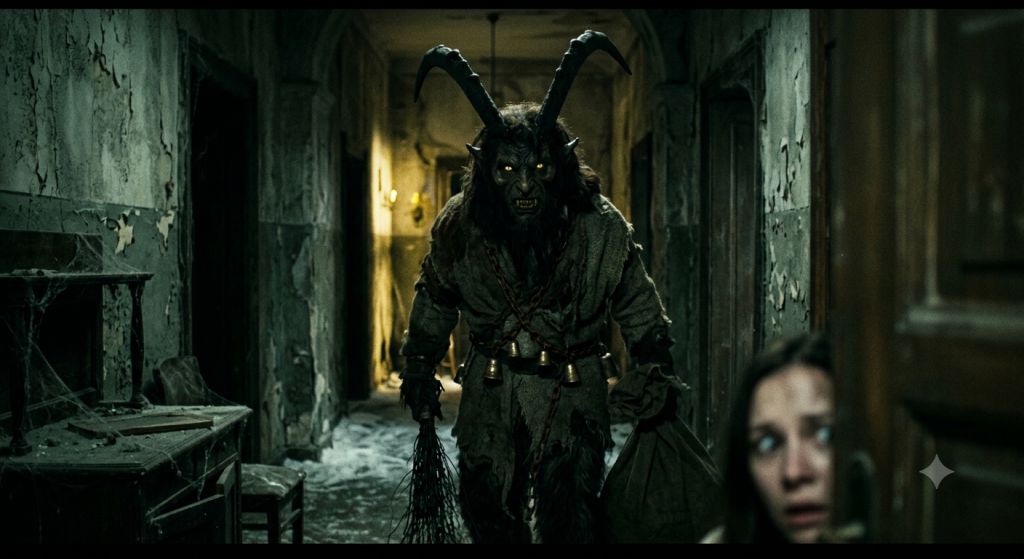
Père Fouettard, Father Whipper, is the dark companion of Saint Nicholas in the French Christmas tradition, particularly in northeastern France, Belgium, and parts of Switzerland. He appears alongside Saint Nicholas on the 6th of December, carrying a bundle of birch switches with which he beats children who have misbehaved during the year, while Nicholas distributes gifts to those who have been good. He is dark-clothed, rough in appearance, and represents the punishing dimension of the Christmas gift-giver that Saint Nicholas himself is too dignified to express directly.
His origin story, in the tradition that attempts to explain who Père Fouettard actually is, is one of the darkest in the entire canon of Christmas folklore. He is said to have been a butcher or an innkeeper who kidnapped three children, murdered them, and was caught by Saint Nicholas, who resurrected the children and condemned the butcher to accompany him forever, serving penance for his crime by helping distribute both rewards and punishments at Christmas. The story is darker than the figure’s current folkloric function strictly requires, and it connects Père Fouettard to a genuinely ancient layer of the Saint Nicholas tradition.
The Three Children
The legend of Saint Nicholas and the three murdered children is one of the oldest and most widely distributed in the Nicholas tradition. It appears in various forms across Europe and predates the development of the Père Fouettard figure as Nicholas’s specific companion. In the French version that produced Père Fouettard, the butcher or innkeeper lured three children into his establishment, killed them, and preserved their bodies in a barrel of brine, intending to sell them as pork. Saint Nicholas discovered the crime, resurrected the children, and punished the killer by binding him to his service.
The specific detail of the brine barrel appears consistently across versions and is grim enough to make this one of the few genuinely disturbing canonical Saint Nicholas legends. The resurrection of the children is the miracle that established Nicholas as a patron saint of children in the first place, and Père Fouettard is the preserved memory of the crime that made the miracle necessary.
Regional Variations
Père Fouettard is known under different names in different French-speaking regions. In Belgium he is sometimes called Père Fouettard and sometimes identified with Hans Trapp, which leads to some confusion between the two figures in the border regions where both traditions are present. In some Swiss French-speaking cantons he appears under the name Schmutzli, which connects him to the Germanic Schmutzi tradition of a dirty, rough Christmas companion.
The common thread across all regional variants is the same: a dark, rough, threatening figure who accompanies the benevolent Saint Nicholas and handles the punishment that the saint cannot administer directly. The specific name, appearance, and origin story vary, but the structural role is consistent.
Père Fouettard in Contemporary France
Père Fouettard remains a recognisable figure in northeastern French Christmas culture, though his prominence has declined with the increasing dominance of the American Santa Claus tradition in French popular culture. He appears in regional Christmas parades and celebrations in Lorraine and Alsace, where the Saint Nicholas tradition is maintained most vigorously, and on traditional Christmas imagery sold in those regions. Outside of northeastern France he is less well known, which reflects the regionalisation of the Saint Nicholas tradition in France generally.
Further Reading
If this article sparked your interest, these are the books worth reading next.
The Dark Side of Christmas
The dark figures, the threatening traditions, and the midwinter beliefs that the commercial Christmas has largely erased. Essential reading for anyone who wants to understand what the season actually was before it became what it is now.
Krampus: The Devil of Christmas
by Monte Beauchamp — a visually extraordinary collection of vintage Krampus greeting cards with historical context. The best introduction to the Krampus tradition’s visual culture.
The Battle for Christmas
by Stephen Nissenbaum — a genuinely excellent history of how Christmas became what it is, from its contested early modern origins through the Victorian reinvention that produced the holiday we now celebrate.
For more on the Christmas folklore tradition, the Hans Trapp article covers the other French dark Christmas companion. The Krampus article covers the Alpine equivalent. The Christmas hub page has every article in the cluster.
Never miss a myth
Thank you for being here. The site is brand new and every subscriber genuinely means something to me. If you're here, you care about this stuff as much as I do - and that's all the reason I need to keep going. New stories, videos and dark folklore from around the world, straight to your inbox. No algorithm. Just the stories, when they're ready.