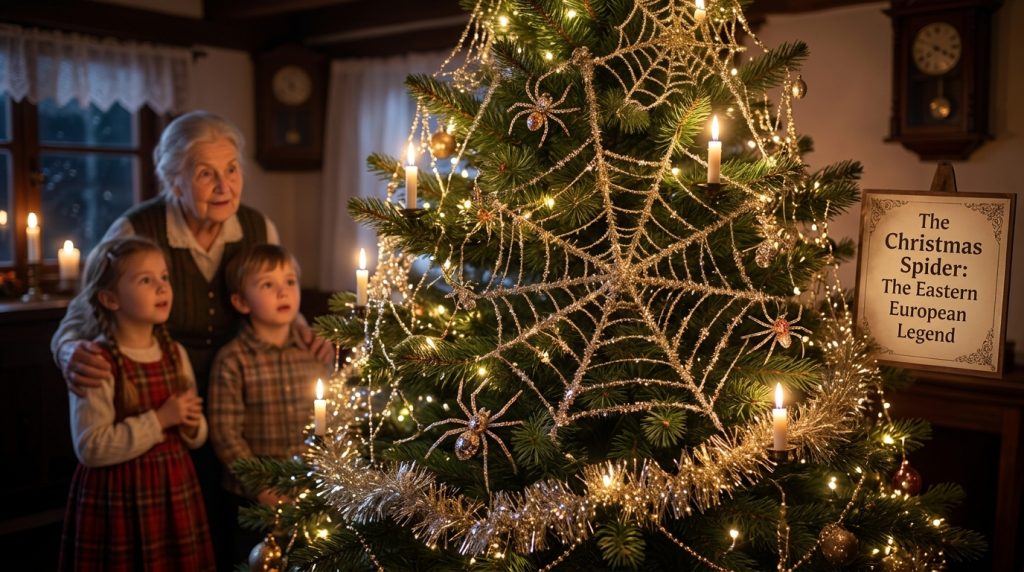
The Christmas Spider is a folk legend from Ukraine, Poland, and Germany that explains the origin of tinsel on Christmas trees through a story of poverty, kindness, and a spider’s gift. The legend exists in several versions but the core is consistent: a poor family grows a Christmas tree from a pine cone but cannot afford decorations. On Christmas morning the children wake to find the tree covered in spiderwebs, which the rising sun transforms into gold and silver. The family’s poverty is ended. The spider’s webs became the world’s first Christmas tree decorations, and tinsel is the memory of that gift.
The Christmas Spider legend is one of the most widely circulated of the lesser-known Christmas traditions and one of the most commercially productive: spider ornaments, often in gold or silver, are sold as Christmas decorations across Eastern Europe and increasingly in international markets, with the legend attached as a gift-giving story. Whether the legend is genuinely ancient or is a relatively recent folk invention that has been widely circulated is debated, but the emotional appeal of the story — poverty transformed by a small creature’s gift, the poor family rewarded at Christmas — is timeless enough to have given it genuine currency.
The Ukrainian Version
In the Ukrainian version of the legend, a widowed mother has raised her children in poverty and cannot afford to decorate the Christmas tree the children have grown from a pine cone. The spiders of the house, who have watched the family’s struggles, weave their webs across the tree’s branches during the night of Christmas Eve. When morning comes and the light touches the webs, they transform into gold and silver and the tree gleams with beauty. The family is poor no longer.
The Ukrainian spider Christmas ornament, called pavuchky, meaning little spider, is a traditional craft made from paper or straw in geometric patterns and hung on the Christmas tree. Whether the pavuchky tradition preceded the legend or was the tradition that the legend was invented to explain is unclear, but the two are now inseparable in Ukrainian Christmas culture.
The German Version
The German version of the legend has a slightly different structure. A family decorates their Christmas tree and goes to bed. During the night, spiders crawl all over the tree, covering it with webs. The Christ child, passing through the house, feels sorry for the family and transforms the webs into silver and gold so that when the family wakes they find their tree gloriously decorated rather than covered in cobwebs.
The Christ child’s role in the German version gives the legend a specifically Christian dimension that the Ukrainian version lacks, and it connects the spider legend to the broader German tradition of the Christkind, the Christ child as gift-bringer, rather than to the more secular family-and-poverty narrative of the Ukrainian version.
Why Spiders
The spider’s role as a benefactor in the Christmas legend sits within a broader tradition of spider symbolism that is more positive in Eastern European culture than in much of Western European culture. Spiders in Ukrainian tradition are associated with good luck and with the protective domestic qualities of the web. A spider in the house is good fortune, not a nuisance. The Christmas spider who transforms poverty into wealth is drawing on this positive tradition rather than on the negative spider symbolism more common in Western European folklore.
Further Reading
If this article sparked your interest, these are the books worth reading next.
The Dark Side of Christmas
The dark figures, the threatening traditions, and the midwinter beliefs that the commercial Christmas has largely erased. Essential reading for anyone who wants to understand what the season actually was before it became what it is now.
Krampus: The Devil of Christmas
by Monte Beauchamp — a visually extraordinary collection of vintage Krampus greeting cards with historical context. The best introduction to the Krampus tradition’s visual culture.
The Battle for Christmas
by Stephen Nissenbaum — a genuinely excellent history of how Christmas became what it is, from its contested early modern origins through the Victorian reinvention that produced the holiday we now celebrate.
For more on the Christmas folklore tradition, the Real Saint Nicholas article covers the history behind the Christmas gift-giving tradition. The Tomte article covers the Scandinavian farm spirit whose Christmas role also involves protection of the household. The Christmas hub page has every article in the cluster.
Never miss a myth
Thank you for being here. The site is brand new and every subscriber genuinely means something to me. If you're here, you care about this stuff as much as I do - and that's all the reason I need to keep going. New stories, videos and dark folklore from around the world, straight to your inbox. No algorithm. Just the stories, when they're ready.