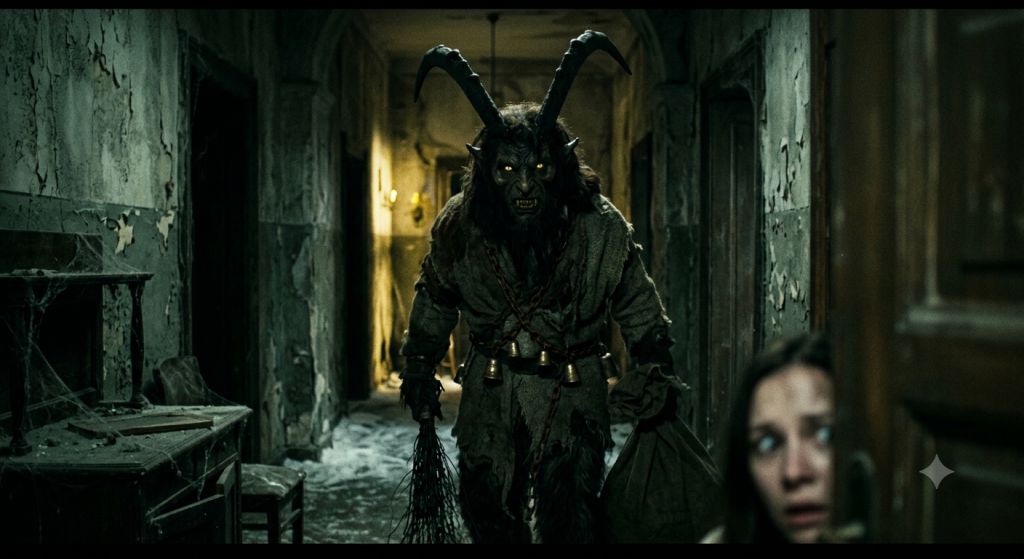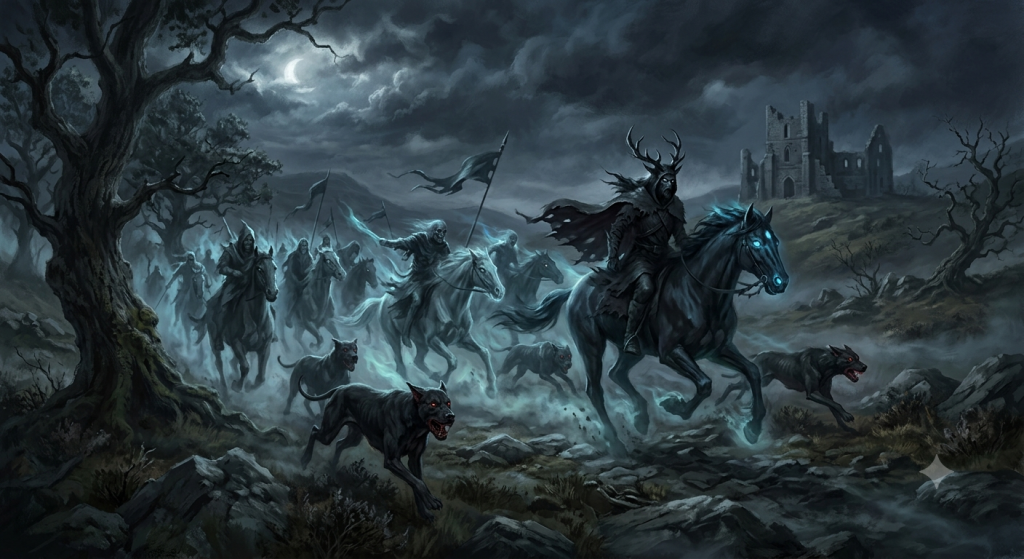
The twelve days of Christmas, the period between the 25th of December and Epiphany on the 6th of January, are in Germanic folk tradition the most dangerous period of the entire year for supernatural encounter. This is the time when the boundary between the living world and the dead world is at its most permeable, when the Wild Hunt rides most frequently and most ferociously through the winter sky, and when the precautions that normally keep the supernatural at a manageable distance require their most serious application. The midwinter darkness, the storms, the longest nights of the year — all of these are the Hunt’s natural environment, and the twelve days mark its peak season.
The connection between the Wild Hunt and the Christmas period is older than Christianity’s placement of Christmas on the 25th of December. The winter solstice and the days around it were understood across Germanic and Scandinavian tradition as a time of supernatural permeability — the Yule period, from which the modern word derives — and the Wild Hunt’s association with this period reflects a pre-Christian understanding of the darkest point of the year as the moment when the dead were closest to the living.
Wotan and the Twelve Days
In the Germanic tradition, the Wild Hunt during the twelve days is led specifically by Wotan, the chief of the Germanic gods, riding his eight-legged horse Sleipnir through the storm clouds with his retinue of the dead following behind. The specific association of Wotan with the twelve days period reflects his broader character as a god of the road, of wandering, of the dead, and of the liminal spaces between the ordered world and the wild. The twelve days are precisely the kind of liminal period that Wotan inhabits: between the old year and the new, between darkness and the gradual return of light, between the world of the living and the world of the dead.
The offerings left for Wotan during the twelve days in the pre-Christian Germanic tradition — food and hay left outside for his horse, small gifts left at crossroads — were absorbed into the Christmas gift-giving tradition in complex ways. The hay left for Sleipnir became hay left for Saint Nicholas’s horse, and eventually carrots left for Santa’s reindeer. The midnight rider who brings things to the household has Christian and pre-Christian layers pressed together in ways that are difficult to fully separate.
What to Do During the Twelve Days
The practical guidance that Germanic folk tradition offered for surviving the twelve days without supernatural incident was specific and consistent across regional variants. Do not leave laundry hanging outside at night — the Hunt will soil it or carry it away. Do not leave spinning unfinished — Perchta will punish you. Do not leave food on the table after dark — the spirits will eat it. Do not go out alone at night — you risk being swept into the Hunt’s procession. Do not make too much noise — you will attract attention from things you do not want to attract.
The indoor, domestic, contained quality of the ideal Christmas celebration in Germanic tradition reflects this supernatural anxiety about the twelve days. Christmas is celebrated inside, around the hearth, with family, because outside is where the Hunt rides and where the dead walk. The warmth and light of the domestic Christmas is not simply festive preference. It is protective enclosure against the specific dangers of the twelve days.
The Rauhnächte
The twelve days are called the Rauhnächte in German, the Rough Nights, and the name captures the tradition’s understanding of the period better than any neutral calendar description. They are rough because the supernatural is rough, because the weather is rough, because the dead are close and demanding. The Rauhnächte tradition includes specific rituals for each of the twelve nights, each one associated with particular activities, particular foods, particular protective measures, that together constitute a sustained engagement with the supernatural demands of the darkest period of the year.
Incense is burned through the house during the Rauhnächte to purify the domestic space and drive out supernatural presences. Animals are given extra care because they are understood to be particularly vulnerable during this period. New projects are not begun. Old debts are settled. The twelve days are a time for completion and preparation rather than for new beginnings, because the supernatural environment of the period is hostile to new things.
Further Reading
If this article sparked your interest, these are the books worth reading next.
The Dark Side of Christmas
The dark figures, the threatening traditions, and the midwinter beliefs that the commercial Christmas has largely erased. Essential reading for anyone who wants to understand what the season actually was before it became what it is now.
Krampus: The Devil of Christmas
by Monte Beauchamp — a visually extraordinary collection of vintage Krampus greeting cards with historical context. The best introduction to the Krampus tradition’s visual culture.
The Battle for Christmas
by Stephen Nissenbaum — a genuinely excellent history of how Christmas became what it is, from its contested early modern origins through the Victorian reinvention that produced the holiday we now celebrate.
For more on the Christmas folklore tradition, the Wild Hunt Germany article covers the tradition in its full scope. The Perchta article covers the Alpine witch whose twelve days inspections parallel the Hunt’s activity. The Christmas hub page has every article in the cluster.
Never miss a myth
Thank you for being here. The site is brand new and every subscriber genuinely means something to me. If you're here, you care about this stuff as much as I do - and that's all the reason I need to keep going. New stories, videos and dark folklore from around the world, straight to your inbox. No algorithm. Just the stories, when they're ready.