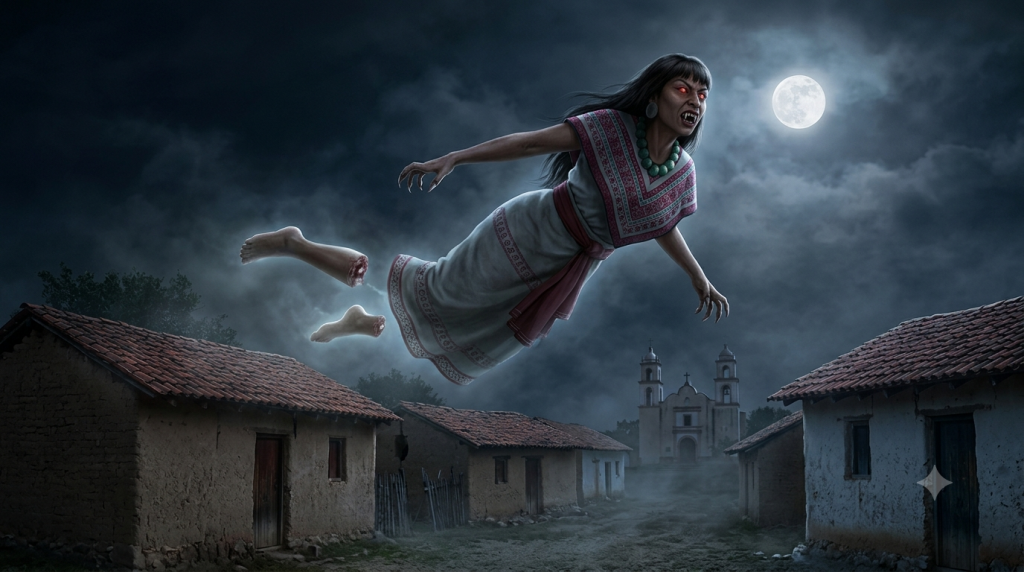
The Tlahuelpuchi is a vampire figure from the Tlaxcala region of Mexico, and she is distinguished from most of the world vampire tradition by one specific characteristic: she does not become a vampire through sin, through improper burial, through a pact with evil, or through any choice at all. She is born a Tlahuelpuchi. The transformation that reveals her nature occurs at puberty, and from that point she is bound to feed on human blood once a month or die. She cannot stop. She cannot be cured. She is what she is.
The tradition has been documented by anthropologists working in Tlaxcala in the twentieth century, most extensively by Hugo Nutini and John Roberts whose 1993 study Blood-Sucking Witchcraft collected dozens of accounts of Tlahuelpuchi cases from communities where the belief remained active. Their research provides an unusually detailed contemporary account of a living vampire tradition and the social functions it served in explaining infant death.
What She Was and What She Did
The Tlahuelpuchi in most accounts was female, though male Tlahuelpuchi were acknowledged as existing and were considered more powerful and more dangerous. She lived in the community as a normal person, her nature known only to her immediate family, who were bound by a strict obligation of secrecy. Revealing a family member as a Tlahuelpuchi was understood to bring terrible consequences on the family, and the shame and danger of the disclosure was sufficient to keep most families silent regardless of what their relative was doing.
Once a month she was compelled to feed. She transformed, typically into a turkey, a dog, a flea, or another animal that could move inconspicuously, and she sought out an infant to drain. The infant would be found dead the following morning with marks on the body consistent with the attack. The family of the dead child might suspect a Tlahuelpuchi but needed to follow specific identification procedures before making any accusation.
The Monthly Compulsion
The monthly feeding requirement is one of the most specifically documented aspects of the tradition and one of the most practically significant. A Tlahuelpuchi who did not feed would die, which meant that her family’s silence was partly self-interested: revealing her would result in her death, but so would preventing her from feeding. The family was caught between complicity in her attacks and the loss of their relative.
Nutini and Roberts’s research found that families with a Tlahuelpuchi member often tried to direct her attacks toward infants in other communities rather than their own, sometimes providing information about households where infants were sleeping lightly guarded or where protective measures had not been taken. The vampire tradition in Tlaxcala was not simply a supernatural explanation for infant death but a social phenomenon with real implications for community relationships and inter-family politics.
Identifying and Dealing With a Tlahuelpuchi
The identification of a Tlahuelpuchi after a suspected attack followed specific procedures. The body of the infant was examined for marks. The direction from which the creature had approached was assessed. Certain protective measures, if they had been in place and appeared to have been circumvented, could indicate the specific form the Tlahuelpuchi had taken.
Once identified, the Tlahuelpuchi was typically killed, and the method had to be specific to be effective: she had to be killed in animal form rather than human form for the destruction to be permanent. Killing the human she appeared as during the day without catching her in her transformed state was understood as ineffective, the creature would simply find another form or recover.
Protective measures for infants included garlic, metal objects, onion, and specific arrangements of mirrors or shiny objects that reflected her approach back at her. The cross was also effective, consistent with the broader Catholic framework within which the Tlaxcalan tradition existed alongside older indigenous belief.
For more on the vampire traditions of the world, the Soucouyant article covers the Caribbean skin-shedding vampire with her own tradition of involuntary transformation. The Bruxsa article covers the Portuguese vampire witch who similarly targets infants. The Vampires: The Ancient Origins article covers the broader history of vampire belief across cultures.
Never miss a myth
Thank you for being here. The site is brand new and every subscriber genuinely means something to me. If you're here, you care about this stuff as much as I do - and that's all the reason I need to keep going. New stories, videos and dark folklore from around the world, straight to your inbox. No algorithm. Just the stories, when they're ready.