
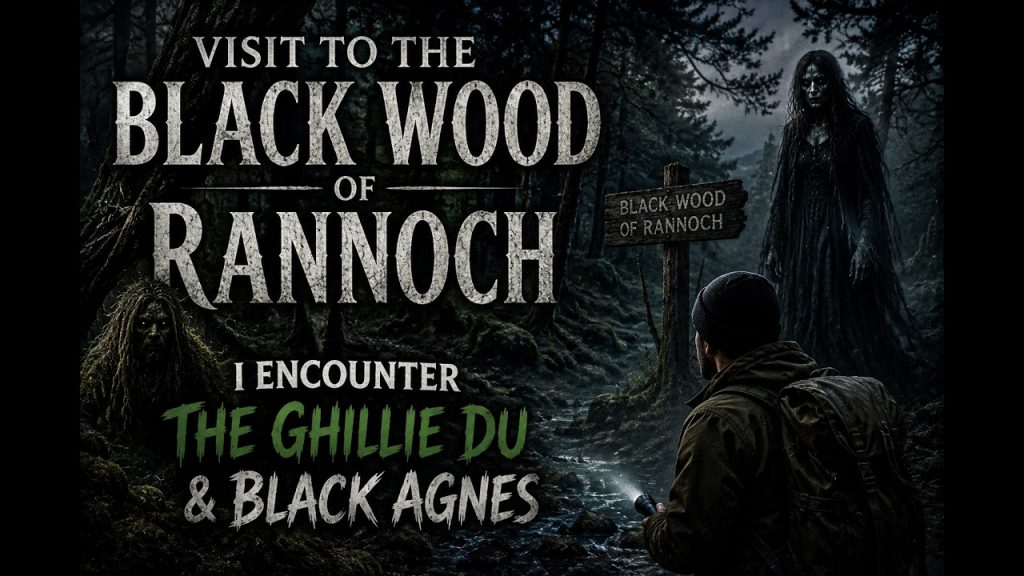
There are forests, and then there are the old forests. The ones that were ancient when the first human settlements were young, that have stood through everything history has thrown at this island and simply continued, indifferent and enduring, doing what forests have always done. The Black Wood of Rannoch is one of those places. A surviving fragment of the great Caledonian pine forest that once blanketed much of Scotland, it sits on the southern shore of Loch Rannoch in Perthshire, and it feels, from the moment you step beneath its canopy, categorically different from any managed or replanted woodland you have ever walked through.
This is not nature that has been shaped to human purposes. This is nature that has been here long enough to have developed purposes of its own.
I went into the Black Wood expecting folklore and history. I found both of those things. I also found something else, two things, in fact, pulling in completely opposite directions. One of them felt like being watched over. The other felt like being hunted.
What the Black Wood Is
The Black Wood of Rannoch is one of the largest remaining fragments of ancient Caledonian pinewood in Scotland, a living remnant of a forest that once stretched across millions of acres of the Scottish highlands. The Caledonian forest was already ancient when the Romans arrived and noted it with a mixture of admiration and unease. It shrank over millennia through a combination of climate change, grazing, and human clearance, until what survives today are scattered fragments, islands of the original wildwood in a landscape that has mostly been transformed beyond recognition.
The Black Wood survived partly through geography and partly through fortune. Its trees are not the neat ranks of commercial forestry. They are gnarled, individual, wildly various in shape and age, with the kind of character that only centuries of unmanaged growth produces. Some of the pines here are three hundred years old. The forest itself, in an unbroken sense, is thousands of years older than that.
Walking into it, you become aware almost immediately that the usual relationship between human visitor and woodland has been reversed. You are not exploring this forest. It is, in some quiet and unhurried way, examining you.
The Ghillie Dhu: The Guardian in the Trees
If you have read the article on this site about the Ghillie Dhu, you will already know something of this figure. But knowing about a creature from folklore and standing in the specific kind of landscape it is said to inhabit are two very different experiences.
The Ghillie Dhu is a solitary fairy of Scottish Gaelic tradition, a being associated specifically with birch trees and wild woodland, described as dark-haired and clothed in leaves and moss, a guardian of the forest rather than a threat to those who enter it respectfully. Unlike many of the supernatural figures associated with the Scottish highlands, the Ghillie Dhu is not predatory. It is protective, particularly of children who become lost in the woods, but more broadly of the wild places themselves and those who move through them without causing harm.
The Black Wood is precisely the kind of place the Ghillie Dhu belongs. Ancient, undisturbed, a living ecosystem with its own rules and its own rhythms. If there were ever a forest with a guardian, this would be it.
I felt it before I had any rational framework to put around the feeling. A sense of being watched that carried no threat in it whatsoever. Not the prickling alertness of surveillance by something hostile, but something closer to the awareness you might feel if you knew that someone who wished you well was keeping an eye on you from a distance. A presence in the trees that was curious rather than predatory, attentive rather than aggressive.
It is difficult to write about this kind of experience without sounding like you are reaching for something that isn’t there. I am aware of how it sounds. But I have been in enough unsettling places and felt enough genuinely uncomfortable presences to know the difference, and what I felt in the deeper parts of the Black Wood did not make me want to leave. It made me want to move carefully and quietly, as you would in a place you respect and where you understand that you are a guest.
The Ghillie Dhu, if it was there, seemed satisfied with that.
The Silence That Shouldn’t Have Been
The other thing began differently. Not with a presence exactly, but with an absence.
Birdsong in a woodland is so constant that you stop registering it within minutes of arriving. It becomes part of the background texture of the place, as unremarkable as the sound of your own footsteps. You only truly notice it when it stops.
In the Black Wood, the birdsong stopped dead. Not gradually, not the way it fades when you move toward open ground. All at once, as though someone had put a hand over the mouth of the forest. The silence that followed was not peaceful. It was the silence of things holding very still because something was moving nearby that they did not want to draw the attention of.
Anyone who has spent time outdoors knows what that silence means. Birds do not go quiet without reason. They go quiet when a predator is in the area, when something has entered the space that does not belong there, when the calculus of survival says that the safest thing is to stop making noise and wait.
We were not alone in the trees. And whatever had silenced the birds was not us.
Black Agnes: The Hag at the Edge of the Forest
I want to be careful about how I frame what I am about to say, because it involves both a genuine folkloric tradition and an experience that I cannot fully explain, and I have no interest in overclaiming on either front.
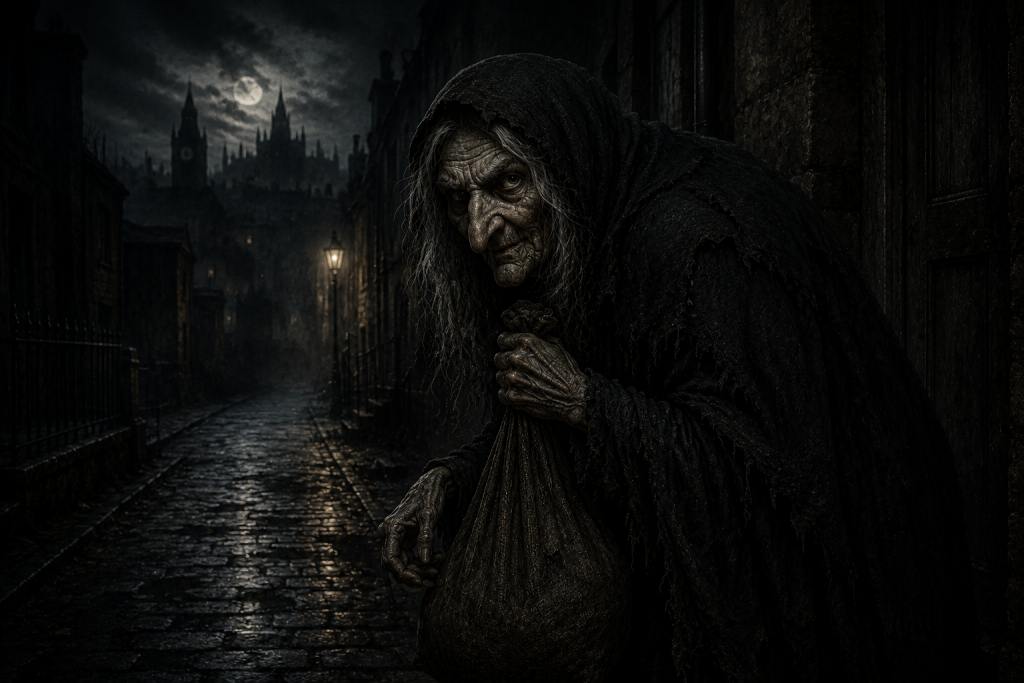
The figure known as Black Annis in English folklore, particularly associated with Leicestershire, is a hag of the most archetypal and disturbing variety. She is described as blue-faced and iron-clawed, living in a cave she is said to have dug from the rock with her bare hands, coming out at night to hunt children and adults alike, draping the skins of her victims on a nearby oak tree to dry. She is old. Not old in the way that elderly people are old, but old in the way that certain things in folklore are old, which is to say that she feels like she was never young, like she exists outside the normal categories of age and origin entirely.
Black Annis is generally placed in England. Leicestershire claims her. There are specific geographical features associated with her name in that county, caves and ancient trees that bear her tradition in the local landscape.
But here is the thing about creatures like Black Annis, creatures of deep folklore whose origins predate the nation states and county boundaries that we have placed over the landscape. They do not have maps. They do not observe the borders that human beings drew across the land in the last few centuries, or even the last few millennia. If something like Black Annis is real, or was real, or represents a real category of thing that inhabited the wild places of this island, then why would it be confined to Leicestershire? The Caledonian forest stretched across Scotland for thousands of years before Leicestershire was a concept. Whatever hunted in old forests a thousand years ago would have found the Black Wood of Rannoch perfectly adequate hunting ground.
Perhaps Black Annis came from places like this. Perhaps what English tradition eventually located in a Leicestershire cave had kin in the ancient Scottish pinewoods long before the two traditions diverged. The hag figure appears across every culture that has old, dark forests in its history. She wears different names in different places. Whether those names refer to genuinely different beings or to different regional expressions of the same deep thing is a question nobody can answer with any certainty.
What I know is what I felt in the Black Wood when the birdsong stopped. A quality of attention from somewhere in the trees that was nothing like the benign watchfulness I had felt earlier. This was surveillance with intent. The feeling of being assessed, not as a visitor to be tolerated, but as something that had wandered into the wrong part of the forest and might not easily find its way back out.
I do not know what was in those trees. I know what it felt like. And it felt old, and hungry, and entirely unbothered by whether I believed in it or not.
If you want more like this, the Tales of Myth and Magic newsletter delivers new creatures, legends, and forgotten folklore straight to your inbox.
No fixed schedule. No noise. Just the stories, when they are ready.
Sign up here →Two Presences, One Forest
What struck me most about the Black Wood, reflecting on it afterward, was the contradiction at its heart. Two completely opposing experiences in the same place within the same visit. One presence that felt protective, that seemed to wish us well and to take quiet satisfaction in our respectful passage through the trees. And one that felt like something that had noticed us in the way a predator notices prey.
Perhaps this is simply true of ancient places. They are not uniformly anything. They contain multitudes, accumulated across millennia of existence, and what you encounter within them depends on where you are, when you are there, and possibly what you bring with you. The Ghillie Dhu protects the forest and those who move through it carefully. But the forest is not only the Ghillie Dhu’s domain. Other things have been here longer, or at least as long, and they have their own relationship with the dark beneath the pines.
The Black Wood of Rannoch has been standing for thousands of years. It has seen things come and go that we do not have names for anymore. Whatever lives within it now, under that ancient canopy, alongside those three-hundred-year-old pines, has had a very long time to become whatever it is.
I came out of the trees as the light was beginning to change, and I was glad, in a way I could not entirely articulate, to be back in open ground.
Some places have a feeling about them. The Black Wood of Rannoch has several. Not all of them want you to stay.
Further Reading
If this article sparked your interest, these are the books worth reading next.
Scottish Urban Legends: 50 Myths and True Stories
by Aaron Mullins — fifty Scottish urban legends including stories from Glasgow, Edinburgh, and the Highlands. The kind of tradition that Maggie Murphy belongs to, collected properly in one volume.
Scottish Urban Myths and Ancient Legends
by Grace Banks and Sheena Blackhall — vampires, werewolves, devil encounters, and the school playground legends of Scotland. A genuinely good collection of the stories Scots have been telling each other for generations.
The Lore of Scotland: A Guide to Scottish Legends
by Jennifer Westwood and Sophia Kingshill — the most comprehensive collection of Scottish legend in print, covering Glasgow to Shetland, exploring origins and historical basis. Endorsed by Terry Pratchett as the real macabre.
Never miss a myth
Thank you for being here. The site is brand new and every subscriber genuinely means something to me. If you're here, you care about this stuff as much as I do - and that's all the reason I need to keep going. New stories, videos and dark folklore from around the world, straight to your inbox. No algorithm. Just the stories, when they're ready.
Pingback: Black Annis: The Blue-Faced Hag Who Hunted the Children of England - Tales of Myth and Magic