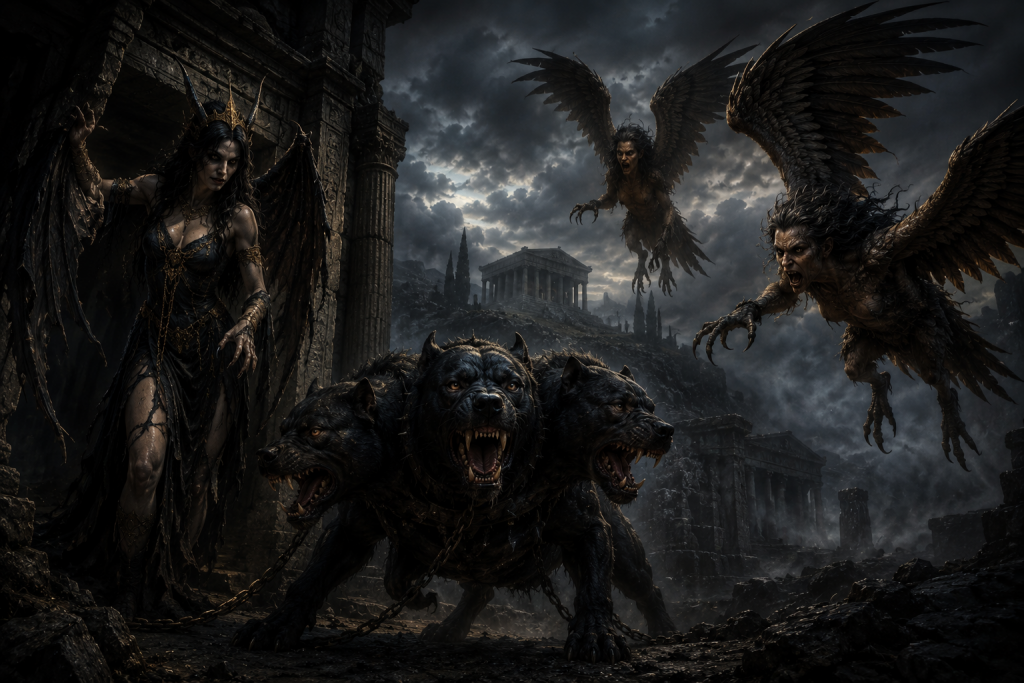
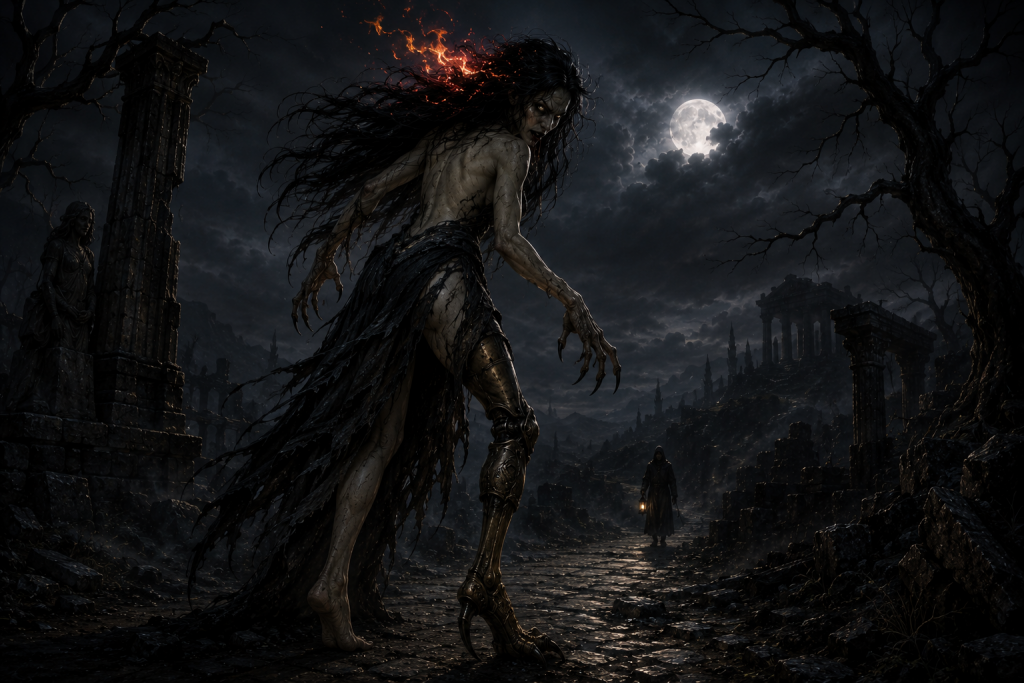
The Strigla is the witch figure of Greek folk tradition, a woman who possesses the evil eye, who can curse through her gaze or her words, who may fly at night to attack sleeping victims, and whose power is understood in the communities that maintain the tradition as genuinely real and genuinely dangerous rather than as metaphor or superstition. She is distinct from the ancient literary figures of Greek witchcraft — Circe, Medea, Hecate — and from the vampire-adjacent Empusa of ancient tradition. She is the folk witch, the woman in the village who is suspected, who is watched, whose curse is blamed for the illness of children and the failure of crops.
The Strigla tradition connects Greece to the broader Mediterranean and pan-European witch tradition while maintaining specifically Greek characteristics. Her name derives from the Latin strix, the screech owl, which connects her to the Roman tradition of the bird-woman who preys on infants and which connects through that tradition to the Portuguese Bruxsa and the broader European night-witch lineage. In Greek the word strigla has become generalised to mean witch in folk usage, equivalent to mágissa in the more literary tradition.
The Evil Eye
The evil eye, known as matiasma or simply mati in Greek, is the most practically important element of the Strigla’s power set and the one most deeply embedded in contemporary Greek culture. The belief that a person can cause harm through an admiring or envious gaze is ancient in Greece, documented in classical sources, and has survived continuously into the present in a way that few folk beliefs have. The blue glass eye amulets sold in every tourist shop in Greece are protective devices against the evil eye that are genuinely used rather than simply sold as decorations.
The evil eye in Greek tradition is not always intentional. A person with strong matiasma can harm inadvertently through genuine admiration: to compliment a child excessively is to risk giving it the evil eye even with no malicious intent. This involuntary quality makes the evil eye a social anxiety rather than simply a threat from identified witches, because anyone with strong eyes and genuine feelings can cause harm without meaning to.
The Night Flight
The night-flying aspect of the Strigla connects her to the broader European witch tradition of the nocturnal sabbath and the night-flight that characterises witch activity across multiple cultures. In Greek folk tradition, the Strigla who flies at night is hunting for sleeping victims rather than attending a supernatural gathering, and her specific targets are infants and pregnant women in a pattern consistent with the broader Mediterranean tradition of the night-witch as a threat to the vulnerable and the liminal.
She enters houses through keyholes and small gaps rather than through the chimney, which distinguishes her entry method from the Kallikantzaroi’s, and she crouches on sleeping victims in a manner that produces the experience of sleep paralysis — the inability to move, the sense of a weight on the chest, the terror that accompanies waking in a paralysed state — which the Greek tradition attributes to her direct physical presence rather than to any physiological cause.
Protection and Counter-Magic
The protective measures against the Strigla are extensive and regionally varied, reflecting the seriousness with which the tradition was maintained. Iron at the threshold, garlic at the window, specific prayers and blessings, the blue eye amulet, and the intervention of specialists who could diagnose and treat matiasma were all part of the practical toolkit available to Greek households who believed themselves threatened. The specialist who treats the evil eye, often a woman who has inherited the knowledge and the prayers from her mother or grandmother, represents a survival of the cunning person tradition that appears across European folk cultures.
Further Reading
If this article sparked your interest, these are the books worth reading next.
The Iliad — Homer (Penguin Classics)
by Homer — the primary source for everything in this article, and still the most vivid account of the Trojan War ever written.
The Odyssey — Homer (Emily Wilson translation)
by Homer, translated by Emily Wilson — the best modern English translation, and the book that contains Odysseus’s own account of the horse.
The Trojan War: A Very Short Introduction
by Eric Cline — the clearest and most up to date account of what archaeology actually tells us about Troy and whether any of it happened.
For more on the folklore of Greece, the Vrykolakas article covers the Greek undead tradition. The Gello article covers the child-stealing demon whose tradition overlaps with the Strigla’s targeting of infants. The Greece folklore hub page has every article in the cluster.
Never miss a myth
Thank you for being here. The site is brand new and every subscriber genuinely means something to me. If you're here, you care about this stuff as much as I do - and that's all the reason I need to keep going. New stories, videos and dark folklore from around the world, straight to your inbox. No algorithm. Just the stories, when they're ready.