Gello is one of the oldest named demons in the Greek tradition, a supernatural being whose specific function is the theft and killing of infants and the harm of pregnant women, and whose origin story connects her to the most ancient stratum of Mediterranean belief about the dangerous supernatural female. She appears in sources from classical antiquity through the Byzantine period and into the modern era, maintaining a consistent identity and a consistent threat across two and a half millennia of Greek culture, which makes her one of the longest continuously documented supernatural figures in European folklore.
The name Gello appears in Sappho, the sixth century BCE lyric poet, which gives the tradition a documented history stretching back to the archaic Greek period. By the Byzantine era she had been developed into a fully articulated demonic figure with a specific origin story, specific methods, and specific counter-measures. The Byzantine magical texts that describe her and the spells designed to repel her represent the most detailed early documentation of the Gello tradition and the basis for much of what scholars know about her.
Who Gello Was
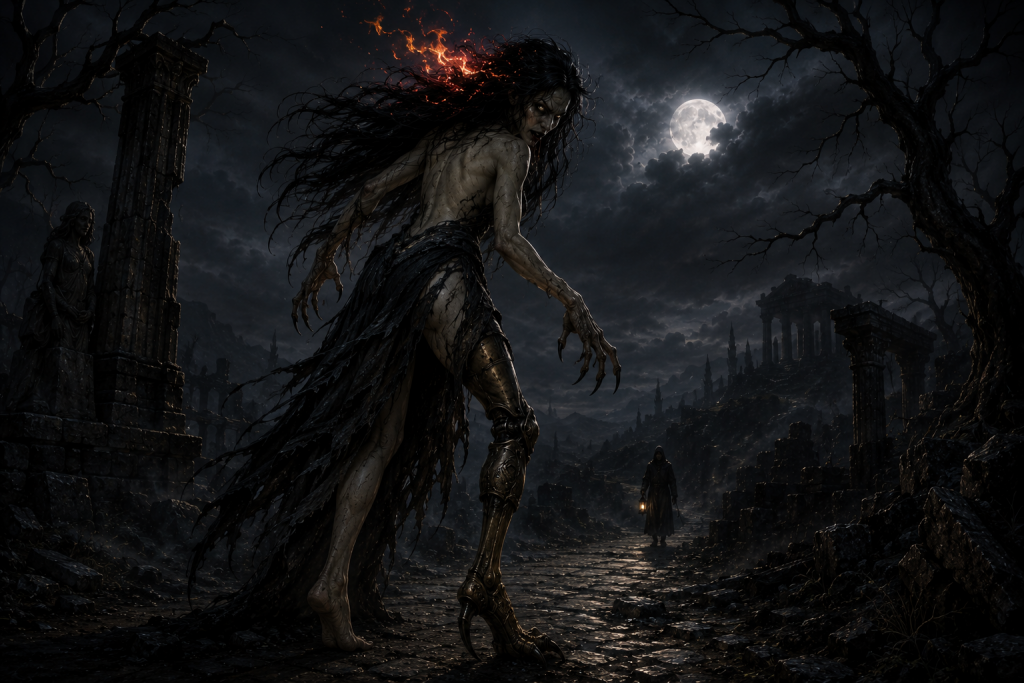
The Byzantine tradition gives Gello a specific origin: she was a young woman who died before having children, and whose premature death left her with an unfulfilled desire for the children she never had. She returns as a demon to steal the children of others, not out of malice precisely but out of the compulsive need to possess what she was denied in life. This origin connects her to the broader tradition of the untimely female dead who return to harm the living, the same tradition that produces the Rusalka in Slavic belief and the Langsuir in Malaysian tradition.
Her childlessness is both her motive and her defining characteristic. She wants children. She cannot have them through any natural means. She therefore takes them from those who can. The demon is the expression of a grief that could not be resolved in life and has become something destructive in death.
Her Methods
Gello attacks infants directly, causing the sudden unexplained deaths that the pre-modern world attributed to supernatural causes rather than to the natural causes that medicine now understands. She also attacks pregnant women, causing miscarriage and complications in labour, which positions her as a threat throughout the entire process of reproduction from conception through birth.
She is particularly active at the threshold moments of infant life: the period immediately after birth before baptism, when the child is most vulnerable to supernatural attack. The urgency of baptism in Greek Orthodox tradition partly reflects this supernatural framing: the unbaptised child is unprotected, and Gello is watching.
Counter-Measures and the Dialogue with Gello
The Byzantine magical texts preserved in the Biblioteca Medicea Laurenziana in Florence include a remarkable document known as the Dialogue of Solomon and Gello or the Dialogue of the Virgin and Gello, in which a supernatural interrogator forces Gello to reveal her true names. The tradition holds that she has twelve and a half names, and that knowing and reciting all of them gives power over her. The texts provide the names and the formulas, along with the specific ritual procedures for protecting a newborn child from her attack.
The twelve and a half names detail is one of the most curious in the tradition — the half name suggesting an incompleteness in Gello’s nature, something unfinished about her that mirrors the unfinished life that produced her. She is a demon of incompletion, and even her name is incomplete.
Further Reading
If this article sparked your interest, these are the books worth reading next.
The Iliad — Homer (Penguin Classics)
by Homer — the primary source for everything in this article, and still the most vivid account of the Trojan War ever written.
The Odyssey — Homer (Emily Wilson translation)
by Homer, translated by Emily Wilson — the best modern English translation, and the book that contains Odysseus’s own account of the horse.
The Trojan War: A Very Short Introduction
by Eric Cline — the clearest and most up to date account of what archaeology actually tells us about Troy and whether any of it happened.
For more on the folklore of Greece, the Strigla article covers the Greek witch figure who similarly targets infants. The Lamia article covers the child-devouring monster whose tradition parallels Gello’s. The Greece folklore hub page has every article in the cluster.
Never miss a myth
Thank you for being here. The site is brand new and every subscriber genuinely means something to me. If you're here, you care about this stuff as much as I do - and that's all the reason I need to keep going. New stories, videos and dark folklore from around the world, straight to your inbox. No algorithm. Just the stories, when they're ready.