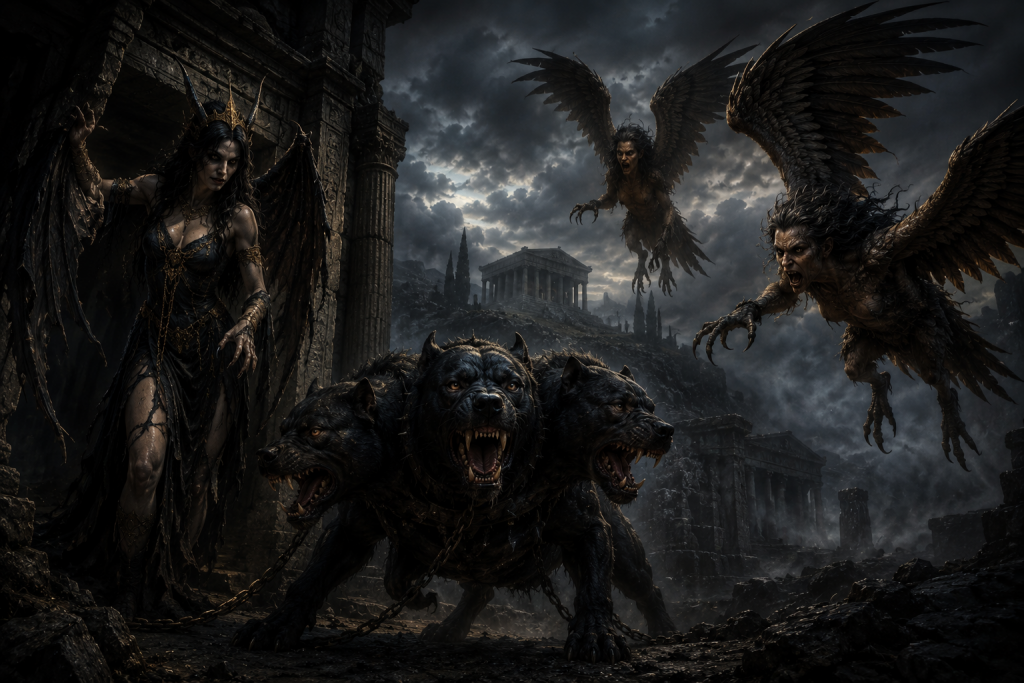
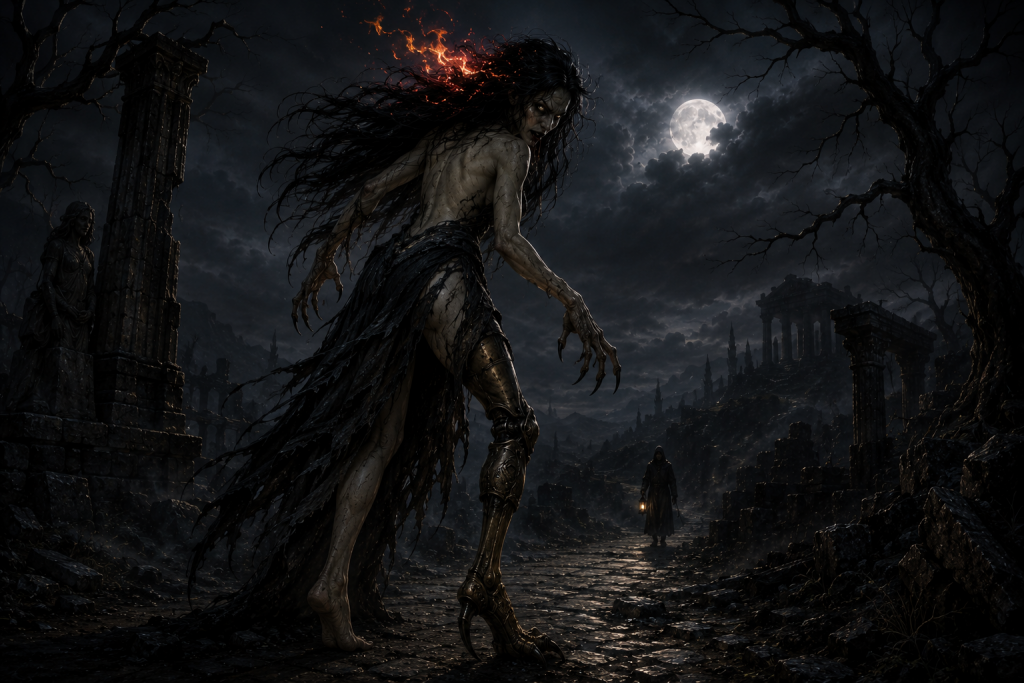
Lamia was a queen of Libya, beautiful and beloved by Zeus, who bore him children. Hera, as was her practice when Zeus’s infidelities produced offspring, destroyed what she could: she killed Lamia’s children, or in some versions drove Lamia to kill them herself in a state of divinely induced madness. The grief and the madness transformed Lamia into a monster. She cannot sleep because every time she closes her eyes she sees her dead children, which is why Zeus gave her the ability to remove her eyes — she can take them out when she wants to rest, and put them back when she needs to see. She roams the world devouring the children of others, which is the monstrous expression of the loss she cannot resolve.
The Lamia tradition is ancient, appearing in sources from the fifth century BCE onward, and it has a continuous history through the Byzantine period into Greek folk tradition and beyond. John Keats used her as the basis for his 1820 poem Lamia. The word lamia in modern Greek folklore refers to a category of dangerous supernatural female being rather than to the specific mythological figure, which suggests how thoroughly she embedded herself in the Greek supernatural imagination.
The Ancient Lamia
In the ancient sources Lamia is used as a bogeyman figure to frighten children, which is the same function she serves in later folk tradition. The philosopher Diodorus Siculus gives the most detailed ancient account of her origin, describing her as a Libyan queen of great beauty who became Zeus’s lover and was punished by Hera with the destruction of her children. The disfigurement that accompanied the transformation — she became ugly, snake-like, monstrous — is the physical expression of what grief and madness did to her.
The removable eyes are one of the most distinctive details in the ancient tradition and one of the most discussed. They have been interpreted as a symbol of her grief — she removes them so she does not have to see the world from which her children are absent — and as a practical magical detail: the eyes can be used as scrying devices when removed, which gives her a form of clairvoyance separate from her ordinary vision.
The Folk Lamia
In Greek folk tradition, the lamia is a category of supernatural woman who seduces and destroys men rather than specifically targeting children. The folk lamia is beautiful, irresistible, and lethal, draining the vitality of the men she seduces until they waste away. This is a different emphasis from the ancient tradition’s child-devouring focus, and it reflects the folk tradition’s tendency to develop specific aspects of a mythological figure into a new direction while maintaining the core identity.
The folk lamia of the Greek islands in particular developed a rich and distinct tradition, with specific regional variants that gave her local characteristics while maintaining the core element of the dangerous supernatural seductress. She appears in the poetry of the Greek demotic tradition, the folk songs that were collected in the nineteenth century as evidence of Greek cultural continuity, as a figure of the dangerous feminine whose beauty is inseparable from her lethality.
Keats’s Lamia
John Keats’s 1820 poem Lamia drew on the version of the story recorded by the philosopher Apollonius of Tyana as preserved by the biographer Philostratus: a philosopher named Lycius falls in love with a beautiful woman who is actually a lamia in disguise, and his teacher Apollonius exposes her true nature at their wedding, after which she vanishes and Lycius dies. Keats used this story to explore the conflict between imagination and cold philosophy, between the beauty that enchants and the rational analysis that destroys it, which gave the ancient figure a specifically Romantic dimension that had not been present in the earlier tradition.
Further Reading
If this article sparked your interest, these are the books worth reading next.
The Iliad — Homer (Penguin Classics)
by Homer — the primary source for everything in this article, and still the most vivid account of the Trojan War ever written.
The Odyssey — Homer (Emily Wilson translation)
by Homer, translated by Emily Wilson — the best modern English translation, and the book that contains Odysseus’s own account of the horse.
The Trojan War: A Very Short Introduction
by Eric Cline — the clearest and most up to date account of what archaeology actually tells us about Troy and whether any of it happened.
For more on the folklore of Greece, the Gello article covers the other great child-threatening female demon of Greek tradition. The Strigla article covers the Greek witch whose danger also operates through the gaze and the night attack. The Greece folklore hub page has every article in the cluster.
Never miss a myth
Thank you for being here. The site is brand new and every subscriber genuinely means something to me. If you're here, you care about this stuff as much as I do - and that's all the reason I need to keep going. New stories, videos and dark folklore from around the world, straight to your inbox. No algorithm. Just the stories, when they're ready.