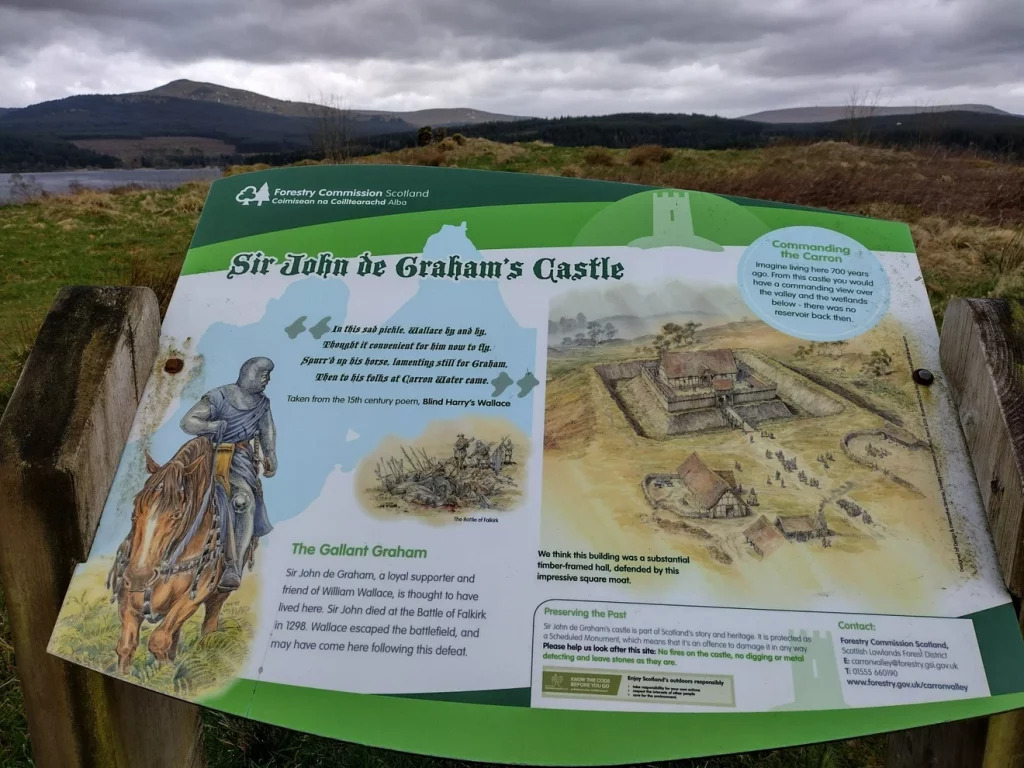
In the Carron Valley west of Falkirk, half hidden by forestry commission land at the edge of a reservoir, a raised earthwork sits on the end of a ridge with commanding views over Strathcarron. Most people who pass it have no idea what it is. Those who do know its name understand that the story attached to it touches one of the most dramatic and tragic episodes in the history of Scottish independence.
A Ruin With a Name Worth Remembering
Dundaff Castle, more evocatively known as Sir John de Graham’s Castle, is one of Scotland’s quieter historical sites. It does not have an entry booth or a gift shop. It does not appear prominently on tourist maps. What it has instead is a remarkably well preserved earthwork, a square ditched platform set on a natural ridge, the outlines of a courtyard traceable in the ground around it, and a silence that sits heavily on the site in a way that feels appropriate given who is associated with it and how his story ended.
The castle dates to the twelfth century and is classified as a square motte and bailey fortification, meaning it was built around a raised central platform defended by a ditch, with outer buildings arranged within a surrounding courtyard or bailey. It served as the caput baronium, the principal seat of the Barony of Dundaff, and passed through several generations of the Graham family before the events of the late thirteenth century gave it the name by which most people now know it.
What survives today is the earthwork itself rather than any standing masonry. The defensive ditch is still clearly visible, with the upcast material from its excavation used to create a more impressive outer scarp, suggesting the builders were working with real defensive intent rather than simply following convention. The central platform is raised within the ditch, and stone wall remnants around the exterior hint at the courtyard that once surrounded it. It was never a great stone castle in the manner of Edinburgh or Stirling, and according to historical assessment it was likely defended throughout its active life with a timber palisade rather than stone walls, its strength coming from position and earthwork as much as from masonry.
The site is set on forestry commission land at the north end of the Carron Valley Reservoir, and the area around the castle itself has been kept deliberately clear of tree planting, which allows its defensive character to be read clearly from the ground.
The Graham Family of Dundaff
The castle’s story begins well before Sir John himself entered it. The Graham family had held the Barony of Dundaff since the early thirteenth century, with Sir David de Graham recorded as being in possession of the barony by 1237, and charter records establishing the family’s connections to the area reaching back even further, to the 1240s when witnesses were recorded at transactions involving the Dundaff lands.
David de Graham was a man of real standing in thirteenth century Scotland. He served Patrick, the fifth Earl of Dunbar, as a retainer, rose to become deputy justiciar of Lothian in 1248, and was Sheriff of Berwick by 1264. In 1253 he was confirmed in the lands of Dundaff and Strathcarron by King Alexander III, a royal confirmation that underlined the legitimacy of the family’s hold on their Stirlingshire territory. He died sometime between 1270 and 1272, leaving behind several sons who would each, in their own way, be caught up in the catastrophic events that overtook Scotland in the final decade of the century.
Among those sons was Sir John de Graham of Dundaff, the man who would give the castle its lasting name and whose death on a July afternoon in 1298 would be mourned by the most celebrated figure in Scottish history.
William Wallace’s Right Hand
The historical record of Sir John de Graham is frustratingly sparse, as it is for almost everyone connected to William Wallace. The documented sources from the period are fragmentary, heavily shaped by the perspective of the English crown which had no particular interest in celebrating Scottish knights who fought against it, and the later chronicles that might have provided more detail are themselves operating at significant remove from events.
What the historical record does confirm is this: Sir John de Graham fought alongside William Wallace during the Wars of Scottish Independence, was present at the Battle of Stirling Bridge in 1297, and was killed at the Battle of Falkirk on 22 July 1298. He was Wallace’s second in command, and his death at Falkirk is noted in the chronicles as one of the significant Scottish casualties of that day.
Beyond those bare facts, the fuller portrait of Sir John de Graham comes from a fifteenth century source: Blind Harry’s epic poem The Wallace, composed around 1477, nearly two centuries after the events it describes. Blind Harry, whose real name and biography remain uncertain, was a Scottish poet and minstrel who drew on oral tradition, earlier chronicles, and his own considerable narrative gifts to produce the single most influential account of Wallace’s life ever written. It is the text that, filtered through later editions and translations, ultimately fed into the film Braveheart and into the popular understanding of Wallace that persists to this day.
In Blind Harry’s telling, Sir John de Graham, referred to throughout as Schir Jhone the Grayme, is Wallace’s most trusted lieutenant, his right hand, and by most readings his closest friend. He participates in the key campaigns of the resistance, advises Wallace on strategy, rallies southern Scottish forces, and is described with the epithet Graeme with the bright sword. The relationship between the two men is portrayed as one of the deepest bonds in the poem, a loyalty and brotherhood that makes what happens at Falkirk all the more devastating.
Historians are careful to note that Blind Harry’s narrative is historical fiction as much as history, a romanticised and patriotic account composed long after the events it describes, containing demonstrable inaccuracies alongside its genuine historical elements. The prominence Harry gives to de Graham sits in some tension with the near-silence of near-contemporary chronicles on the subject. Walter Bower’s Scotichronicon, written in the 1440s, and the verse chronicle of Andrew of Wyntoun both focus on Wallace’s leadership without giving de Graham any particular prominence, suggesting his legendary status may owe more to poetic tradition than to the documentary record.
But it is equally true that his burial at Falkirk church, the tomb that still exists there today, and the inscription on that tomb, are physical, archaeological evidence that a knight of this name and standing was indeed killed at Falkirk, was mourned, and was remembered. The legend and the grave agree on the basic shape of the story, even if the poetry surrounds the facts with considerably more colour than the chronicles provide.
The Battle of Falkirk and the Death of a Friend
The Battle of Falkirk on 22 July 1298 was one of the most significant defeats of the early Wars of Scottish Independence. Edward I of England, stung by the humiliation of Stirling Bridge the previous year, led a powerful force northward with the specific intention of ending Wallace’s resistance. The Scottish forces, organised into tightly packed circular formations called schiltrons that had proved devastatingly effective at Stirling, were unable to hold against the combination of English longbowmen and heavy cavalry on the open ground at Falkirk.
The schiltrons were broken. The Scottish cavalry, which might have stabilised the position, withdrew early in the fighting under circumstances that have been debated by historians ever since, leaving the infantry exposed. The rout that followed was devastating.
Among the slain was Sir John de Graham, described as the bosom friend of Wallace, whose death as Blind Harry tells it threw the hero into a frenzy of rage and grief, with the account of his distress counted as one of the finest passages in the poem. Wallace carried his friend’s body to the Parish Church of Falkirk, where he was buried.
Blind Harry’s account of the moment Wallace finds his fallen companion on the field is the emotional peak of the entire poem, the point where the scale of what has been lost becomes fully apparent. Whatever its historical accuracy in detail, it preserved something that clearly resonated with Scots for centuries afterward: the image of a leader not just defeated in battle but personally bereaved, carrying the body of the man he trusted most off a field that had just cost Scotland everything it had won.
Robert Burns later visited de Graham’s grave at Falkirk and, by his own account, knelt beside it in reverence for what he called the gallant friend of the immortal Wallace.
The Tomb at Falkirk
Sir John de Graham was buried at Falkirk Old Parish Church, and his tomb is still there today, making it one of the most tangible physical connections to the Scottish Wars of Independence that survives.
The tomb carries two inscriptions, one in Scots and one in Latin, both of which identify him in terms that go beyond simple memorial and into something approaching official commemoration. The Scots inscription reads:
Here lyes Sir John the Grame, baith wight and wise, Ane of the chiefs who rescewit Scotland thrise, Ane better knight not to the world was lent, Nor was gude Graham of truth and hardiment.
The Latin inscription, translated, describes him as strong alike in head and hand, the faithful friend of Wallace, slain in battle by the English on 22 July 1298. The iron structure visible on the tomb today was added in 1860. The sword resting on it is a replica.
Whatever the precise relationship between the historical Sir John de Graham and the legendary figure Blind Harry enshrined in verse, the tomb establishes that he was remembered with genuine honour and real feeling, not merely as a casualty of battle but as something worth specifically commemorating: a man whose loyalty, friendship, and death meant something that the people of Falkirk wanted future generations to understand.
A Name That Stayed on the Map
The reach of Sir John de Graham’s memory extended beyond his tomb and his castle. His name attached itself to the landscape in ways that have persisted to the present day.
The Grahamston area of Falkirk carries his name still, a district of the town that grew up in the vicinity of the ground most associated with his family. Falkirk Grahamston railway station, one of Falkirk’s two mainline stations, takes its name from the same source. The Society of John de Graeme, established in 2016 with the aim of raising awareness of de Graham’s role in Scottish history, has worked to bring greater public attention to both the historical figure and the castle associated with him.
The spelling of the name itself was never fixed: Blind Harry gives us Schir Jhone the Grayme, the tomb has him as Sir John the Grame, and modern sources most commonly use de Graham, a reminder that medieval naming conventions were considerably more fluid than the modern expectation of a fixed and consistent surname.
If you want more like this, the Tales of Myth and Magic newsletter delivers new creatures, legends, and forgotten folklore straight to your inbox.
No fixed schedule. No noise. Just the stories, when they are ready.
Sign up here →Finding the Castle Today
The earthwork at Dundaff sits on forestry commission land in the Carron Valley, accessible on foot from the north end of the Carron Valley Reservoir. It is not a managed visitor attraction in the conventional sense, which means it is also not a crowded one. What you find when you reach it is the earthwork itself, the ditch and platform and the cleared ground that allows the site’s defensive logic to be read directly from the landscape, without interpretation panels or reconstructions standing between you and the shape of the thing.
The views from the ridge over Strathcarron are, by most accounts, exactly what a medieval lord would have wanted from a defensive position: extensive, commanding, and difficult to approach unobserved. Standing on the platform, looking out over the valley that the Graham family held for generations and that Sir John de Graham left behind when he rode south to join Wallace’s campaign, it is not difficult to understand why the site felt worth the considerable effort of its construction.
The castle is listed on the CANMORE database maintained by the Royal Commission on the Ancient and Historical Monuments of Scotland, which documents it as the peel tower of Sir John de Graham, identified with confidence as the fortification associated with Wallace’s most celebrated companion.
Most of Scotland’s famous historical sites come with crowds, interpretation, and the managed distance of heritage presentation. This one does not. It sits in the Carron Valley as it has for eight centuries, waiting for the people who know to look for it.
Further Reading
If this article sparked your interest, these are the books worth reading next.
Scottish Urban Legends: 50 Myths and True Stories
by Aaron Mullins — fifty Scottish urban legends including stories from Glasgow, Edinburgh, and the Highlands. The kind of tradition that Maggie Murphy belongs to, collected properly in one volume.
Scottish Urban Myths and Ancient Legends
by Grace Banks and Sheena Blackhall — vampires, werewolves, devil encounters, and the school playground legends of Scotland. A genuinely good collection of the stories Scots have been telling each other for generations.
The Lore of Scotland: A Guide to Scottish Legends
by Jennifer Westwood and Sophia Kingshill — the most comprehensive collection of Scottish legend in print, covering Glasgow to Shetland, exploring origins and historical basis. Endorsed by Terry Pratchett as the real macabre.
Never miss a myth
Thank you for being here. The site is brand new and every subscriber genuinely means something to me. If you're here, you care about this stuff as much as I do - and that's all the reason I need to keep going. New stories, videos and dark folklore from around the world, straight to your inbox. No algorithm. Just the stories, when they're ready.