
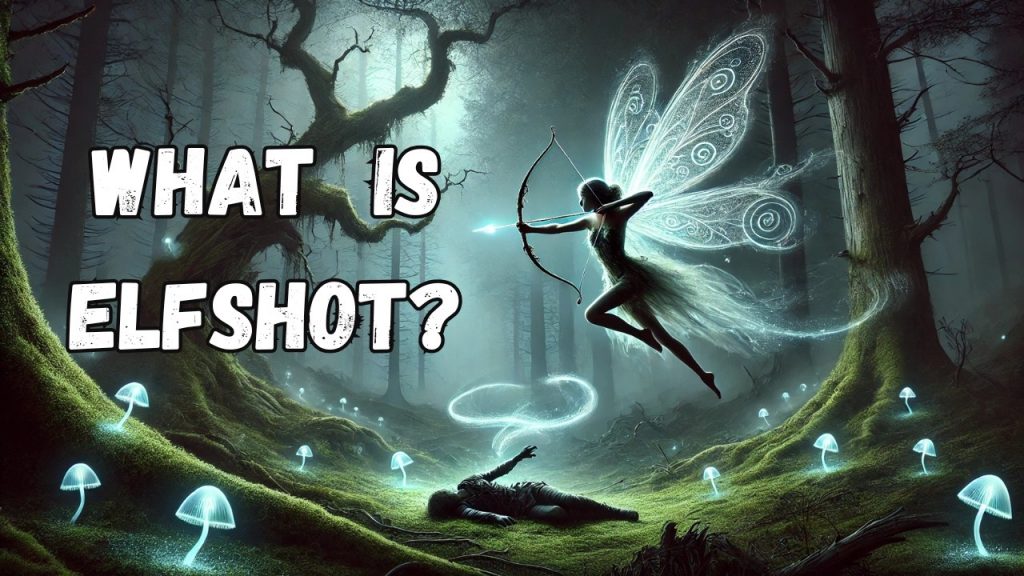
A farmer steps outside on an ordinary morning to find a cow standing motionless in the field. No visible wound. No obvious cause. By nightfall the animal is dead. The farmer knows what happened. Something invisible passed through the air the night before, and it found its mark.
A Diagnosis With a Very Long History
Before germ theory, before the microscope, before medicine had any reliable framework for explaining why a perfectly healthy person or animal might suddenly collapse with sharp internal pain or waste away without apparent cause, people across Britain and Northern Europe had an explanation ready. Something had shot them. Something that could not be seen, fired by something that did not want to be seen, using a weapon that left no external wound and no trace except the suffering it caused.
This was elf-shot, one of the most persistent and widely documented beliefs in the folklore of the British Isles, and it reached considerably further and lasted considerably longer than most people now realise.
What Elf-Shot Actually Was
Elf-shot, also known as elf-bolt, elf-arrow, or in Scottish Gaelic as saighead sith meaning fairy arrow, described the sudden onset of sharp, inexplicable internal pain or illness, in a human or an animal, believed to be caused by invisible projectiles fired by elves, fairies, or other supernatural beings. The condition it most likely corresponded to in practical terms included what we would now call rheumatism, arthritis, muscle cramps, colic in livestock, wasting diseases in cattle, and any number of sudden internal afflictions with no obvious visible cause.
The key detail in every version of the belief is that elf-shot left no external mark. A person or animal struck by it might show no wound at all, which was itself taken as evidence of the supernatural nature of the attack. An ordinary weapon leaves a visible injury. An invisible arrow fired by something from beyond the human world does its damage entirely on the inside, and the absence of any other explanation simply confirmed what the belief already held to be true.
The belief was not restricted to any single social class, region, or time period. It appears in some of the earliest surviving manuscripts of Anglo-Saxon medicine, persists through the medieval period, runs directly through the Scottish witch trials of the seventeenth century, and according to some accounts lingered in rural Highland communities well into the twentieth century.
The Anglo-Saxon Manuscripts
The oldest documentary evidence for elf-shot in the British Isles comes from two Old English medical texts that have survived, almost miraculously, from the early medieval period.
The first is Bald’s Leechbook, a medical manuscript compiled around the ninth or tenth century and now held in the British Library. It contains numerous remedies and charms for ailments specifically attributed to elves, including preparations for the internal pains that the text associates with their invisible attacks on both humans and livestock. The remedies blend what we would recognise as practical herbal medicine with ritual elements, reflecting a worldview in which the physical and the supernatural were not cleanly separated categories.
The second is the Lacnunga, another Anglo-Saxon medical collection held in the British Library, which contains one of the most extraordinary documents to survive from early medieval England: a charm called Wið færstice, which translates directly as against a sudden stabbing pain. This text, dated to somewhere in the tenth or eleventh century, is a fully formed narrative charm intended to be spoken by a healer while treating a patient suffering from exactly the kind of sharp, invisible internal attack that elf-shot described.
The charm opens with a vivid, almost cinematic scene: a group of powerful women riding loudly over the hill, screaming as they travel, hurling spears. It references the Aesir, the Norse gods, alongside elves, hags, and other spirits, combining what appears to be pre-Christian Germanic mythology with later Christian elements in exactly the kind of layered, syncretic mix that characterises Anglo-Saxon religious life. The healer speaking the charm invokes protection against all of these, drives out the arrow with a series of increasingly forceful commands, and concludes with a declaration that the patient will be made whole.
What makes Wið færstice so remarkable is how completely it captures the mindset behind the belief. Elf-shot was not understood as a vague, metaphorical kind of supernatural influence. It was understood as a literal projectile attack, and the cure for it involved the healer effectively entering the same narrative frame as the attack itself, identifying the weapons, naming the attackers, and commanding the arrow to leave the body as specifically as a surgeon might remove a physical foreign object.
The Arrows Themselves
Here is where the story takes a genuinely strange turn, because the arrows believed to cause elf-shot were not entirely imaginary. They had a physical form, and that physical form was real, ancient, and widespread.
Across Scotland and the north of England, farming communities regularly turned up small, finely worked flint arrowheads in their fields and on hillsides, the remnants of Neolithic and Bronze Age tool-making that had been lying in the soil for thousands of years before anyone in the early medieval period thought to wonder what they were. To communities with no knowledge of prehistoric archaeology, these sharp, carefully shaped flint points had no obvious origin. They had clearly been worked with skill and intention, but no living craftsman made them. They appeared from the earth without explanation.
The conclusion that people reached was, in its own way, entirely logical: these were the arrows of supernatural beings, fallen to earth after being used in attacks on the living. In Scotland they were called saighead sith, fairy arrows, and later simply elf-bolts or elf-arrows when the terminology shifted into English. They were treated with profound seriousness and considerable ambivalence: dangerous objects that had already been used to cause harm, but also potentially powerful tools for healing if handled correctly.
Some healers boiled the arrowheads in water and gave the resulting liquid to sick cattle or people as a cure, on the logic that the arrow that caused the affliction might also carry within it the means to reverse it. Others kept them as protective amulets, believing that an elf-arrow set in silver or carried on the person could ward off further attacks. The second edition of the Encyclopaedia Britannica, published in the 1770s, recorded that belief in elf-arrows was still active enough in Scotland at the time to warrant a mention, nearly a thousand years after the first written charms against elf-shot had been committed to manuscript.
Isobel Gowdie and the Elf Boys
The most extraordinary and disturbing window into how elf-shot belief operated in early modern Scotland comes not from a medical text or a folklore collection, but from a witch trial.
In the spring of 1662, a woman named Isobel Gowdie from the parish of Auldearn in Nairnshire confessed to a local commission to being a witch. What made her confession exceptional, and what has kept scholars arguing about it for more than three and a half centuries, was the quality of what she described. Her account was not vague or coerced into the standard shapes of witch trial testimony. It was specific, consistent, elaborately detailed, and delivered apparently without torture in four separate depositions over several weeks.
Among the things Gowdie described was a journey to what she called the elves’ house, a place she reached in the company of the fairy host. Inside, she saw elf boys, described as hollow and boss-backed, working over small pieces of flint with sharp tools, whittling them into arrow heads. The devil, she said, shaped the arrow heads with his own hands before passing them to the elf boys to finish. In her own words, preserved in the original court record: the divell shapes them wi his awin hands to gie to elf boyes, who whytts them wi a sharp thing lyk a baking neidle.
These finished arrows were then passed to the witches, including Gowdie herself, who used them to inflict harm on people and livestock. Without bows, they fired the arrows using a flick of the thumbnail, a detail so specific it seems impossible to have been suggested by an interrogator working from a standard script. Gowdie described flying through the air with her coven, shooting elf-arrows at people passing below on the roads of Nairnshire. She claimed the arrows always killed their target eventually, though the death might take some time to manifest.
The parallels between Gowdie’s account and the much older Wið færstice charm are striking. Both describe groups of supernatural beings manufacturing and deploying invisible projectiles against human targets. Both identify a smith figure as central to the production of the weapons. Scholars of Old English and early modern Scottish folklore have noted that the connection suggests a continuous tradition of elf-shot belief running from at least the tenth century through to the seventeenth, adapted and reframed over the centuries but recognisably the same underlying idea. Gowdie’s elves were working for the devil rather than acting independently, a shift that reflects the way Christian diabolism absorbed and recast older fairy beliefs in the early modern period, but the arrows were the same arrows that had been terrifying the British Isles since long before anyone framed them that way.
No verdict or execution record survives for Isobel Gowdie’s trial. What happened to her is unknown.
Treating the Shot and Protecting Against It
The folk medicine that developed around elf-shot was, by any measure, eclectic and creative, blending pagan and Christian elements with what looks to modern eyes like a determined pragmatism about trying everything available.
For elf-shot livestock, Anglo-Saxon texts suggest placing a sewing needle folded inside a page torn from a psalm book into the animal’s hair. A cure for an elf-shot horse involved mixing dock seed, Irish wax, and holy water, then having a priest sing twelve masses over the preparation before administering it. Some remedies involved iron, which across British and Northern European tradition held a consistent reputation for repelling fairy influence generally, used here as a barrier against whatever had already done its damage.
In Scotland, the elf-arrows themselves were central to treatment. A healer recorded in 1628 named Stein Maltman treated a woman called Jonet Chrystie for what was identified as elf-shot by rubbing a flint arrowhead over the affected area and then infusing it in water for her to drink. The same object that had supposedly caused the harm was being pressed into service as the cure, a logic that appears in folk medicine across many cultures and eras, the principle of treating like with like given its most literal possible expression.
Iron amulets, protective knots, specific spoken charms, holy water, prayers from Christian liturgy, invocations of older protective figures from pre-Christian tradition: all of these appear in different documented remedies at different times and places, frequently combined within the same treatment with no apparent sense of contradiction. A household protecting itself against elf-shot was not choosing between paganism and Christianity. It was using whatever it had.
If you want more like this, the Tales of Myth and Magic newsletter delivers new creatures, legends, and forgotten folklore straight to your inbox.
No fixed schedule. No noise. Just the stories, when they are ready.
Sign up here →A Word That Survived the Belief
The English language carries a small piece of elf-shot still, in the way that old beliefs sometimes leave traces in words long after the beliefs themselves have faded.
When we describe a sharp, sudden pain as a stabbing or a shooting pain, we are using language that was shaped partly by the belief that such pains were literally caused by something being shot invisibly into the body. The idea that invisible forces could strike a person from the outside, causing internal damage with no visible entry point, did not begin as a metaphor. It was a medical diagnosis, held seriously by people across a very long stretch of British history, and it produced real medical texts, real trial testimonies, real healing practices, and real stone arrowheads mounted in silver and worn as protection against further attacks.
The Neolithic arrowheads are still being found in Scottish fields today. The manuscripts are still in the British Library. And somewhere in the gap between what Anglo-Saxon healers wrote down about sudden stabbing pains and what Isobel Gowdie saw in the elves’ house in 1662, a tradition stretching over at least seven hundred years left its mark on how a very large number of people understood the relationship between invisible forces and the suffering of the body.
It was not a comfortable relationship. But it was, for a very long time, a real one.
Further Reading
If this article sparked your interest, these are the books worth reading next.
Scottish Urban Legends: 50 Myths and True Stories
by Aaron Mullins — fifty Scottish urban legends including stories from Glasgow, Edinburgh, and the Highlands. The kind of tradition that Maggie Murphy belongs to, collected properly in one volume.
Scottish Urban Myths and Ancient Legends
by Grace Banks and Sheena Blackhall — vampires, werewolves, devil encounters, and the school playground legends of Scotland. A genuinely good collection of the stories Scots have been telling each other for generations.
The Lore of Scotland: A Guide to Scottish Legends
by Jennifer Westwood and Sophia Kingshill — the most comprehensive collection of Scottish legend in print, covering Glasgow to Shetland, exploring origins and historical basis. Endorsed by Terry Pratchett as the real macabre.
Never miss a myth
Thank you for being here. The site is brand new and every subscriber genuinely means something to me. If you're here, you care about this stuff as much as I do - and that's all the reason I need to keep going. New stories, videos and dark folklore from around the world, straight to your inbox. No algorithm. Just the stories, when they're ready.
Pingback: Trows: Shetland's Trolls and the Dark Magic of the Northern Islands - Tales of Myth and Magic