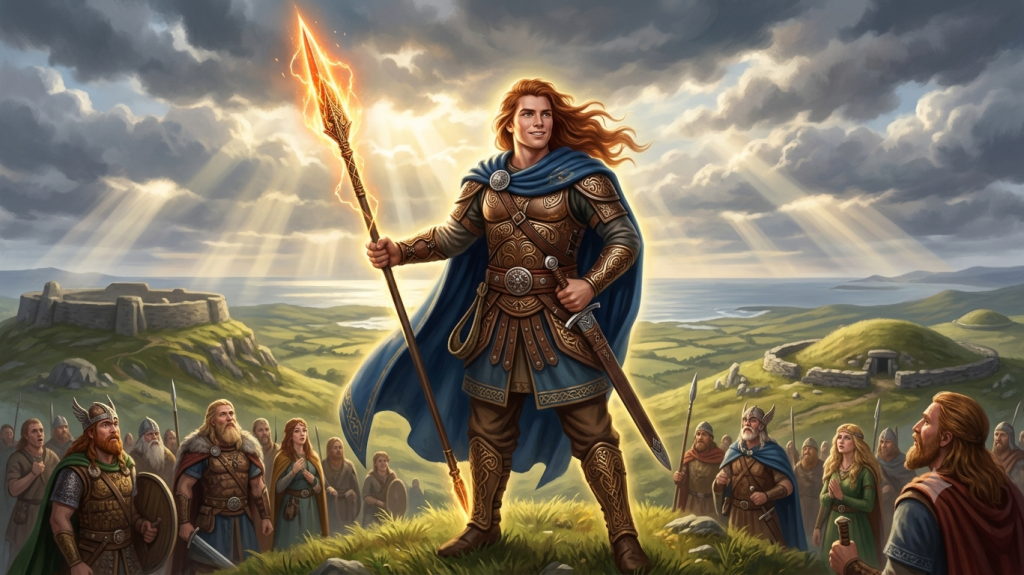
When Lugh arrived at the gates of Tara and asked to be admitted to the court of the Tuatha Dé Danann, the gatekeeper asked him what skill he possessed. Every man who entered Tara had to bring a skill with him. Lugh said he was a carpenter. The gatekeeper told him they already had a carpenter. Lugh said he was a smith. They had one of those too. He listed his skills one by one, and for each one the gatekeeper told him the position was filled. Then Lugh asked whether they had any man who possessed all of those skills simultaneously. They did not. He walked through the gate.
This exchange is one of the most characteristic moments in Irish mythology, and it establishes Lugh’s position in the tradition precisely. He is not the god of one thing. He is the god of all things, the figure who embodies the principle of comprehensive excellence, who is better at every individual skill than the specialists and better at all of them combined than anyone else in existence. His name in Irish tradition is Lugh Lámhfhada, Lugh of the Long Arm, which may refer to the reach of his spear, or the reach of the sun’s rays, or simply the reach of his ability into every domain of human and divine endeavour.
Origins and the Four Cities
Lugh does not arrive with the original Tuatha Dé Danann from the four northern cities. He comes to them. His origins are more complicated than those of most Irish mythological figures, because he is half Fomorian on his mother’s side, the grandson of Balor of the Evil Eye through his mother Ethniu. His father is Cian of the Tuatha Dé Danann. This makes him the product of the two great opposing forces in Irish mythology, part god and part the enemy of the gods, which is precisely what makes him capable of defeating the Fomorians in a way that none of the purely Tuatha Dé Danann figures could.
He arrives at Tara with the Manannán mac Lir as his foster father, already possessed of his defining weapons: the spear from Gorias, one of the Four Treasures of Ireland, from which no battle was ever sustained against it. The spear is sometimes called Areadbhar or Lúin, and it is one of the most feared weapons in the tradition, requiring a cauldron of poisoned water to keep it cool when not in use, because otherwise it would burn through anything it touched.
The Court at Tara
The scene at Tara’s gates is followed by Lugh demonstrating his abilities to the assembled court. He plays fidchell, the Irish board game, and beats everyone. He performs feats of strength. He plays the harp and produces the three strains of music, of sorrow, of joy, and of sleep. He is admitted to the company of the Tuatha Dé Danann as Samildánach, the one of many skills, and eventually given a position of authority that reflects his comprehensive excellence.
The Dagda, the existing chief god, is not displaced by Lugh but rather complemented by him. Where the Dagda embodies abundance, fertility, and the life and death cycle, Lugh embodies skill, mastery, and the solar principle of brilliance that illuminates and achieves. The two figures represent different aspects of divine power rather than competing for the same domain.
Lugh’s connection to the sun is explicit in his epithet and implicit throughout the tradition. The festival of Lughnasadh, celebrated on the first of August, is named for him and marks the beginning of the harvest season. The association between the sun god and the harvest, between the light that ripens the grain and the celebration of the grain’s ripening, is one of the oldest in Celtic religious tradition and among the most directly functional: this is not an abstract theological connection but one grounded in the agricultural realities that defined life in early Ireland.
Balor and the Prophecy
Balor of the Evil Eye was Lugh’s grandfather through his mother, and the relationship between them is one of the great tragic structures in Irish mythology: a divine being whose grandson was prophesied to kill him, who did everything possible to prevent the prophecy from being fulfilled, and who succeeded only in ensuring it came true.
Balor had received a prophecy that he would be killed by his own grandson. His response was to lock his daughter Ethniu in a glass tower on Tory Island, where no man could reach her, ensuring she would have no children and he would have no grandchildren to fulfil the prophecy. Cian of the Tuatha Dé Danann reached her anyway, through the magical assistance of a druidess, and Ethniu gave birth to three boys. Balor had two of them drowned immediately. The third was dropped and caught by a servant woman, who gave him to Manannán mac Lir to foster. That child was Lugh.
Everything Balor did to prevent the prophecy ensured that Lugh grew up under the best fosterage available in Irish mythology, trained by the master of the sea and the Otherworld, possessed of the finest weapons in existence, arriving at Tara equipped to take his place among the gods and eventually to face his grandfather in battle. The prophecy worked precisely because of the attempt to prevent it.
The Second Battle of Mag Tuired
Lugh’s defining act in Irish mythology is killing Balor at the Second Battle of Mag Tuired. The battle itself is the great conflict of Irish mythology, the moment when the Tuatha Dé Danann defeat the Fomorians definitively and establish their sovereignty over Ireland. Lugh leads the Tuatha Dé Danann in this battle, though the full account of how that leadership came about is complex.
Balor’s evil eye could kill an army if it was opened fully. It took four men with hooks to lift the eyelid, and when they did, whatever it looked upon died. At the moment of the battle’s crisis, Balor lifted his eye toward the Tuatha Dé Danann forces. Lugh put a stone from his sling through the eye as it opened. The stone drove the eye backward through Balor’s head so that it faced his own Fomorian army. The gaze that had been meant to destroy the Tuatha Dé Danann destroyed the Fomorians instead.
It was a sling stone. The master of all arts, the god of comprehensive excellence, the sun deity of Irish mythology, killed his prophesied victim not with the magical spear or with divine power but with a stone and a sling. The tradition gives this no special commentary. It is simply what happened, and what happened was the end of Balor and the decisive moment of the greatest battle in Irish mythology.
Lughnasadh and the Living Tradition
Lughnasadh, the harvest festival named for Lugh, is one of the four great seasonal festivals of the Celtic year alongside Samhain, Imbolc, and Bealtaine. It was celebrated on the first of August and marked the beginning of the harvest season. The name contains the element nasadh, which may mean assembly or commemoration, and the tradition connects the festival to funeral games Lugh held in honour of his foster mother Tailtiu, who died of exhaustion after clearing the plains of Ireland for agriculture.
The connection between a sun god, a harvest festival, and the death of a foster mother who cleared land for farming is one of the richest symbolic conjunctions in Celtic mythology. Tailtiu’s sacrifice of herself to prepare the land is mirrored in the harvest’s demand on the land, and Lugh’s commemoration of her is mirrored in the community’s acknowledgment that the harvest comes at a cost. The festival was not simply a celebration of abundance but a recognition of what abundance required.
Lughnasadh is still celebrated in Ireland today, most visibly at the Puck Fair in Killorglin in County Kerry, one of the oldest fairs in Ireland, where a wild mountain goat is crowned King Puck for three days and the town celebrates in a manner that the tradition recognises as continuous with the ancient festival even if the specific theology has faded into general festivity.
Further Reading
If this article sparked your interest, these are the books worth reading next.
The Mabinogion
The foundational collection of Welsh mythology — the primary source for the Arthurian tradition, the four branches of Welsh legend, and the stories that sit at the heart of the Celtic world.
Celtic Myths and Legends
by Peter Berresford Ellis — the best single-volume introduction to the full range of Celtic mythology, covering Irish, Welsh, Scottish, Gaulish, and Breton traditions properly.
The Táin: Translated from the Old Irish Epic Táin Bó Cúailnge
The great Irish epic — Cu Chulainn, Queen Medb, and the Cattle Raid of Cooley. The closest thing the Celtic world produced to the Iliad, and considerably stranger.
For more on the tradition, the Tuatha Dé Danann article covers the divine race Lugh joins and eventually leads. The Balor article covers the grandfather whose prophecy Lugh fulfilled and whose eye he drove through his own skull. The Second Battle of Mag Tuired article covers the conflict in which Lugh’s sling stone ended the Fomorian threat to Ireland.
Never miss a myth
Thank you for being here. The site is brand new and every subscriber genuinely means something to me. If you're here, you care about this stuff as much as I do - and that's all the reason I need to keep going. New stories, videos and dark folklore from around the world, straight to your inbox. No algorithm. Just the stories, when they're ready.