The Tuatha Dé Danann are the gods of Ireland. Not gods in the abstract, remote sense that the word sometimes implies, beings who created the world from a distance and then stepped back to let it run. They are present gods, embedded in the Irish landscape in a way that makes them impossible to separate from the land they inhabit. The hill of Knocknarea in Sligo belongs to them. The Brú na Bóinne, the great passage tomb complex at Newgrange, is the Dagda’s home. Lough Derg in Clare is where Aengus buried his foster son. The geography of Ireland is the mythology of the Tuatha Dé Danann made physical, and it has been that way for longer than anyone can reliably determine.
Their name means the People of the Goddess Danu, or possibly the People of Divine Skills, depending on which etymological tradition you follow. The goddess Danu herself is one of the most tantalising absences in Irish mythology: named in the title of her people, she appears almost nowhere in the actual texts, leading some scholars to question whether she was ever a fully developed figure in the tradition or whether the name refers to something else entirely. The ambiguity is typical of how the Tuatha Dé Danann tradition works: confident on the stories, reticent on the theology behind them.
The Primary Sources
The Tuatha Dé Danann are primarily preserved in the Lebor Gabála Érenn, the Book of the Taking of Ireland, a collection compiled by Christian monks in the eleventh and twelfth centuries from older material. The Lebor Gabála is not a straightforward mythological text. It is an attempt to fit Irish mythology into a Christian framework of universal history, tracing successive waves of settlers in Ireland from the biblical Flood forward and presenting the Tuatha Dé Danann not as gods but as a gifted race of people whose supernatural abilities were explained as advanced knowledge rather than divine power.
The scholar Kim McCone’s essential caution applies here: the Lebor Gabála is a euhemerised account, one that deliberately rationalises what was originally theological material into historical-sounding narrative to make it acceptable to Christian sensibility. The Tuatha Dé Danann were gods. The monks who wrote them down made them human. Reading the tradition requires holding both registers simultaneously.
The other major source is the Cath Maige Tuired, the Battle of Mag Tuired, which describes the Tuatha Dé Danann’s great conflict with the Fomorians and contains some of the richest individual characterisation in Irish mythology. The Dagda, Lugh, the Morrigan, Nuada, and many others appear in this text with specific personalities, specific powers, and specific dramatic functions that give the tradition its texture and depth.
Where They Came From
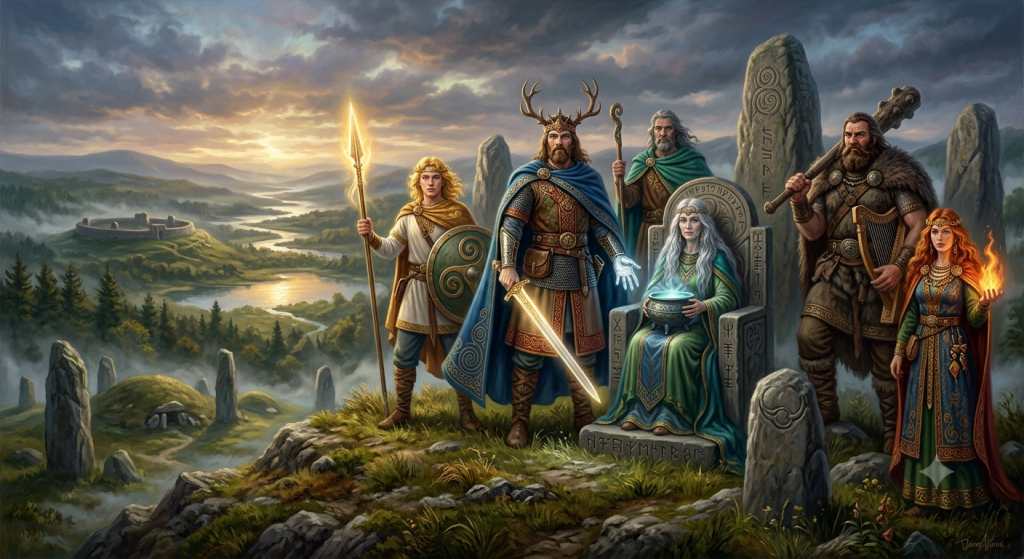
The Lebor Gabála describes the Tuatha Dé Danann arriving in Ireland from four cities in the northern world: Falias, Gorias, Murias, and Findias. From each city they brought one of the Four Treasures of Ireland, the objects that defined their power and their identity. From Falias came the Lia Fáil, the Stone of Destiny, which cried out when a true king of Ireland stood upon it. From Gorias came the spear of Lugh, from which no battle was ever sustained. From Findias came the sword of Nuada, from which no enemy ever escaped. From Murias came the cauldron of the Dagda, from which no company ever went away unsatisfied.
These four treasures are among the most discussed objects in Irish mythology and among the most persistently fascinating. The cauldron of plenty reappears across Celtic tradition in various forms, and the resonance with later Arthurian Grail mythology has been noted by scholars for over a century. Whether the connection is one of direct influence or parallel development from shared Indo-European roots is a question the tradition does not settle.
They arrived in Ireland covered in a magical mist or, in some versions, traveling in ships. They found the Fir Bolg already there, the people who had come before them, and they challenged them for the island. The First Battle of Mag Tuired was the result, and the Tuatha Dé Danann won it, though their king Nuada lost his arm in the fighting and had to step down from kingship because Irish tradition required a king to be physically whole.
The Gods and What They Governed
The Tuatha Dé Danann are not an undifferentiated mass of supernatural beings. They are a community of individuals with specific domains, specific relationships to each other, and specific roles in the tradition. Understanding who they are individually is understanding the full range of what Irish mythology covers.
The Dagda is the chief god, the great father, whose cauldron and club and harp embody the three great functions of divine power: sustenance, life and death, and mastery over time and emotion. He is not a sleek or glamorous figure in the tradition. He is vast, earthy, frequently crude, and immensely powerful.
Lugh is the sun god and the master of all arts, the young champion who joins the Tuatha Dé Danann and eventually leads them against the Fomorians. His name may connect to a pan-Celtic solar deity whose worship extended across Ireland, Britain, and Gaul, and the festival of Lughnasadh in early August is named for him.
The Morrigan is the triple goddess of war, fate, and sovereignty, who moves through the tradition as a crow, a wolf, a beautiful woman, and a hag, sometimes all in the same story. She is one of the most fully realised and most discussed figures in Irish mythology.
Nuada Airgetlám, Nuada of the Silver Arm, is the king who loses his arm at the First Battle of Mag Tuired and has a replacement made of silver by the divine physician Dian Cecht. His name and his silver arm appear in parallel in Welsh mythology as Nudd and Lludd, suggesting a shared divine figure older than either tradition’s surviving texts.
Brigid, daughter of the Dagda, is the goddess of poetry, healing, and smithcraft, whose cult was strong enough in Ireland that the Christian church eventually absorbed her as Saint Brigid of Kildare, one of the three patron saints of Ireland.
Manannán mac Lir governs the sea and the Otherworld, and is the figure most closely associated with the passage between worlds. He lends his name to the Isle of Man and appears in the mythology of both Ireland and Scotland in ways that suggest his worship was genuinely pan-Gaelic.
The Defeat and the Disappearance
After the Tuatha Dé Danann defeated the Fomorians at the Second Battle of Mag Tuired, they faced a new challenge: the Milesians, the Sons of Míl, the people who would become the Gaelic Irish. The Milesians came from Spain in the mythology, and their arrival represented the transition from the age of gods to the age of humans.
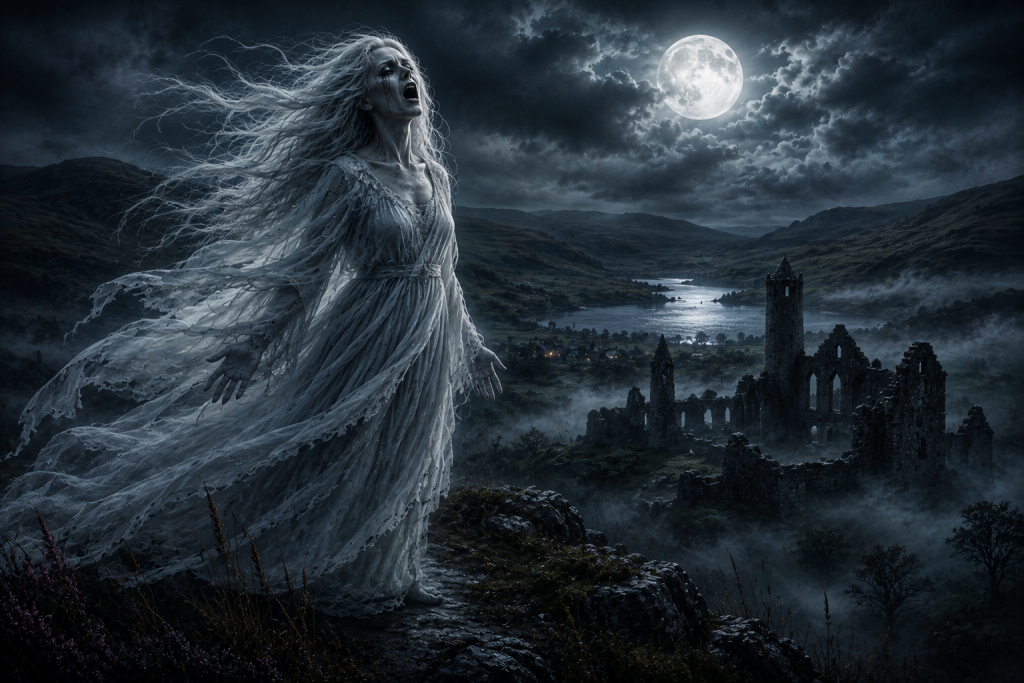
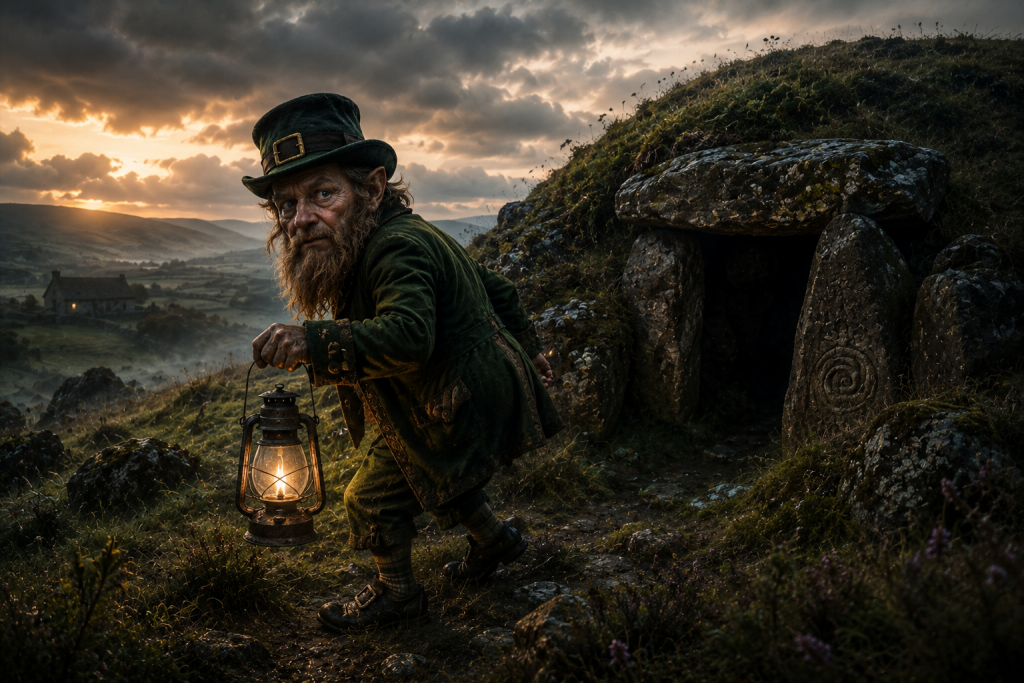
The Tuatha Dé Danann and the Milesians agreed to divide Ireland: the Milesians would take the surface world, and the Tuatha Dé Danann would take what lay beneath it. They retreated into the sídhe, the fairy mounds, the hollow hills that dot the Irish landscape, and became the Aos Sí, the people of the mounds. In doing so they did not exactly die or depart. They withdrew. They remained in the landscape, present but invisible, accessible through the right kind of vision or at the right kind of moment.
This withdrawal is the most distinctive feature of Irish mythology compared to other traditions. The Norse gods are destined to die at Ragnarök. The Greek gods retreat to Olympus. The Tuatha Dé Danann go underground and stay there, in the hills and the ancient tombs that their descendants could still see and visit, present in the world in a diminished but indelible form. They became the fairy folk of later tradition not as a debasement but as a continuation, the same beings in a new register, their power changed but not extinguished.
Further Reading
If this article sparked your interest, these are the books worth reading next.
The Mabinogion
The foundational collection of Welsh mythology — the primary source for the Arthurian tradition, the four branches of Welsh legend, and the stories that sit at the heart of the Celtic world.
Celtic Myths and Legends
by Peter Berresford Ellis — the best single-volume introduction to the full range of Celtic mythology, covering Irish, Welsh, Scottish, Gaulish, and Breton traditions properly.
The Táin: Translated from the Old Irish Epic Táin Bó Cúailnge
The great Irish epic — Cu Chulainn, Queen Medb, and the Cattle Raid of Cooley. The closest thing the Celtic world produced to the Iliad, and considerably stranger.
For more on the individual members of the Tuatha Dé Danann, the Dagda article covers the chief god and his three great treasures. The Lugh article covers the sun god and master of all arts. The Morrigan article covers the triple goddess who shaped the destiny of both gods and heroes.
Never miss a myth
Thank you for being here. The site is brand new and every subscriber genuinely means something to me. If you're here, you care about this stuff as much as I do - and that's all the reason I need to keep going. New stories, videos and dark folklore from around the world, straight to your inbox. No algorithm. Just the stories, when they're ready.