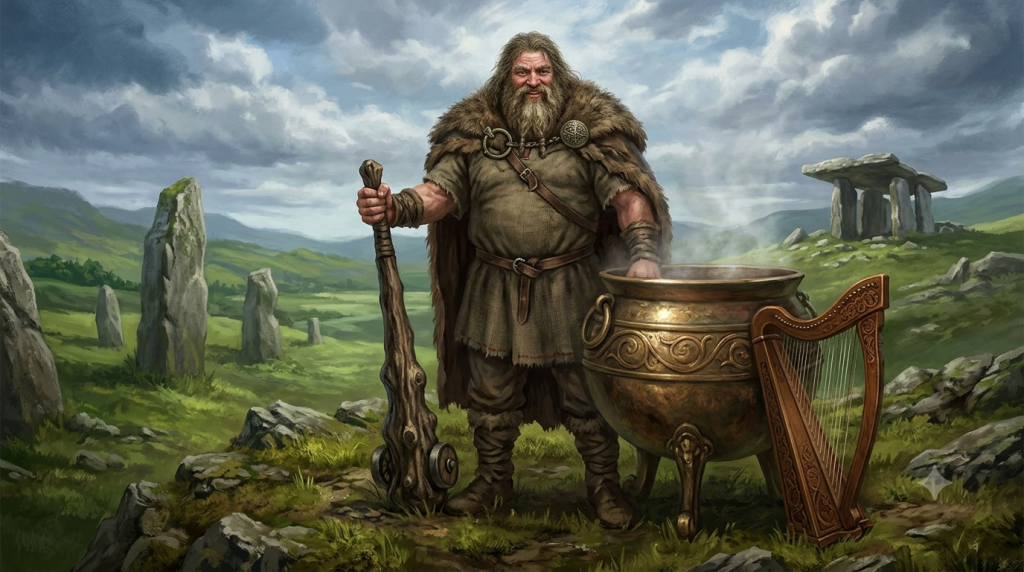
The Dagda is the chief god of the Tuatha Dé Danann and one of the most distinctive figures in any mythology. He is enormous, physically. He drags a club so large that eight men would be needed to carry it, and it leaves a furrow in the ground behind him like a boundary ditch. His cauldron is big enough to fit several men inside it. His appetite is legendary: at one point in the Cath Maige Tuired he is given a porridge of whole goats, sheep, and pigs boiled in a full-sized cauldron, and he eats it all with a ladle large enough for a man and a woman to lie in together.
He dresses like a peasant. His tunic is too short and shows his backside. He is frequently described as ugly. When he walks, the people who see him find him ridiculous.
He is also the king of the gods, the master of life and death, the keeper of the cauldron from which no one goes away hungry, the wielder of the harp that controls the seasons, and the father of Brigid, Aengus, and the Morrigan’s allies. The gap between his appearance and his power is not a contradiction the tradition resolves or apologises for. It is precisely the point.
The Name and What It Actually Means
Dagda comes from dag dia, meaning good god or excellent god. The name is not a moral judgment. In Old Irish, good in this context means skilled or excellent across a wide range of abilities, the god who can do everything, the master of all crafts and all functions. When the Tuatha Dé Danann were preparing for the Second Battle of Mag Tuired and each member declared what they would contribute, the Dagda promised to do everything that all the others had already pledged. The name records that claim. He is the good god not because he is virtuous but because he is comprehensive.
His other names give further dimensions. Eochaid Ollathair means Great Father or All-Father, a title that resonates with Odin’s Allfather designation in Norse mythology and suggests a shared Indo-European archetype of the comprehensive father deity. Ruad Ro-fessa means Lord of Great Knowledge. He gives a list of nearly a dozen names for himself in the Cath Maige Tuired, each carrying a different aspect of his nature, in a form of dense alliterative poetry called a rosc that resists clean translation but demonstrates that his identity in the tradition is multiple and layered rather than simple.
The Three Treasures
The Dagda is associated with three objects that together define the scope of his power.
The cauldron came from Murias, one of the four northern cities where the Tuatha Dé Danann learned their arts before coming to Ireland. No company ever went away from it unsatisfied. This is not simply abundance in the sense of enough food. It is perfect provision: the cauldron gives each person exactly what they need, no more and no less, and the company as a whole is always satisfied by it. The cauldron as a symbol of divine nourishment that sustains the worthy is one of the deepest recurring images in Celtic mythology, and its resonance with later Arthurian Grail traditions has been extensively discussed by scholars of both traditions.
The club has two ends. Strike with one end and it kills. Strike with the other and it revives. The Dagda is the god of life and death simultaneously, not as two opposing principles but as two aspects of the same function, and the club encodes that theological position in physical form. He drags it rather than carrying it, and the track it leaves in the ground is one of the memorable images of the Irish tradition: the chief god walking through the landscape, his power too large to be held lightly.
The harp is called Uaithne or Cóir Cetharchorr, and it controls the seasons and human emotions. The Dagda plays three strains on it: the strain of sorrow, the strain of joy, and the strain of sleep. When the Fomorians steal the harp during the Second Battle of Mag Tuired, the Dagda goes with Lugh and Ogma to recover it. When he calls it from inside the Fomorian hall, the harp flies to his hands, killing nine men on its way. He then plays the three strains in sequence, first making the Fomorians weep, then making them laugh, then sending them to sleep, while the Tuatha Dé Danann escape. Music in Celtic mythology is not entertainment. It is a force that shapes reality, and the Dagda’s harp is its most powerful expression.
The Porridge Episode
The most deliberately comic episode in the Dagda’s mythology is also one of the most revealing about what the tradition understood him to be.
Before the Second Battle of Mag Tuired, the Fomorians decide to humiliate him by demanding he eat an enormous porridge made from eighty measures of milk, whole goats, sheep, and pigs, all cooked together in a full-sized cauldron. They dig a pit to hold it and ladle the food into the pit rather than a bowl. The Dagda eats it all. He uses a ladle large enough for a man and woman to lie in together. He scrapes the pit clean. Then he falls asleep, his belly so distended it looks like a cauldron itself.
The tradition tells this story without apparent embarrassment. The chief god of Ireland is here being presented as grotesque, crude, and absurd. The Fomorians’ attempt to humiliate him succeeds on a superficial level and fails entirely on the level that matters: his capacity for consumption is literally unlimited, and the porridge that was meant to be a punishment is simply more of what he always does. You cannot humiliate by excess the god of abundance itself.
The Morrigan and the River
On the morning before the Second Battle of Mag Tuired, the Dagda meets the Morrigan at a ford on the River Unshin in Connacht. She is washing herself in the river, one foot on the south bank and one on the north, straddling the boundary between territories in a gesture that encodes her nature as a liminal figure who operates across thresholds. They have a sexual union there at the ford, after which she tells the Dagda the battle plan of the Fomorians and promises to magically weaken the Fomorian king Indech by taking from him the blood of his heart and the kidneys of his valour.
The encounter is significant for several reasons. It positions the Dagda and the Morrigan as the two central pillars of the Tuatha Dé Danann’s war effort, the one embodying natural abundance and the other embodying sovereignty and fate. It frames the Morrigan’s military contribution as proceeding from her alliance with the Dagda rather than from an independent decision. And it places the sexual union at a river crossing, a boundary space, at the moment before the defining battle of the mythology, which is exactly the kind of charged liminal context that Irish mythology consistently uses for the most significant encounters.
The Brú na Bóinne
The Dagda’s home is the Brú na Bóinne, the great passage tomb complex on the River Boyne in County Meath that includes the monuments now known as Newgrange, Knowth, and Dowth. These are among the oldest megalithic structures in the world, built around 3200 BCE, predating Stonehenge by several centuries and the Egyptian pyramids by several decades. The Irish tradition associated them with the Tuatha Dé Danann generally and with the Dagda specifically, understanding them as his dwelling place after the Tuatha Dé Danann’s withdrawal into the sídhe.
When the Milesians defeated the Tuatha Dé Danann and divided Ireland between them, the story is told that the Dagda distributed the sídhe mounds among his people. He gave Newgrange to his son Aengus, and Aengus eventually tricked him out of it through a clever manipulation of the terms of the agreement. The great god of the Tuatha Dé Danann was outwitted by his own son over property rights to a prehistoric monument. This too is entirely consistent with how the tradition presents the Dagda: vast, powerful, comprehensive, and entirely capable of being outmanoeuvred by someone smaller and more agile.
Further Reading
If this article sparked your interest, these are the books worth reading next.
The Mabinogion
The foundational collection of Welsh mythology — the primary source for the Arthurian tradition, the four branches of Welsh legend, and the stories that sit at the heart of the Celtic world.
Celtic Myths and Legends
by Peter Berresford Ellis — the best single-volume introduction to the full range of Celtic mythology, covering Irish, Welsh, Scottish, Gaulish, and Breton traditions properly.
The Táin: Translated from the Old Irish Epic Táin Bó Cúailnge
The great Irish epic — Cu Chulainn, Queen Medb, and the Cattle Raid of Cooley. The closest thing the Celtic world produced to the Iliad, and considerably stranger.
For more on the tradition, the Tuatha Dé Danann article covers the divine race to which the Dagda belongs and their full history in Ireland. The Second Battle of Mag Tuired article covers the conflict in which the Dagda’s harp is stolen and recovered and his alliance with the Morrigan proves decisive. The Morrigan article covers the goddess who meets the Dagda at the ford and shapes the battle’s outcome.
Never miss a myth
Thank you for being here. The site is brand new and every subscriber genuinely means something to me. If you're here, you care about this stuff as much as I do - and that's all the reason I need to keep going. New stories, videos and dark folklore from around the world, straight to your inbox. No algorithm. Just the stories, when they're ready.