The Fomorians are the oldest hostile force in Irish mythology. They were in Ireland before the Tuatha Dé Danann arrived, before the Fir Bolg, before Nemed and Partholón, present at the very beginning of the mythological history of the island in a way that makes them less an invading enemy and more a permanent condition: the chaos that existed before order, the darkness that predates the light, the deep hostility of the natural world to human habitation and cultivation.
Their name may derive from Fo Muir, meaning Under the Sea, or from Fo Mór, meaning Under the Great One, or from an older root entirely that the surviving texts preserve without explaining. What is consistent is their association with darkness, the deep sea, the wild places at the edges of the mapped world, and the principle of destruction that opposes the creative and sustaining functions the Tuatha Dé Danann represent. They are not simply enemies. They are a cosmological necessity: the tradition that produced them understood that order requires something to be ordered against.
What the Fomorians Actually Were
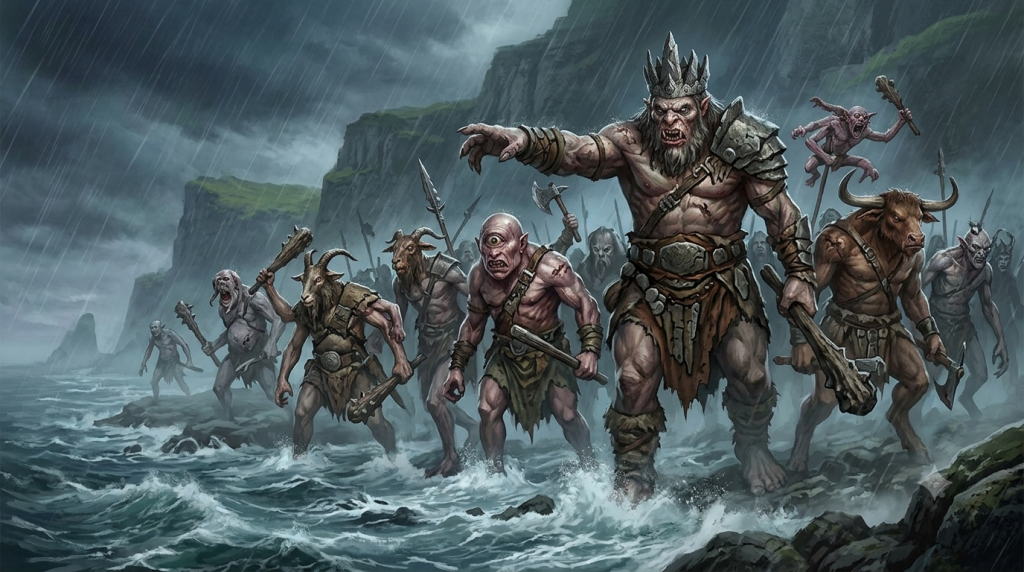
The Fomorians in the Irish tradition are not a consistent and uniform group. Different texts present them differently, and the tradition does not resolve these differences into a single coherent account. In the earliest material they are demonic beings, sometimes described as having animal features, as having only one arm or one leg or one eye, as being grotesque in ways that encode their nature as forces of disorder and incompleteness. In later material they appear more as a rival race of beings, similar in kind to the Tuatha Dé Danann but opposed to them in nature and allegiance.
The Cath Maige Tuired, which gives the fullest account of their conflict with the Tuatha Dé Danann, presents them in ways that complicate the simple good versus evil reading. Their king Bres, the Beautiful, is actually half-Fomorian and half-Tuatha Dé Danann, born of a union between the Fomorian Elatha and the Tuatha Dé Danann woman Ériu. He rules the Tuatha Dé Danann for a period when their own king Nuada is disqualified by the loss of his arm, and his misrule, his failure of hospitality and his extraction of excessive tribute, is what triggers the conflict rather than simple Fomorian aggression.
This complexity is characteristic of how Irish mythology handles its antagonists. The Fomorians are not pure evil in the way that some mythological traditions present their opposing forces. They are the principle of excess and imbalance, which sometimes manifests as active destruction and sometimes simply as the failure of the qualities that sustain community: generosity, proper kingship, the right relationship between ruler and ruled.
Bres and the Failure of Hospitality
Bres mac Elatha became king of the Tuatha Dé Danann after Nuada’s arm was lost at the First Battle of Mag Tuired, and his reign is the most detailed portrait of Fomorian nature in the tradition. He was beautiful, which is the meaning of his name, and he was chosen as a compromise candidate because beauty was considered appropriate in a king. He was a disaster.
The fundamental charge against Bres in the Cath Maige Tuired is the failure of hospitality. Irish society at every level was structured around obligations of generosity: the duty of the host to feed and shelter the guest, the duty of the king to provide for his people, the duty of the noble to maintain the warriors in his service. Bres violated all of these simultaneously. The knives of his warriors were not greased. Their breath did not smell of ale. The poet Cairbre, when he visited, was given a small dark room with no fire, no bed, and no food except a small dry cake. He left and composed the first satire in Irish history against Bres, and the satire caused blemishes to appear on Bres’s face, disqualifying him from kingship just as Nuada’s lost arm had disqualified him.
Bres then went to his Fomorian father Elatha to ask for an army to win back the kingship by force, and Elatha, importantly, refused to give him one on the grounds that he had lost the kingship unjustly and that reclaiming it by violence would be wrong. The Fomorian king’s refusal to support his son’s unjust claim is one of the most morally nuanced moments in Irish mythology, and it demonstrates that the tradition’s understanding of the Fomorians was more sophisticated than a simple association with evil.
Bres went instead to Balor of the Evil Eye, who agreed to provide an army, and the Second Battle of Mag Tuired was the result.
Fomorian Contributions to Irish Civilisation
One of the most surprising aspects of Fomorian mythology is how much of Irish civilisation they are credited with contributing to. The Fomorians taught agriculture to the first settlers of Ireland. Some traditions credit them with the construction of the great megalithic monuments. Their king Elatha is presented as a figure of dignity and justice rather than brutality. Their connection to the sea, which provided food and trade routes, positions them as forces that were not simply destructive but also sustaining in ways the land-focused Tuatha Dé Danann were not.
This reflects the tradition’s understanding that the forces of chaos and darkness are not simply negative. They are the conditions against which order defines itself, and they contain within them things of genuine value: the sea’s abundance, the deep knowledge that comes from existing before the current order was established, the ruthless clarity of forces that do not operate by the polite conventions of the divine community.
The Dagda’s relationship with the Fomorians illustrates this. Before the Second Battle of Mag Tuired, the Dagda is sent to negotiate with them, and he spends time in their camp eating their porridge and consorting with their people. He is not presented as disgusted or endangered by this contact. The boundary between the Tuatha Dé Danann and the Fomorians is permeable in ways that the narrative of conflict obscures, and the tradition preserves these permeable moments alongside the battle accounts without apparent discomfort.
After the Battle
The Second Battle of Mag Tuired ended with the Fomorians’ defeat and their retreat from Ireland. But they were not destroyed. The tradition does not describe a final extermination of the Fomorians, only their departure across the sea to wherever they came from. The forces of chaos and disorder in Irish mythology are not eliminated. They are pushed back to the edges, where they remain, ready to return if the conditions that hold them at bay are weakened.
This is one of the most honest things about Irish mythology’s treatment of its antagonists. The Fomorians are a permanent feature of the cosmos rather than a problem to be solved. The victory of the Tuatha Dé Danann at Mag Tuired is a real victory but not a final one. The forces of darkness do not go away. They simply agree, under sufficient pressure, to retreat for now.
Later Irish tradition continued to include Fomorian figures in various forms. Some of the great monsters of Irish folklore carry Fomorian ancestry or association. The tradition understood that the boundary between the ordered world and what lay outside it was maintained by continuous effort rather than by any single decisive act.
Further Reading
If this article sparked your interest, these are the books worth reading next.
The Mabinogion
The foundational collection of Welsh mythology — the primary source for the Arthurian tradition, the four branches of Welsh legend, and the stories that sit at the heart of the Celtic world.
Celtic Myths and Legends
by Peter Berresford Ellis — the best single-volume introduction to the full range of Celtic mythology, covering Irish, Welsh, Scottish, Gaulish, and Breton traditions properly.
The Táin: Translated from the Old Irish Epic Táin Bó Cúailnge
The great Irish epic — Cu Chulainn, Queen Medb, and the Cattle Raid of Cooley. The closest thing the Celtic world produced to the Iliad, and considerably stranger.
For more on the tradition, the Tuatha Dé Danann article covers the divine race who opposed the Fomorians and eventually defeated them. The Balor article covers the greatest Fomorian king and his fatal eye. The Second Battle of Mag Tuired article covers the defining conflict between the two forces and the mythology’s most important battle.
Never miss a myth
Thank you for being here. The site is brand new and every subscriber genuinely means something to me. If you're here, you care about this stuff as much as I do - and that's all the reason I need to keep going. New stories, videos and dark folklore from around the world, straight to your inbox. No algorithm. Just the stories, when they're ready.