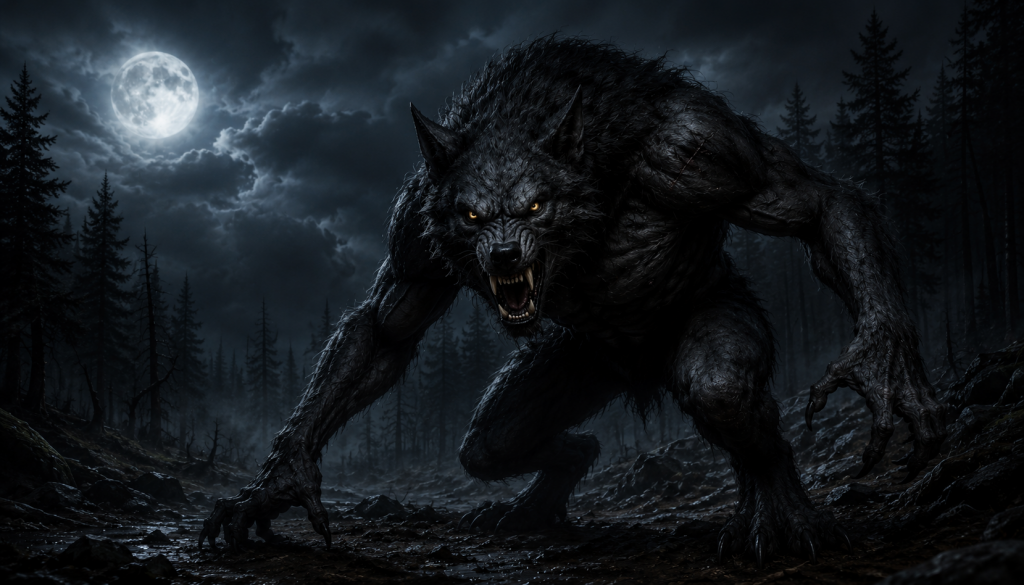
Between 1764 and 1767 in the Gévaudan region of south-central France, something killed between sixty and a hundred people, mostly women and children tending livestock in the fields. The attacks were attributed to a single creature of extraordinary size and ferocity, described by survivors as larger than any wolf they had seen, with a broad chest, a reddish coat, and a tail unlike a wolf’s. It attacked people rather than livestock, targeting the head and throat, and it kept attacking despite organised hunts that killed hundreds of ordinary wolves in the region.
The Beast of Gévaudan became a national crisis. King Louis XV sent professional hunters including the celebrated Antoine de Beauterne. The local bishop ordered public prayers. The attacks were reported in the Paris press and followed across France with an intensity that reflected both the genuine horror of what was happening and the period’s appetite for sensational news. When de Beauterne finally killed a large wolf in September 1765 and presented it as the Beast, the attacks stopped briefly and then resumed. Whatever the Beast was, it had not been killed.
The Attacks
The pattern of attacks was unusual enough to sustain the belief that something beyond an ordinary wolf was responsible. The creature attacked people preferentially over livestock, which was not typical wolf behaviour. It targeted the head and throat with a precision that survivors described as deliberate. Some victims were partially eaten. Others were killed and left largely intact. The scale of the death toll over three years, in a relatively small and sparsely populated region, was without precedent in French records.
Survivors gave consistent descriptions of a large, reddish animal with an unusual tail and chest that moved with speed and apparent intelligence. Some accounts described it as accompanied by a smaller animal, possibly a mate. The consistency of the descriptions across independent witnesses gave them a credibility that purely folkloric monster accounts often lack.
The attacks concentrated in specific areas of the Gévaudan and followed seasonal patterns that suggested the creature had a territory and habits. It avoided traps with a consistency that frustrated the hunters sent to kill it. When large numbers of armed men organised drives across its territory, it simply wasn’t where they were looking.
What It Actually Was
The identity of the Beast has been debated since the eighteenth century and remains genuinely uncertain. The most widely accepted explanation among historians and zoologists is that it was one or more large wolves, possibly unusually bold individuals that had learned to prey on humans rather than livestock, possibly wolves that had escaped from captivity and lacked the ordinary fear of humans that wild wolves develop. A striped hyena has been proposed. A wolf-dog hybrid has been proposed. A serial human killer using a trained animal as a weapon has been proposed.
The creature eventually identified as the most likely killer was shot in June 1767 by a local hunter named Jean Chastel, using bullets he had cast himself. The attacks stopped after this killing and did not resume. Chastel’s bullets were later claimed in popular tradition to have been made of silver, adding a werewolf dimension to a story that the contemporaries had already been interpreting in supernatural terms. The silver bullet claim appears to be a later embellishment, but its attachment to the Gévaudan story reflects how thoroughly the case had been absorbed into the werewolf tradition by the time the legend had fully developed.
The Werewolf Dimension
Contemporaries in Gévaudan explicitly discussed the possibility that the Beast was a werewolf. The period’s theological framework made this a serious rather than a metaphorical suggestion: if the Beast could not be killed by ordinary means, if it avoided traps with apparent intelligence, if it preferred human victims over easier prey, then supernatural explanation was genuinely available to people whose worldview included supernatural explanation as a category.
The Gévaudan case sits at the intersection of real animal predation and werewolf mythology in a way that most cases in the tradition do not. Peter Stumpp and Gilles Garnier are trial records of human beings who confessed under torture to crimes they may or may not have committed. The Beast of Gévaudan killed real people over three years and was never conclusively identified. The gap between what happened and what can be explained remains real, which is what has kept the case alive in popular imagination for two and a half centuries.
Further Reading
If this article sparked your interest, these are the books worth reading next.
The Beast of Gévaudan
by Jay M. Smith — the most thorough historical investigation into the creature that terrorised southern France between 1764 and 1767, and what the historical record actually reveals about what it was.
The Werewolf Book: The Encyclopedia of Shape-Shifting Beings
The most comprehensive reference on the werewolf tradition across world cultures — every regional variant, every historical case, every folkloric and literary expression of the shape-shifting being.
The Werewolf in Lore and Legend
by Montague Summers — the classic scholarly treatment of werewolf belief, drawing on primary sources from across Europe. Dense, serious, and still the best single academic treatment of the tradition.
For more on the werewolf tradition, the Peter Stumpp article covers the most famous werewolf trial in European history. The Loup-Garou article covers the French werewolf tradition within which the Gévaudan attacks were understood. The Werewolf Trials of Europe article covers the broader history of werewolf belief and prosecution.
Never miss a myth
Thank you for being here. The site is brand new and every subscriber genuinely means something to me. If you're here, you care about this stuff as much as I do - and that's all the reason I need to keep going. New stories, videos and dark folklore from around the world, straight to your inbox. No algorithm. Just the stories, when they're ready.