
The Norse gods are powerful, ancient, and in most cases considerably older than the humans they watch over. Odin has sacrificed an eye and hung from a tree in pursuit of knowledge. Thor is strong enough to fight the World Serpent. The Aesir command the nine realms and prepare for the apocalypse with the seriousness of beings who have known it was coming for a very long time.
None of them can change what the Norns have decided.
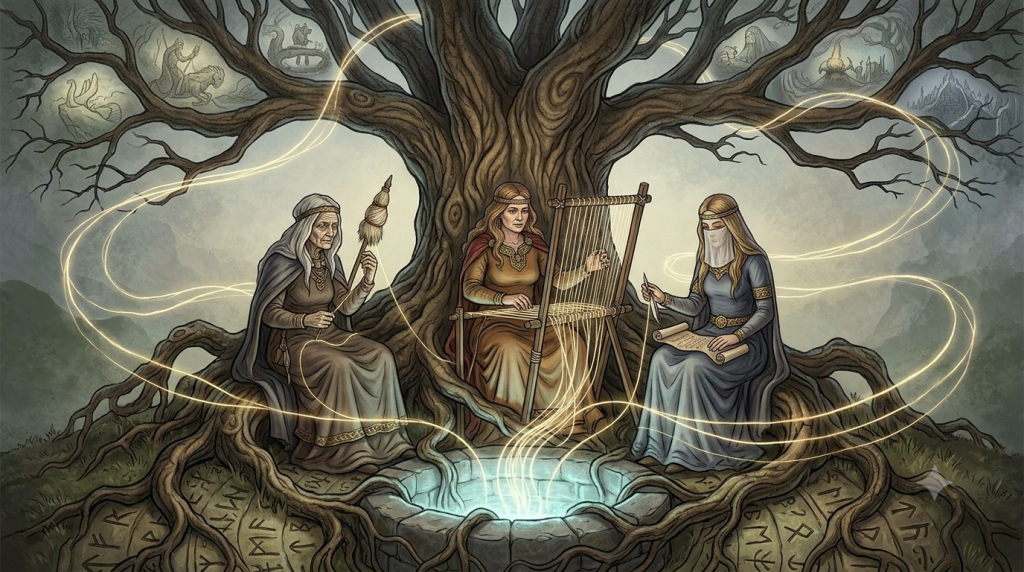
The three Norns who sit beside the Well of Urðarbrunnr at the roots of Yggdrasil are not part of the divine order that Odin leads. They are not Aesir and not Vanir and not giants and not dwarves. They belong to no faction. They serve no master. They were there before the current order of things and will presumably persist beyond it. When the Völuspá describes their arrival in the world, it marks the moment when time and consequence entered the cosmos: before the Norns came, things existed but did not yet have a destiny.
Odin knows his fate at Ragnarök. He cannot change it. The Norns have woven what they have woven, and the most powerful god in the Norse cosmos can no more alter what they have set than he can alter the past itself. That is the position the tradition assigns them: above the gods, in the specific sense that the structure within which the gods operate is something the Norns determine rather than something they determine.
What the Names Mean
The three principal Norns are named Urðr, Verðandi, and Skuld, and their names are worth examining in the original Old Norse before translation collapses the precision out of them.
Urðr is the oldest form and the most fundamental. Her name is related to the Old Norse verb verða, to become or to happen, and to the noun urðr, fate or what has happened. She is not simply the past in the sense of what is over. She is the accumulated weight of what has already become real, the totality of events that have already resolved into fact and cannot be undone. The Well of Fate is named after her, Urðarbrunnr, the Well of Urðr, and the gods hold their councils at Yggdrasil beside it. Everything that has already happened is under her authority.
Verðandi comes from the present participle of the same verb, verða. She is what is becoming, the present moment in its process of resolving into fact. Not what has happened and not what will happen but the instant of happening itself, the continuous present tense of events moving from possibility into reality. She is the most active of the three in the most literal sense: her work is always in progress, always current, never finished.
Skuld’s name is the one that most rewards attention, because the conventional translation, the future, obscures what the word actually means in Old Norse. Skuld is related to the verb skulu, the ancestor of the modern English auxiliary should, and to the noun skuld, meaning debt or obligation. The future in Norse thought is not an open field of possibilities. It is a debt that the present owes to what has been set in motion by the past. What Skuld determines is not simply what will happen but what must happen, what is owed, what cannot be avoided because the past and the present have already made it necessary.
She is also sometimes identified as a Valkyrie in the sources, which connects her to the moment of death specifically. The Norn of what must be and the Valkyrie who chooses the slain are, in this identification, the same being. Fate and death are not separate mechanisms in the Norse tradition. They are aspects of the same process.
What They Do at the Well
The Völuspá describes three maidens coming from the hall beneath Yggdrasil, beside the Well of Urðr, to establish fate. Their arrival is placed at a pivotal moment in the poem’s account of creation: after the gods have shaped the earth and given gifts to the first humans Ask and Embla. The Norns do not create. They determine the conditions within which what has been created will live and die.
The Prose Edda describes them carving runes into the wood of Yggdrasil, making strings, and weaving at a loom. They draw water from the Well of Urðr and mix it with the white clay around the well’s edge to pack around Yggdrasil’s roots, maintaining the tree that holds the nine worlds together. They are simultaneously the determiners of fate and the caretakers of the cosmic structure. The two functions are connected: the tree sustains the nine worlds, and the nine worlds are the space within which the fates they weave are lived out.
The methods of fate-determination in the sources are several and not entirely consistent. Carving runes. Weaving threads at a loom, where the length of thread represents the length of a life and the texture represents its character. Casting wooden lots. The tradition does not fix a single mechanism. What it fixes is the result: what the Norns determine is determined, and it cannot be altered after the fact any more than the past can be altered.
One of the most significant structural details in the sources is the relationship between the Well of Urðr and the gods’ council. The gods meet daily at Yggdrasil to conduct the business of governing the cosmos, and they do so at the same location where the Norns maintain their work. The divine council and the determiners of fate operate in the same space simultaneously. Whether the gods find this reassuring or disquieting the tradition does not say. It simply notes that both activities happen at the roots of the world tree beside the same well.
The Many Norns
The three principal Norns, Urðr, Verðandi, and Skuld, are not the only ones. The Prose Edda specifies that there are many other norns who perform similar functions on a smaller scale, and it divides them by origin: some are of the race of gods, some of the race of elves, and some of the race of dwarves.
These lesser norns attend individual births. When a child is born, a norn comes to determine the length of their life, the character of what they will experience, and the manner of their death. The birth-norn tradition connects the Norse Norns to a practice of belief that is widespread across Northern European folk tradition: supernatural beings present at births who determine or influence the fate of the child. The Anglo-Saxon tradition of the wyrd, fate or what becomes, draws on the same root as Urðr. The Germanic word for destiny encoded in the Norns spread across the languages descended from Proto-Germanic in forms that remained recognisable for centuries after the original tradition had been replaced by Christianity.
The hierarchy implied by the sources is significant. The three great Norns at the Well of Urðr determine the broadest strokes of cosmic destiny: what happens to gods and to the cosmos itself. The lesser norns determine individual human lives within the framework the great Norns have established. Fate operates at multiple scales simultaneously, from the fate of Odin at Ragnarök to the fate of a child born in a Viking Age farmstead, and the tradition populates every level of that scale with beings whose specific function is to weave what will become.
The Norns and the Moirai
The Greek Moirai, the Roman Parcae, the Norse Norns: the tradition of three female beings who determine fate appears across multiple Indo-European traditions with enough consistency that scholars treat it as reflecting a genuinely ancient shared belief rather than independent development. The Greek Clotho spins the thread of life, Lachesis measures it, and Atropos cuts it: functions that closely parallel the weaving, measuring, and cutting attributed to the Norns in Norse sources.
The parallels are real but the differences are equally significant. The Greek Moirai are divine beings operating within a cosmos governed by Zeus, and the relationship between the will of Zeus and the decrees of the Moirai was a genuine theological problem in Greek thought, with different sources giving different answers about whether Zeus could override fate or was himself subject to it. The Norse tradition handles this problem more directly: the gods simply cannot alter what the Norns have woven. Odin does not debate with the Norns or attempt to circumvent their decrees. He seeks to understand what is coming and prepare for it, which is a fundamentally different posture toward fate than the Greek tradition’s ongoing tension between divine will and cosmic necessity.
The Norse Norns are also more thoroughly integrated into the physical structure of the cosmos than the Moirai are. The Norns maintain Yggdrasil. They water its roots. The fate they weave is not simply written in some abstract realm but is literally carved into the wood of the tree that holds the nine worlds together. Fate in the Norse tradition is structural rather than merely theological. It is part of the physical fabric of the cosmos in a way that makes it inseparable from the world’s continued existence.
Free Will and What the Tradition Actually Claims
The existence of the Norns raises the question that the concept of fate always raises: whether anything that happens is genuinely chosen or whether everything is simply the working out of what the Norns have already determined. The Norse tradition does not give a clean answer to this, which is consistent with the seriousness with which it takes both fate and human agency.
What the tradition is clear about is that the Norns determine the framework: the length of a life, the broad character of what will happen within it, the manner of death. What it is less clear about is whether every choice within that framework is also determined. The heroes of Norse mythology make choices, and those choices matter for how their lives unfold and for what their deaths mean. The choice Tyr makes to put his hand in Fenrir’s mouth is presented as a genuine choice, not as a mechanism executing a fate. The choice Freyr makes to give away his sword is presented as a genuine choice with genuine consequences.
The Norns set the conditions. Within those conditions, the tradition allows for something that functions like agency, even if the end point is always what it was always going to be. This is a more sophisticated position than simple predestination and more honest than pure free will. The framework is given. What you do within it is yours. Where the framework ends and the choice begins is not specified, and the tradition does not attempt to specify it.
After Ragnarök
The Völuspá describes the end of the gods at Ragnarök and then the new world that rises from the water afterward. What it does not describe is the fate of the Norns in any of this. They are not among the gods who die in the battles. They are not among the survivors named in the new world. The tradition simply does not address what happens to the beings who determined the fate of the cosmos when that cosmos is destroyed and replaced by a new one.
The silence is consistent with their position in the tradition. The Norns are not part of the divine order that Ragnarök destroys. They preceded it and exist outside it. Whether the new world that rises from the waters has its own Norns, or whether Urðr, Verðandi, and Skuld continue their work unchanged, or whether the new world operates without fate weavers because the new world has a different relationship to time and consequence: none of these questions are addressed by the sources.
What the tradition does leave intact is the Well of Urðr and Yggdrasil, both of which survive Ragnarök. The well that the Norns draw from is still there in the new world. Whether the Norns are still drawing from it is a question the tradition declines to answer, which may itself be a kind of answer. Some things exist before the gods and will exist after them, and the tradition knows better than to specify what they do when the gods are gone.
Further Reading
If this article sparked your interest, these are the books worth reading next.
Norse Mythology
by Neil Gaiman — the most accessible modern retelling of the Norse myths, written with genuine respect for the source material.
The Prose Edda (Penguin Classics)
by Snorri Sturluson — the thirteenth century Icelandic text that is the primary source for almost everything we know about Norse mythology.
The Viking Spirit
by Daniel McCoy — the best modern scholarly introduction to Norse mythology, written for general readers without being dumbed down.
For more on the Norse tradition, the Yggdrasil article covers the world tree whose roots the Norns tend and whose continued existence depends on their daily care. The Ragnarök article covers the fate the Norns have woven for the gods and the cosmos. The Odin article covers the god who knows what the Norns have determined for him and prepares for it anyway.
Never miss a myth
Thank you for being here. The site is brand new and every subscriber genuinely means something to me. If you're here, you care about this stuff as much as I do - and that's all the reason I need to keep going. New stories, videos and dark folklore from around the world, straight to your inbox. No algorithm. Just the stories, when they're ready.

