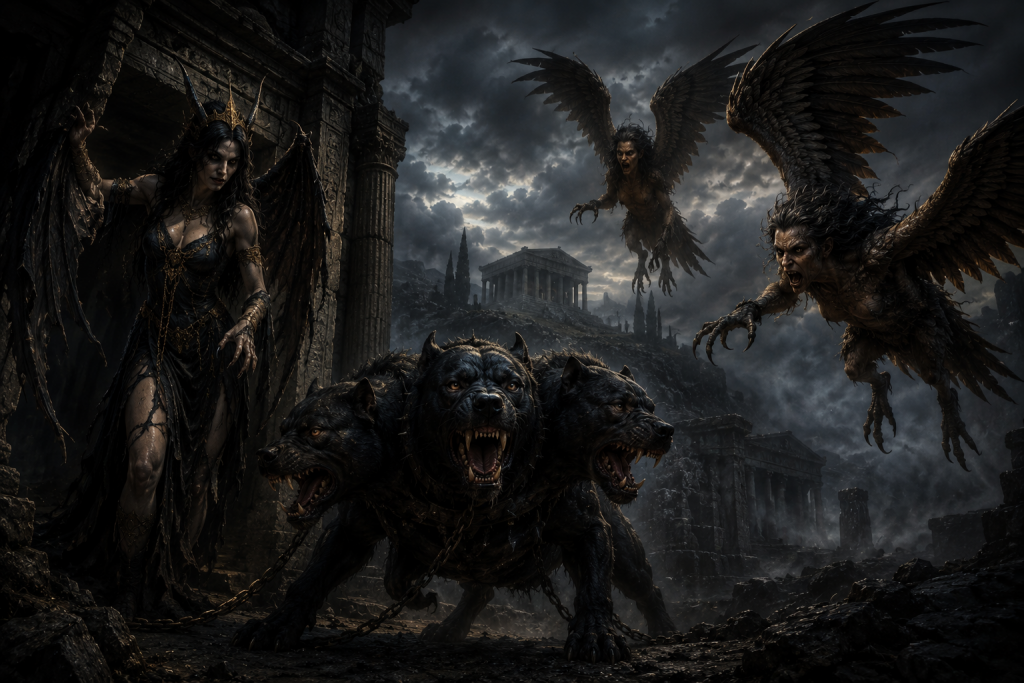
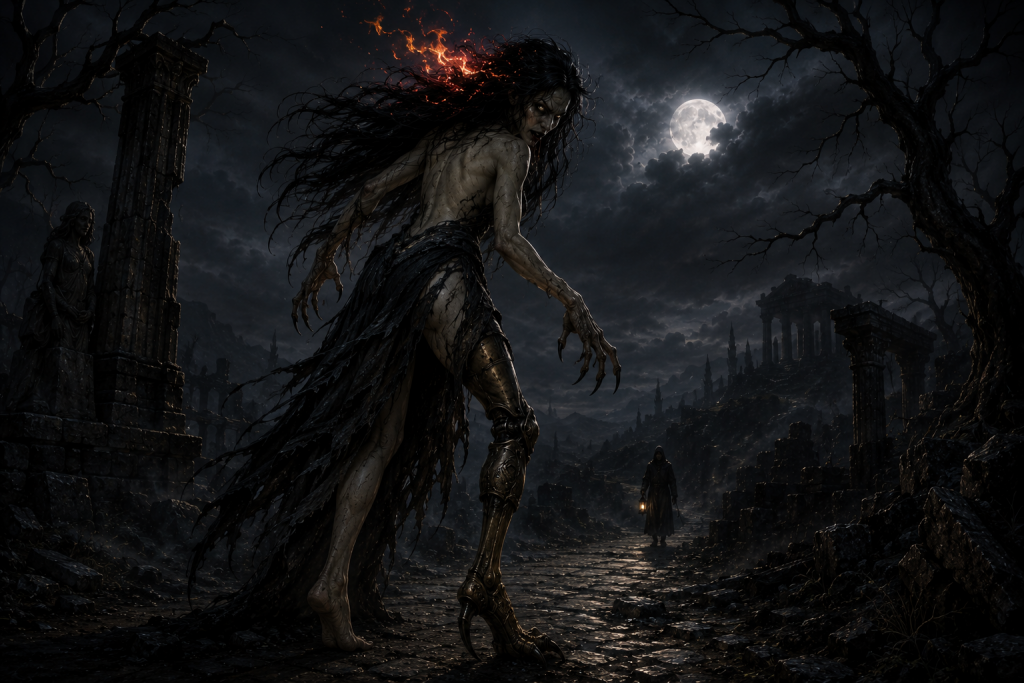
The Telchines are one of the most enigmatic figures in Greek mythology, a group of supernatural craftsmen who inhabited the island of Rhodes before the gods, who were the first smiths and the first sorcerers, who made the weapons of the Olympians including Poseidon’s trident, and who were destroyed by Zeus when their power and their malice became intolerable. They sit at the boundary between the divine and the monstrous, between the useful and the dangerous, in a way that makes them impossible to categorise cleanly as either heroes or villains.
The ancient sources on the Telchines are fragmentary and contradictory, which is characteristic of traditions that predate the standardisation of Greek mythology in the classical period. They were known to the archaic Greeks as the original inhabitants of Rhodes, Crete, and Cyprus, the pre-Olympian craftsmen whose skills with metal and magic preceded and enabled the divine order that replaced them. They were simultaneously admired for their craft and feared for their sorcery, and their destruction by Zeus was understood as both a purification and a loss.
What They Were
The Telchines’ physical description varies by source but consistently emphasises their hybrid nature: they had the flippers or hands of dogs, or the bodies of fish, or webbed fingers, or some combination of human and marine characteristics that placed them in the same boundary category as other pre-Olympian beings who inhabit the space between the human, the divine, and the natural world. This marine quality connects them to the sea that surrounds their island home and positions them as beings of the deep rather than of the sunlit Olympian world.
Their craft skills were extraordinary by any standard. The tradition credits them with founding metallurgy, with being the first to work iron and bronze, with creating the divine weapons that the Olympians used to establish their power. Poseidon’s trident, which he used to rule the seas and to cause earthquakes, was made by the Telchines. The sickle with which Cronus castrated Uranus was in some traditions a Telchines creation. The craftsmen who made the tools of cosmic transformation were themselves pre-cosmic beings, which gives their destruction a specific tragic quality: they made the weapons that established the order that excluded them.
The Sorcery and the Destruction
The Telchines’ malicious use of their supernatural abilities is the justification given in ancient sources for their destruction. They were said to have the evil eye in a particularly potent form. They mixed the waters of the Styx with sulphur and used the mixture to blight crops and poison animals. They could change their forms at will. And they were jealous of their knowledge, refusing to teach their craft to others, which in the tradition of divine craftsmen who are expected to share their skills with humanity was itself a transgression.
Zeus destroyed them with a flood, or with lightning, or drove them from Rhodes before the destruction, depending on the source. Some traditions describe them escaping to various locations — Lycia, Orchomenos, Ceos — where their malign influence continued in attenuated form. Others describe their complete destruction. The inconsistency reflects the genuine ambivalence of the tradition about whether the Telchines deserved what happened to them.
Further Reading
If this article sparked your interest, these are the books worth reading next.
The Iliad — Homer (Penguin Classics)
by Homer — the primary source for everything in this article, and still the most vivid account of the Trojan War ever written.
The Odyssey — Homer (Emily Wilson translation)
by Homer, translated by Emily Wilson — the best modern English translation, and the book that contains Odysseus’s own account of the horse.
The Trojan War: A Very Short Introduction
by Eric Cline — the clearest and most up to date account of what archaeology actually tells us about Troy and whether any of it happened.
For more on the folklore and mythology of Greece, the Hephaestus article covers the Olympian craftsman god who replaced the Telchines as the divine smith. The Kallikantzaroi article covers the other pre-human supernatural beings of Greek tradition. The Greece folklore hub page has every article in the cluster.
Never miss a myth
Thank you for being here. The site is brand new and every subscriber genuinely means something to me. If you're here, you care about this stuff as much as I do - and that's all the reason I need to keep going. New stories, videos and dark folklore from around the world, straight to your inbox. No algorithm. Just the stories, when they're ready.