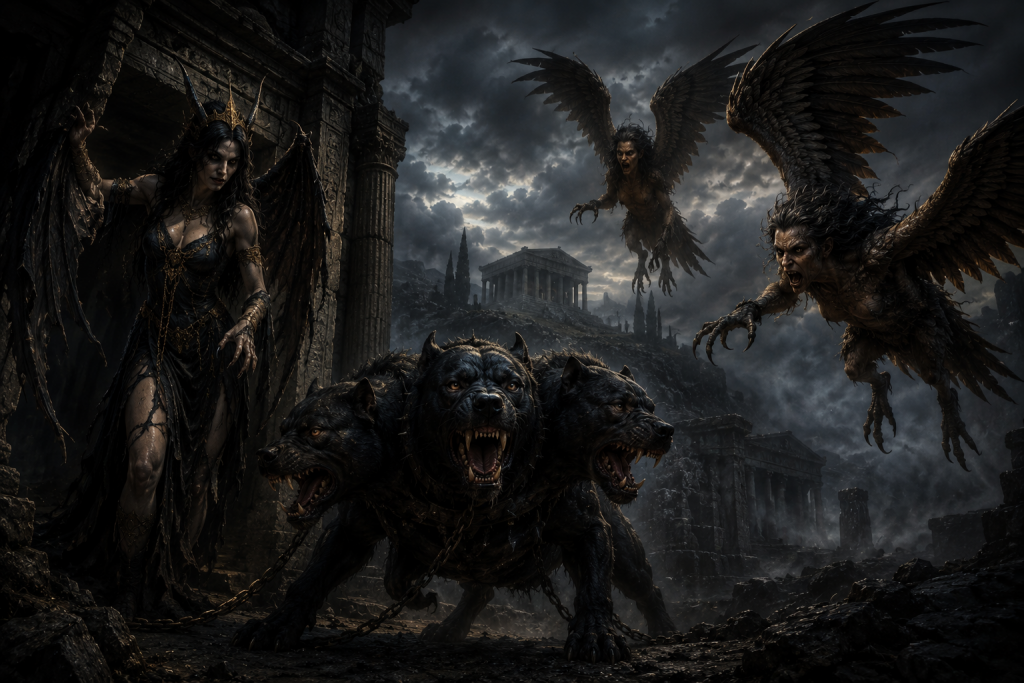
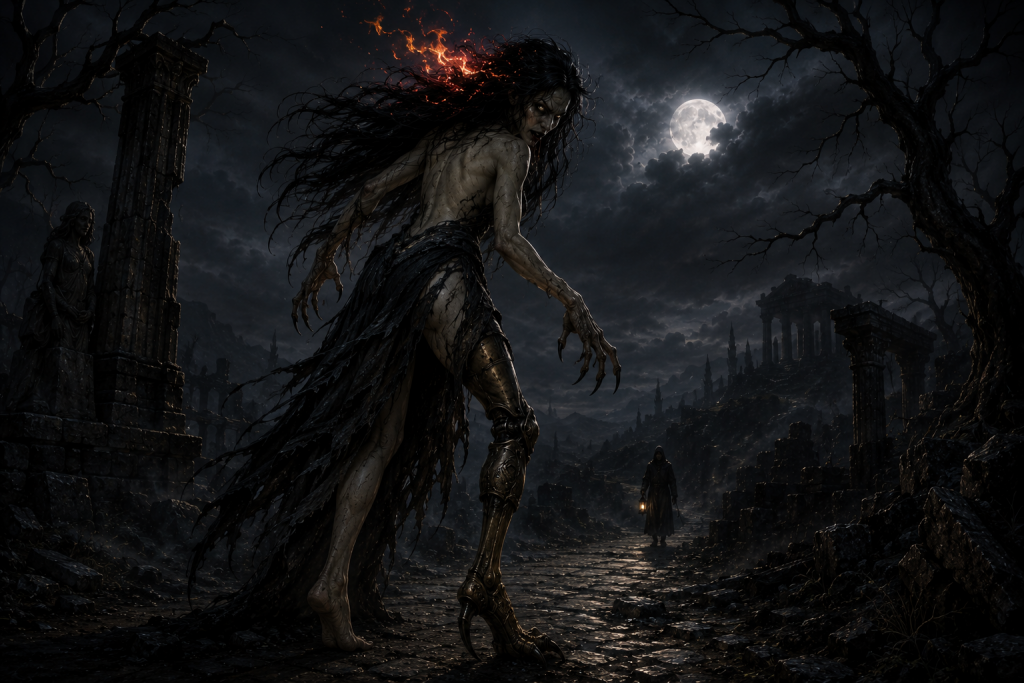
The Drakos of Greek folk tradition is a very different creature from the serpentine monsters of ancient Greek mythology. Where the ancient tradition’s dragon figures — the Hydra, the dragon at Colchis, the serpent of the Garden of the Hesperides — are primarily serpentine and primarily obstacles for heroes to overcome, the folk Drakos is a giant humanoid being of enormous size and strength who inhabits caves in the mountains, guards treasure, and has a complicated relationship with human communities that ranges from predatory to occasionally protective.
The folk Drakos is shaped as much by the Byzantine period and by the influence of Near Eastern traditions as by the ancient Greek dragon tradition. He is enormous, sometimes twelve times the size of a man, and his strength is proportionate. He can throw boulders, uproot trees, and move through the landscape in ways that make him a force of nature as much as a specific supernatural being. He is often depicted as primitive and not entirely intelligent, which gives the human heroes who defeat him in the tradition an advantage that compensates for the vast difference in physical power.
The Drakos and the Hero
The Greek folk tales involving the Drakos follow a consistent structure that mirrors the hero tale structure of the ancient tradition while updating it for the folk context. A young man, often the youngest of three brothers and therefore the least expected to succeed, encounters a Drakos who is threatening a community, devouring its people, or holding a princess captive in his cave. The hero defeats the Drakos through some combination of physical courage, supernatural assistance, and the specific intelligence that the tradition rewards: finding the weak point, exploiting the giant’s pride or greed, using a weapon or a trick that overcomes the size disadvantage.
The Drakos’s weakness is typically located in a specific physical detail: his one vulnerable spot, his dependence on a specific object that contains his strength, his inability to resist a specific challenge to his pride. The hero who identifies and exploits this weakness wins. The hero who attempts to defeat the Drakos by strength alone loses.
The Treasure Guardian
The Drakos as treasure guardian connects him to the broader European dragon tradition in which dragons are associated with hoarded wealth. In the Greek folk tradition this treasure guardian function often combines with the Moira concept of fate: the treasure guarded by the Drakos is destined for a specific person, and only that person can take it, which means that failed attempts to steal the treasure are not simply failures of courage or skill but premature attempts by the wrong person at the wrong time.
The caves in the Greek mountains where the Drakos is said to live are real places that communities identified with the tradition. The Peloponnese, Epirus, and the larger Greek islands all have specific cave systems associated with Drakos legends, and the folk tales attached to those locations have a geographical specificity that suggests genuine local tradition rather than imported narrative.
The Drakos and the Church
The Christianisation of the Drakos tradition produced an interesting hybrid: the folk dragon who is defeated not by a hero but by a saint. Saint George is the most obvious example, but Greek Orthodox tradition includes multiple saints who defeated dragons or Drakos figures in specific locations, and the local saints’ legends often attached themselves to specific caves and specific geographical features that already had Drakos associations in the pre-Christian tradition.
Further Reading
If this article sparked your interest, these are the books worth reading next.
The Iliad — Homer (Penguin Classics)
by Homer — the primary source for everything in this article, and still the most vivid account of the Trojan War ever written.
The Odyssey — Homer (Emily Wilson translation)
by Homer, translated by Emily Wilson — the best modern English translation, and the book that contains Odysseus’s own account of the horse.
The Trojan War: A Very Short Introduction
by Eric Cline — the clearest and most up to date account of what archaeology actually tells us about Troy and whether any of it happened.
For more on the folklore of Greece, the Telchines article covers the other pre-human supernatural craftsmen of Greek tradition. The Stoicheio article covers the building spirit whose tradition also involves sacrifice and supernatural power. The Greece folklore hub page has every article in the cluster.
Never miss a myth
Thank you for being here. The site is brand new and every subscriber genuinely means something to me. If you're here, you care about this stuff as much as I do - and that's all the reason I need to keep going. New stories, videos and dark folklore from around the world, straight to your inbox. No algorithm. Just the stories, when they're ready.