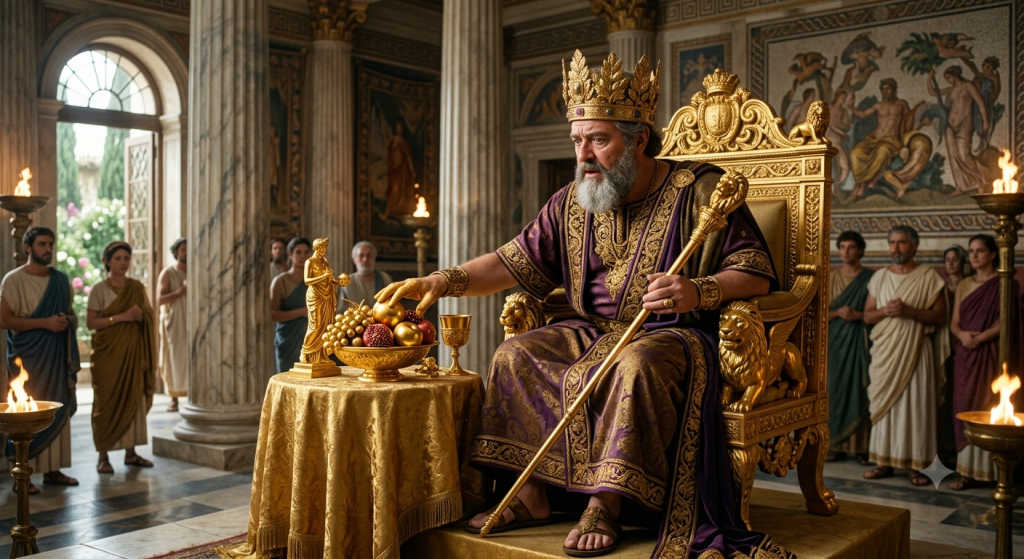
King Midas appears in two separate Greek myths that are not directly connected to each other but that between them cover the two things the tradition most wants to say about him: that he made a wish that destroyed everything good in his life, and that he made a judgment that earned him the ears of a donkey. Both stories concern a failure of wisdom rather than a failure of virtue, and both concern a man who should have known better and did not.
The golden touch is the more famous of the two, and the one that has entered the language as a phrase for someone who turns everything to profit. The original myth is about someone who turned everything to uselessness, which is a different thing entirely.
The Golden Touch
Silenus, the companion and tutor of Dionysus, was found drunk and wandering in Midas’s rose garden. Midas had him brought in, treated hospitably for ten days, and then returned him to Dionysus. The god, grateful for the care shown to his companion, offered Midas any wish. Midas asked that everything he touched be turned to gold.
Dionysus granted the wish with what the tradition implies was a certain awareness of what it would produce. Everything Midas touched became gold: the branches he picked up, the stones underfoot, the food he tried to eat, the water he tried to drink. He could not eat. He could not drink. He was surrounded by gold and dying of thirst and hunger.
He prayed to Dionysus to take back the gift. Dionysus told him to wash in the source of the River Pactolus near Sardis, and the gift would wash away into the river. He did, and it did, and the River Pactolus ran with gold-bearing sands thereafter, which is why the Lydian kingdom was historically so wealthy: the myth explains an observable geographical fact about a gold-bearing river in western Anatolia.
The story encodes a precise observation about desire: the things we most want tend to be things whose value depends on their being limited and scarce. Food is desirable because it is not gold. Water is desirable because it is not gold. Gold is desirable because most things are not gold. Midas was granted the wish that revealed the logical endpoint of the desire for gold, and the endpoint was that gold became worthless because it was everything.
The Donkey Ears
The second Midas myth concerns his role as judge in a musical contest between Apollo and Pan. Pan claimed his pipes were superior to Apollo’s lyre. The mountain god Tmolus judged the contest and awarded it to Apollo. Midas, who was present, said he preferred Pan’s music.
Apollo gave him the ears of a donkey, appropriate for someone with such poor musical judgment. Midas hid the ears under a large turban and told no one. His barber, who had to know, was sworn to secrecy on pain of death. The secret was too much to keep: the barber dug a hole in a riverbank, whispered the secret into it, and filled the hole back in. Reeds grew from the hole, and when the wind blew through them they whispered that Midas had donkey’s ears, and the secret was out.
The detail of the whispering reeds is one of the most beautifully constructed images in the tradition: a secret told to the earth that the earth cannot keep, a truth that works its way back to the surface through the natural world regardless of human efforts to contain it. The barber’s inability to bear the secret, the hole dug in secret to receive it, the reeds that grow and speak anyway: it is a myth about the impossibility of keeping certain truths suppressed, and it uses the simplest natural imagery to make the point.
Midas in History
There was a historical King Midas of Phrygia, who ruled in the late eighth century BCE and is mentioned in Assyrian sources as Mita of Mushki. He is associated with extraordinary wealth, which is consistent with Phrygia’s position on major trade routes and with the gold-bearing sands of the River Pactolus that the myth explains. He was said to have been the first non-Greek king to make a dedication at Delphi.
The relationship between the historical Midas and the mythological one is one of those intersections that Greek mythology regularly produces: a real wealthy king becomes the subject of stories about the nature of wealth, and the stories illuminate the historical reality while departing from it in every specific detail. The historical Midas was rich. The mythological Midas explains what wealth means when you think it through to its conclusion.
Further Reading
If this article sparked your interest, these are the books worth reading next.
The Iliad — Homer (Penguin Classics)
by Homer — the primary source for everything in this article, and still the most vivid account of the Trojan War ever written.
The Odyssey — Homer (Emily Wilson translation)
by Homer, translated by Emily Wilson — the best modern English translation, and the book that contains Odysseus’s own account of the horse.
The Trojan War: A Very Short Introduction
by Eric Cline — the clearest and most up to date account of what archaeology actually tells us about Troy and whether any of it happened.
For more on the Greek tradition, the Dionysus article covers the god who granted Midas the golden touch and who knew exactly what granting it would mean. The Apollo article covers the god whose musical contest Midas judged incorrectly and whose response was characteristically disproportionate. The Greek Mythology hub page has every article in the cluster.
Never miss a myth
Thank you for being here. The site is brand new and every subscriber genuinely means something to me. If you're here, you care about this stuff as much as I do - and that's all the reason I need to keep going. New stories, videos and dark folklore from around the world, straight to your inbox. No algorithm. Just the stories, when they're ready.