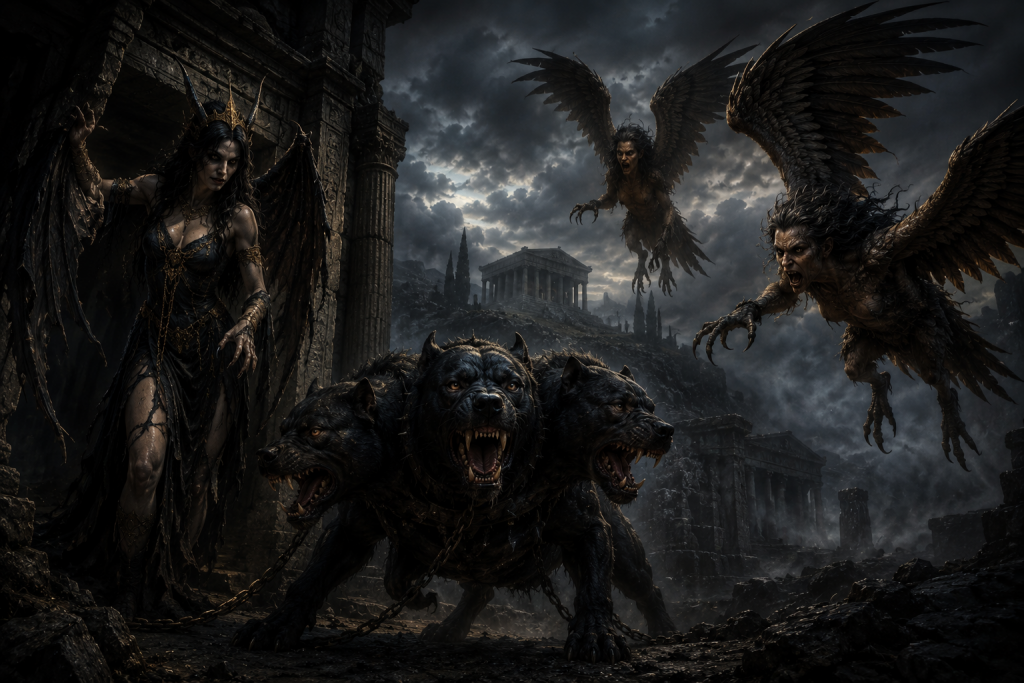
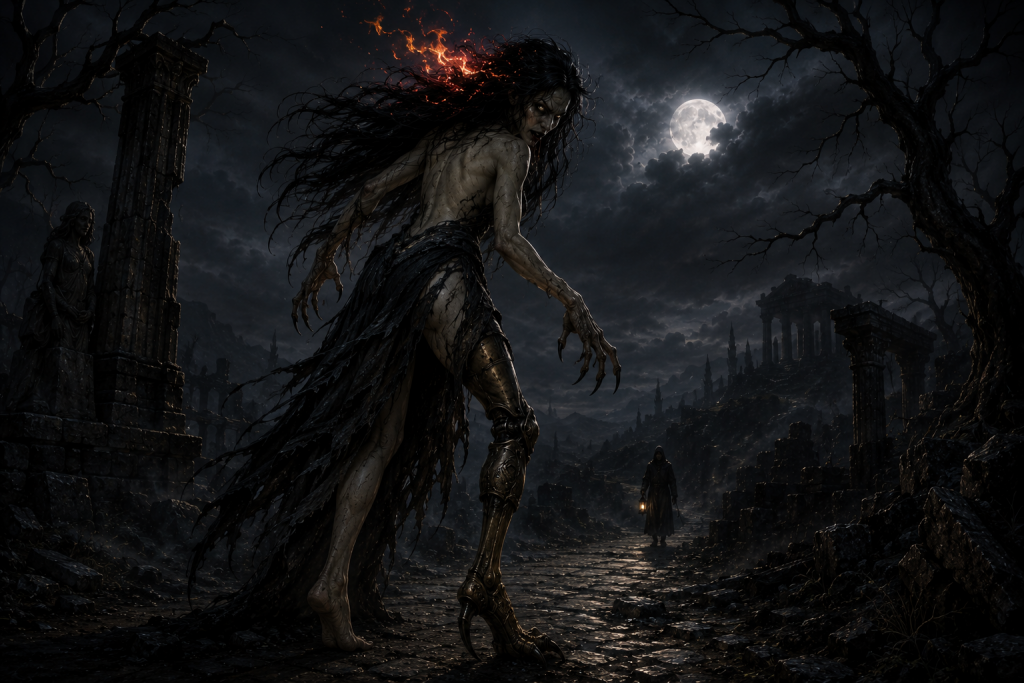
Scylla is one of the most precisely described monsters in Greek mythology. She has twelve feet, six necks, each neck bearing a head with three rows of teeth, and she lives in a cave in a cliff above the sea, reaching down with her heads to snatch sailors from passing ships. She does not pursue. She does not chase. She simply waits in her cave and takes what passes within reach, and the ships that sail the straits where she lives must pass close enough that she will always take something.
Homer describes her in the Odyssey with a specificity that is unusual even by the tradition’s standards. Circe tells Odysseus exactly what he will find, exactly what she looks like, exactly what she will do. There is no way to fight her. There is no trick that works against her. The best strategy, Circe says, is to row past as fast as possible, accept that she will take six men, and not stop to fight because stopping will cost more than six. Odysseus follows this advice. She takes six of his best men. He watches it happen and cannot prevent it.
What She Was Before
Scylla was not always a monster. The tradition gives her two possible origins depending on the source, and both involve her being transformed from something else into what she became.
In Ovid’s account, she was a beautiful sea nymph loved by the sea god Glaucus. Glaucus had himself been transformed from a mortal fisherman into a sea deity when he ate a magical herb, and his transformation had left him with an obsessive nature that focused entirely on Scylla. When she rejected him, he went to Circe for a love potion. Circe, who desired Glaucus herself, poisoned the pool where Scylla bathed instead. When Scylla entered the water, the lower half of her body transformed into the dogs and serpents that define her monstrous form.
In other accounts, Scylla was transformed by Amphitrite, wife of Poseidon, who was jealous of Poseidon’s interest in her. The mechanism differs but the structure is the same: a beautiful woman transformed into a monster through the jealousy of a more powerful female figure, punished for being desired rather than for anything she chose to do.
Is Scylla Immortal? What Happened to Her?
This is the question the tradition answers least clearly, and it is worth being direct about the ambiguity rather than inventing a false certainty.
Within the Odyssey itself, Scylla is not killed. Odysseus passes through the straits twice: once on the way to the underworld, when she takes six men, and once on the return after the cattle of Helios episode, when the text implies the ship passes through again. She is not defeated, not tricked, not driven away. She simply is, a permanent feature of the straits, and the ships that use those waters accept the cost.
Heracles is said in some traditions to have killed her after she stole some of his cattle, and her father Phorcys is said to have restored her to life afterward. This suggests that even within the tradition she is not straightforwardly mortal in the way that human characters are: she can be killed but she can also be restored, which places her outside the ordinary category of beings who die once and stay dead.
The most honest answer is that Scylla does not die in any source that has wide acceptance in the tradition. She exists at the straits. She is there when Odysseus passes. She is implied to still be there when he passes again. What happened to her after the mythological period closes is not recorded because the tradition did not feel the need to resolve it.
The Cave and the Geography
The straits where Scylla lives have been identified by ancient and modern commentators with the Strait of Messina between Sicily and the Italian mainland, where the Charybdis whirlpool has been identified with a real tidal phenomenon and Scylla with the rocky promontory on the Italian side. The ancient city of Rhegium on the Italian coast was close to where tradition placed her cave, and the name Scyllaeum was applied to the headland there in antiquity.
Whether Homer had a specific geography in mind or whether the identification was a later rationalisation by people trying to map mythological events onto real landscapes is a question the sources do not resolve. What is consistent is the cliff, the cave, and the specific height from which Scylla reaches down: high enough that the ships below cannot reach her, low enough that her necks can reach the ships.
The Dogs
Scylla’s lower body is ringed with dogs’ heads that bark continuously, and this detail is one of the most discussed in the tradition because it seems strange even by the standards of Greek monsters. Most hybrid creatures in Greek mythology combine human and animal forms in ways that have symbolic logic: the Minotaur combines human intelligence with animal strength, the Centaurs combine human culture with animal instinct. The dogs around Scylla’s waist are harder to rationalise.
Some scholars have suggested that the barking dogs represent the noise of dangerous rocks and surf, the sound that sailors in a narrow strait would hear as a constant threatening presence. Others have suggested the dogs connect her to Hecate, the goddess of magic and crossroads who was also associated with dogs, and who appears in the versions of the myth involving Circe’s poisoning. The connection is not established by the sources but it is consistent with them.
Further Reading
If this article sparked your interest, these are the books worth reading next.
The Iliad — Homer (Penguin Classics)
by Homer — the primary source for everything in this article, and still the most vivid account of the Trojan War ever written.
The Odyssey — Homer (Emily Wilson translation)
by Homer, translated by Emily Wilson — the best modern English translation, and the book that contains Odysseus’s own account of the horse.
The Trojan War: A Very Short Introduction
by Eric Cline — the clearest and most up to date account of what archaeology actually tells us about Troy and whether any of it happened.
For more on the Odyssey tradition, the Charybdis article covers the whirlpool that Odysseus must navigate alongside Scylla and that poses the opposite kind of threat: not precision destruction but total consumption. The Circe article covers the sorceress who tells Odysseus what to expect and who is connected to Scylla’s origin in several versions. The Greek Mythology hub page has every article in the cluster.
Never miss a myth
Thank you for being here. The site is brand new and every subscriber genuinely means something to me. If you're here, you care about this stuff as much as I do - and that's all the reason I need to keep going. New stories, videos and dark folklore from around the world, straight to your inbox. No algorithm. Just the stories, when they're ready.