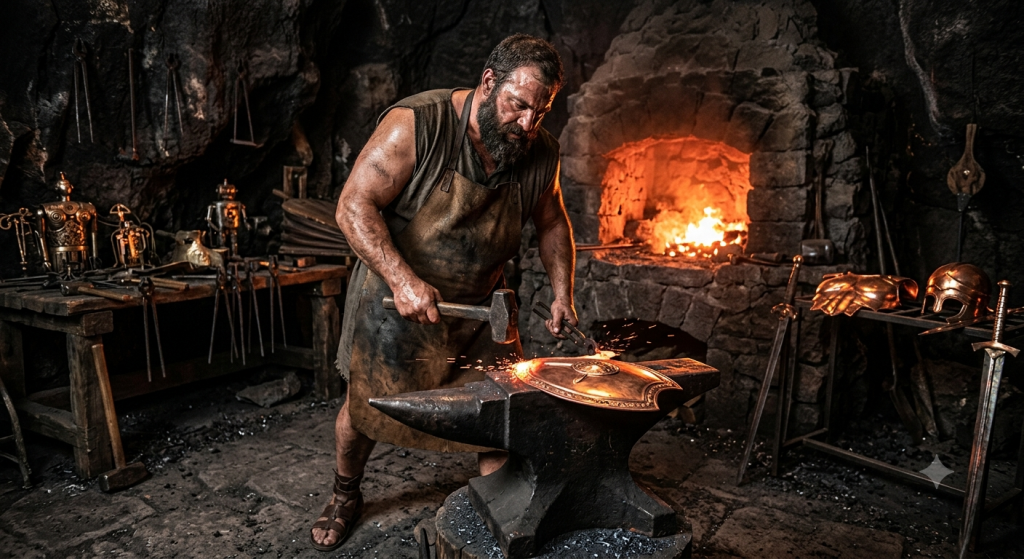
Hephaestus is the god of fire and the forge, the divine craftsman of the Greek pantheon, and the maker of almost every significant magical object in the mythology. The armour of Achilles. The palace of the gods on Olympus. Aphrodite’s girdle. The net that caught Ares and Aphrodite in bed. The chains that bound Prometheus. Pandora herself. The automaton bronze giant Talos who guarded the island of Crete. The winged helmet and sandals of Hermes. The thunderbolts of Zeus.
He is also the only Olympian who is physically imperfect, the only one who works with his hands, and the one most consistently treated as an outsider on Olympus despite being the son of two of the most powerful gods in the tradition. He is married to the most beautiful goddess and she is faithful to nobody. He is the maker of the most beautiful things in the cosmos and he is himself the least physically beautiful of the gods. The tradition holds these contradictions without resolving them because it understood that the capacity to create beauty has nothing to do with possessing it.
The Lame God and How He Got That Way
Two separate traditions explain why Hephaestus is lame, and they cannot both be true, which the tradition is not particularly concerned about. In one version, Hera threw him from Olympus because he was born lame and she was disgusted by his imperfection. He landed on the island of Lemnos and was raised by the people there. In the other, he was thrown from Olympus by Zeus during a quarrel in which he had taken Hera’s side, fell for an entire day, and landed on Lemnos with his legs broken by the impact.
Homer uses both versions at different points in the Iliad without apparent awareness of the contradiction, which tells you something about how the oral tradition that produced Homer worked: the stories that survived were the ones that worked in their particular context, not the ones that were consistent with other stories. The lame god is what matters, not precisely how he became lame.
His lameness in the tradition is associated with the fire of the forge: the metalsmith who works close to extreme heat, who stands in one place for long periods working with his hands, who may have injured legs from early childhood in a culture where childhood injuries could produce permanent disability without adequate treatment. The god is shaped by his craft in the same way that craftspeople are shaped by theirs.
The Revenge on Hera
Hephaestus’s most celebrated act of revenge in the mythology is the golden throne he made for Hera. It was beautiful, perfectly constructed, and when Hera sat in it the invisible bonds sprang and held her completely immobile. None of the other gods could free her. Hephaestus refused to come to Olympus when summoned. Dionysus got him drunk and brought him back on a mule, which is one of the more entertaining images in the tradition: the divine craftsman being returned to Olympus drunk on a mule to release his mother from the trap he had built for her.
The story is presented with evident enjoyment in the ancient sources, and it characterises Hephaestus precisely: he cannot defeat Hera in direct confrontation, but he can outthink her completely, building the revenge into the most beautiful gift imaginable and waiting for her to spring it herself.
The Workshop and What It Produced
Hephaestus’s workshop is described in the Iliad when Thetis comes to ask him to make new armour for Achilles. He is working with twenty bellows simultaneously, all operated by golden automata he has built to assist him. The workshop is a technological marvel: a god whose power is intelligence and craft rather than strength or authority, who has built mechanical assistants to extend his capabilities. The description of the Shield of Achilles that he then makes for Thetis is the most extended ekphrasis in Homer, a description of a work of art embedded in the narrative, covering scenes of city life in peace and war, agriculture, dancing, and the ocean, all contained in the decoration of a single shield.
The shield is the clearest statement in Homer of what Hephaestus actually is: the god who can contain the entire human world in a work of art, who sees everything and can render it in bronze and gold and tin and silver. The armour does not save Achilles, who knows when he accepts it that it is the armour of a man going to his death. But it is the most beautiful armour ever made, and that is what Hephaestus provides: not salvation but the finest possible expression of what the human and divine worlds can produce together.
Further Reading
If this article sparked your interest, these are the books worth reading next.
The Iliad — Homer (Penguin Classics)
by Homer — the primary source for everything in this article, and still the most vivid account of the Trojan War ever written.
The Odyssey — Homer (Emily Wilson translation)
by Homer, translated by Emily Wilson — the best modern English translation, and the book that contains Odysseus’s own account of the horse.
The Trojan War: A Very Short Introduction
by Eric Cline — the clearest and most up to date account of what archaeology actually tells us about Troy and whether any of it happened.
For more on the Greek tradition, the Aphrodite article covers the wife whose infidelity Hephaestus caught in the invisible net. The Achilles article covers the hero for whom Hephaestus forged the most celebrated armour in mythology. The Greek Mythology hub page has every article in the cluster.
Never miss a myth
Thank you for being here. The site is brand new and every subscriber genuinely means something to me. If you're here, you care about this stuff as much as I do - and that's all the reason I need to keep going. New stories, videos and dark folklore from around the world, straight to your inbox. No algorithm. Just the stories, when they're ready.