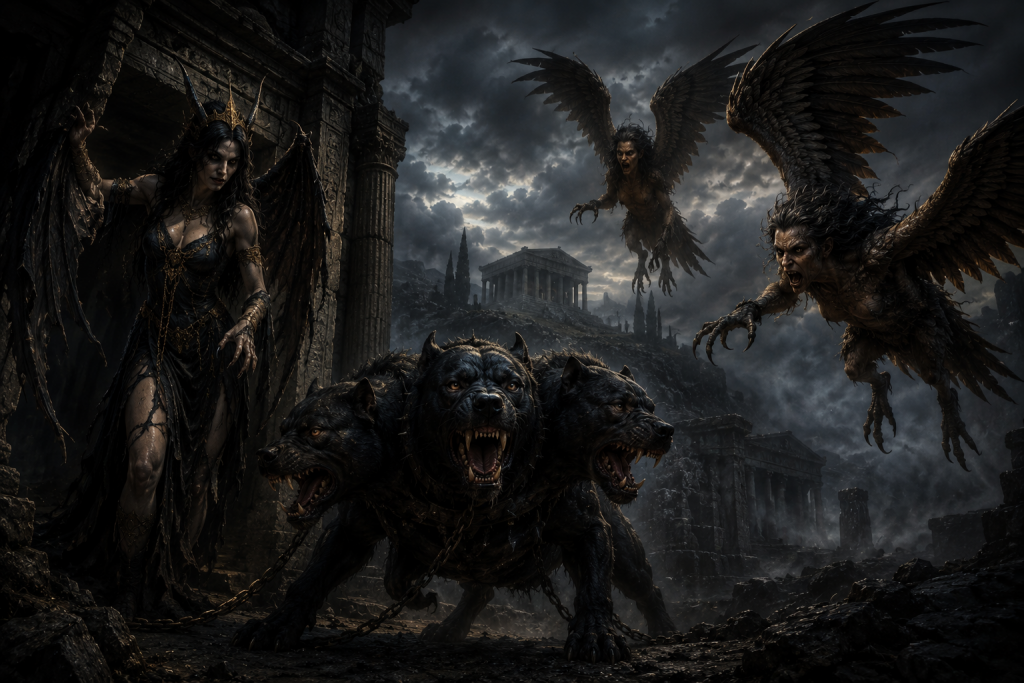
Prometheus is the most politically interesting figure in Greek mythology. He is a Titan who sided with the Olympians against his own kind in the Titanomachy, and then sided with humanity against the Olympians when Zeus decided that humans should be kept ignorant and weak. He stole fire from the gods and gave it to humans. For this he was chained to a rock in the Caucasus Mountains and had his liver eaten by an eagle every day, the liver regenerating each night so the eagle could eat it again the following morning.
He held out. Zeus offered him freedom in exchange for the information Prometheus possessed about a prophecy that would overthrow Zeus. Prometheus refused. He was still chained when Heracles passed by on one of his labours and killed the eagle and freed him, which Zeus permitted partly because it gave Heracles glory and partly because the two sides had reached an accommodation by that point. But Prometheus endured the punishment for as long as the tradition needed him to, which is a very long time.
The Name and What It Means
Prometheus means forethought. His brother Epimetheus means afterthought. The names encode their characters with precision: Prometheus acts from foresight, understanding the consequences of his actions before he takes them, which makes his choice to steal fire a deliberate and fully informed decision rather than an impulsive one. He knew what it would cost him. He did it anyway. Epimetheus acts and then thinks, which is why he accepted Pandora despite Prometheus’s explicit warning not to accept gifts from Zeus.
The two brothers are complementary in the tradition rather than simply contrasting: Prometheus provides the forethought that makes civilisation possible, Epimetheus provides the afterthought that makes the human condition necessary. Both are required.
The Fire and What It Meant
The fire Prometheus stole is not simply warmth and cooking. In the Greek tradition, fire is the technology that distinguishes human life from animal life: it enables metalworking, which enables tools and weapons, which enables agriculture and war and the whole machinery of civilisation. Prometheus gave humanity the capacity for civilised life by giving them fire, and Zeus’s opposition to this was not simply petty jealousy but a genuine theological position about the proper relationship between gods and humans.
The Hesiodic tradition presents Zeus as wanting humans to remain dependent and ignorant, offering the gods sacrifice without receiving too much in return. Prometheus disrupted this arrangement from the beginning: at Mecone, where gods and humans were dividing the sacrificial animal, Prometheus arranged the division to favour humans by hiding the good meat under the stomach lining and making the bones look attractive wrapped in fat. Zeus chose the bones and was outraged when he understood the trick, which is the event that precipitated the withholding of fire and then the theft.
The Punishment
Zeus had Hephaestus chain Prometheus to a rock in the Caucasus, with adamantine chains that could not be broken by mortal or divine strength. Each day an eagle, sometimes said to be a son of Typhon, flew to the rock and ate Prometheus’s liver. Each night the liver regenerated. The punishment was designed to be eternal, which was a genuine theological possibility for an immortal Titan: he could not die of the wound, could not become accustomed to it, could only endure it indefinitely.
Aeschylus’s Prometheus Bound, one of the earliest surviving Greek tragedies, places Prometheus on the rock and has him receive various visitors including Hermes, who comes to demand the prophetic knowledge Prometheus possesses in exchange for freedom. Prometheus refuses with a consistency and a dignity that makes him one of the most admirable figures in Greek tragedy: he is not defiant for its own sake but because he knows he is right and Zeus is wrong, and he will not trade that knowledge for comfort.
The Prophecy
What Prometheus knew was this: Zeus was fated to be overthrown by a son born of a sea nymph, just as Cronos had been overthrown by Zeus and Ouranos by Cronos. The sea nymph in question was Thetis, who Zeus desired. If Zeus had pursued Thetis and fathered a child on her, that child would have overthrown him. Instead, Zeus arranged for Thetis to marry the mortal Peleus, and their son was Achilles, who was a great hero rather than a threat to divine order.
Prometheus possessed this knowledge and refused to share it until Zeus came to terms. The eventual accommodation involved Prometheus being freed by Heracles and the prophecy being resolved through Thetis’s marriage to Peleus rather than to Zeus. Both parties got something: Zeus got the information he needed to avoid being overthrown, and Prometheus got his freedom and the satisfaction of having held out long enough to negotiate rather than simply submit.
Prometheus in Later Tradition
Prometheus became one of the most widely discussed figures in the Western tradition precisely because his myth articulates a genuinely difficult question: is it right to defy divine authority on behalf of humanity? The Romantic tradition adopted him as the archetype of creative rebellion: Shelley’s Prometheus Unbound, Byron’s invocations, Mary Shelley’s subtitle for Frankenstein, or the Modern Prometheus. The figure of the creator who is punished for what he creates, who suffers for his gift to humanity, resonated across two centuries of Romantic literature in ways that the Greek tradition had not anticipated but that the myth entirely supports.
Further Reading
If this article sparked your interest, these are the books worth reading next.
The Iliad — Homer (Penguin Classics)
by Homer — the primary source for everything in this article, and still the most vivid account of the Trojan War ever written.
The Odyssey — Homer (Emily Wilson translation)
by Homer, translated by Emily Wilson — the best modern English translation, and the book that contains Odysseus’s own account of the horse.
The Trojan War: A Very Short Introduction
by Eric Cline — the clearest and most up to date account of what archaeology actually tells us about Troy and whether any of it happened.
For more on the Greek tradition, the Zeus article covers the god who punished Prometheus and whose throne the prophesied son would have threatened. The Pandora article covers the punishment Zeus sent to humanity after Prometheus’s theft, and the brother who accepted her despite the warning. The Greek Mythology hub page has every article in the cluster.
Never miss a myth
Thank you for being here. The site is brand new and every subscriber genuinely means something to me. If you're here, you care about this stuff as much as I do - and that's all the reason I need to keep going. New stories, videos and dark folklore from around the world, straight to your inbox. No algorithm. Just the stories, when they're ready.