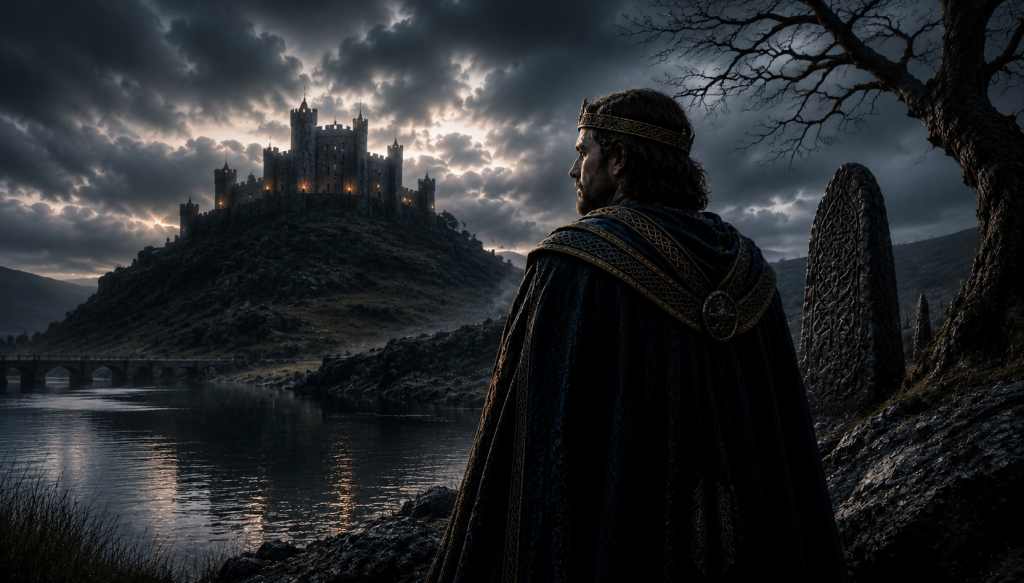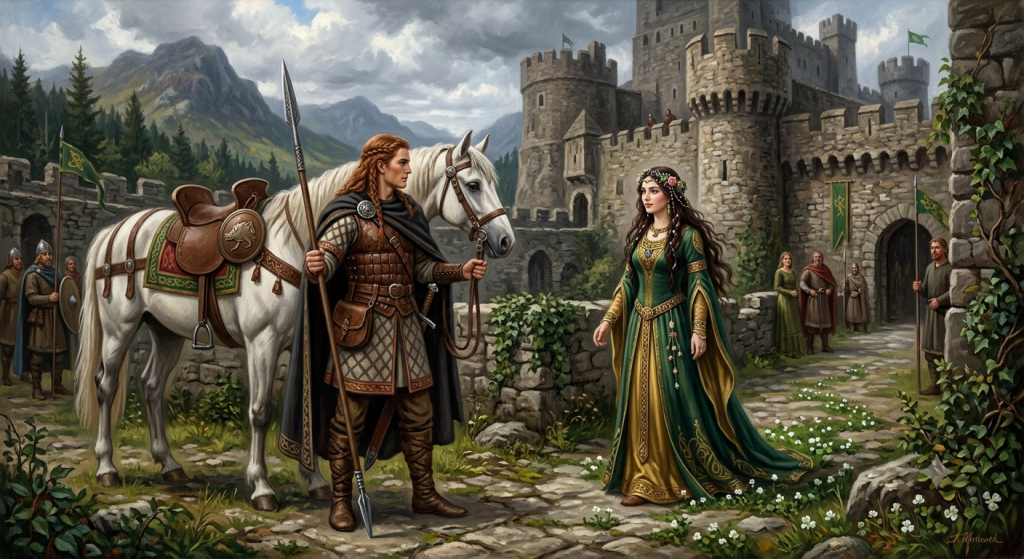
Culhwch and Olwen is the oldest Arthurian narrative in any language. It predates Geoffrey of Monmouth’s Historia Regum Britanniae, which shaped the Arthurian tradition most people know, by at least a century, and it shows Arthur in a form so different from the courtly king of later tradition that readers familiar only with Malory or Tennyson might struggle to recognise him. He is a warrior chieftain, fierce and generous, leading a band of extraordinary individuals with supernatural abilities, called on by his cousin to help accomplish a quest that requires the completion of thirty-nine impossible tasks set by a giant.
The tale is found in both the White Book of Rhydderch and the Red Book of Hergest, the manuscripts that preserve the Mabinogion, and it is generally dated to the late eleventh century in its current form, though the material it draws on is older. It is one of the longest and most exuberant pieces of early Welsh prose, full of catalogues and lists and episodes that seem to spiral out from the central quest in every direction before being pulled back.
The Curse and the Quest
Culhwch’s mother died when he was born. His father remarried. His stepmother learned from a prophecy that her stepdaughter was destined to marry Culhwch, which she did not want, and so she placed a destiny on Culhwch instead: he would never marry any woman except Olwen, daughter of Ysbaddaden Pencawr, the Chief Giant.
This was intended as a curse, because anyone who sought Olwen from her father was killed. But Culhwch heard the name Olwen and fell so completely in love with a woman he had never seen that he could think of nothing else. He went to the court of his cousin Arthur to ask for help, invoking Arthur’s generosity by naming every person at his court one by one in a long and magnificent catalogue that is one of the set pieces of early Welsh literature.
Arthur sent six of his best men with Culhwch to find Olwen. They found her, and she was everything the prophecy had suggested: her hair was yellower than the flowers of the broom, her skin whiter than sea foam, her fingers were whiter than the buds of the wood anemone, wherever she walked four white trefoils sprang up behind her. She told Culhwch that she could not go with him unless her father gave his consent, and that her father would not give consent to anything asked of him, but that he must ask anyway and promise to accomplish whatever tasks were set.
Ysbaddaden and the Thirty-Nine Tasks
Ysbaddaden Pencawr’s eyelids were so heavy that they had to be propped up with forks before he could see. He had another characteristic: every time anyone came to ask for Olwen, he threw poisoned spears at them as they left. Culhwch and his companions came three times, were hit by the spears each time, returned the spears each time, and on the third visit Ysbaddaden set out his conditions.
There were thirty-nine tasks, and they were genuinely impossible in the sense that each one depended on something that could only be obtained through another impossible task. The great hunt for the boar Twrch Trwyth, for instance, was required to obtain a razor and scissors and comb from between his ears, which were needed to cut and dress Ysbaddaden’s hair for the wedding. But to hunt the Twrch Trwyth required specific hounds and a specific leash and a specific huntsman, each of which required other specific things in turn.
The tasks form a web of dependencies that the tale untangles by having Arthur and his warband accomplish them one by one, each accomplishment enabling the next, the whole structure built so that the completion of all thirty-nine is simultaneously the completion of a single enormous quest that has ramified outward and then been drawn back in.
Arthur’s Warband
The members of Arthur’s warband in Culhwch and Olwen are nothing like the knights of the Round Table. They are warriors and wizards and craftspeople and beings with supernatural abilities, each described with the specific quality that makes them useful for a particular task.
Cai can go nine days and nine nights without breathing or sleeping. He can make himself as tall as the tallest tree in a forest. Any wound he deals cannot be healed. Bedwyr is the fastest of all men except Arthur himself and Drych son of Cibddar, and he is one-handed but no three-handed man can draw blood against him. Gwalchmai never returns from a mission without accomplishing it. Menw son of Teirgwaedd can cast a spell of invisibility over the warband.
These are not courtly knights. They are a warband of heroes with specific magical abilities, and the quest tests those abilities methodically. The Arthur who leads them is a king of Britain but not a ceremonial one: he participates directly in the quest, hunts the Twrch Trwyth himself, makes personal decisions about which tasks he will and will not attempt.
The Hunt for Twrch Trwyth
The central episode of the tale and the one that takes up the most space in the telling is the hunt for Twrch Trwyth, a king transformed into a boar by God for his sins, who travels with seven young pigs and who is hunted across Ireland, Wales, Cornwall, and the sea between them. The hunt is one of the most vivid set pieces in early Welsh literature: a landscape-spanning chase involving Arthur’s entire warband, the armies of Ireland, and a boar who fights back with a ferocity that kills many of the hunters.
Specific rivers and mountains and locations in Wales are named in the hunt narrative, giving it a geographical specificity that suggests the tale was connected to real places in the Welsh landscape in the same way that Irish mythology is connected to real Irish geography. The Twrch Trwyth crosses rivers that still exist, passes through valleys that can still be visited, and the tradition of the great boar hunt is embedded in the Welsh landscape as a mythological memory of events that the people who lived there understood to have actually happened.
The End of the Quest
When all thirty-nine tasks were completed, Culhwch returned to Ysbaddaden with everything he had demanded. The giant had nothing left to refuse with. Olwen was given to Culhwch. Ysbaddaden was shaved, roughly, with the razor and comb and scissors taken from the Twrch Trwyth’s ears, and then his head was cut off and placed on a stake.
The ending is characteristic of the archaic folk tale tradition the story draws from: the giant who set impossible conditions loses his daughter and his life when the conditions are met. There is no mercy and no reconciliation. The quest succeeds completely and the obstacles are removed completely, and the last sentence of the tale simply notes that Culhwch obtained Olwen and they slept together that night.
The directness of it, after thirty-nine tasks and a boar hunt across three countries, is exactly right.
Further Reading
If this article sparked your interest, these are the books worth reading next.
The Mabinogion
The foundational collection of Welsh mythology — the primary source for the Arthurian tradition, the four branches of Welsh legend, and the stories that sit at the heart of the Celtic world.
Celtic Myths and Legends
by Peter Berresford Ellis — the best single-volume introduction to the full range of Celtic mythology, covering Irish, Welsh, Scottish, Gaulish, and Breton traditions properly.
The Táin: Translated from the Old Irish Epic Táin Bó Cúailnge
The great Irish epic — Cu Chulainn, Queen Medb, and the Cattle Raid of Cooley. The closest thing the Celtic world produced to the Iliad, and considerably stranger.
For more on the Welsh mythology tradition, the Mabinogion article covers the full collection that contains this tale and its context within Welsh literature. The Welsh Arthur article covers the broader tradition of Arthur in Welsh mythology before the continental romances reshaped him. The Wales category has every article in the Welsh mythology and folklore cluster.
Never miss a myth
Thank you for being here. The site is brand new and every subscriber genuinely means something to me. If you're here, you care about this stuff as much as I do - and that's all the reason I need to keep going. New stories, videos and dark folklore from around the world, straight to your inbox. No algorithm. Just the stories, when they're ready.