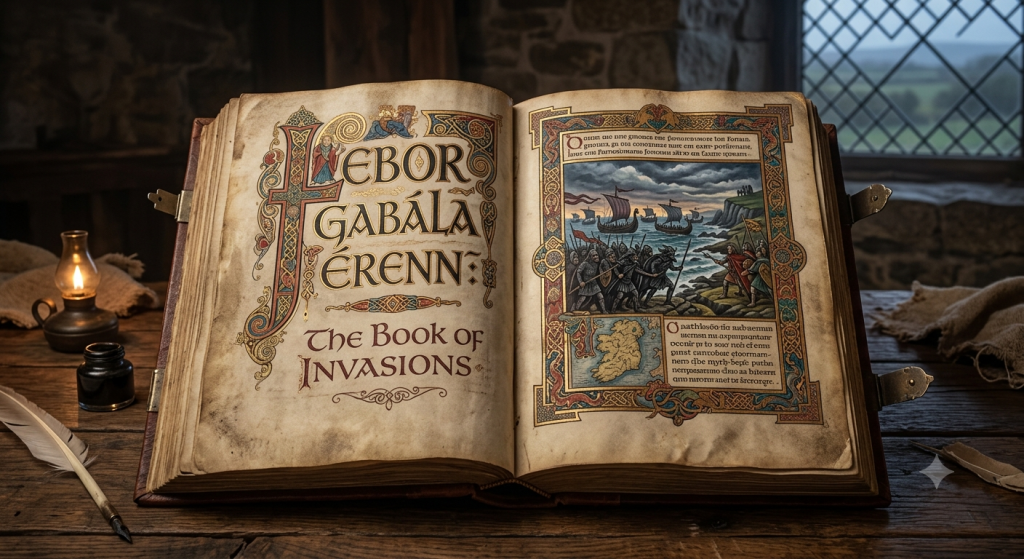
The Lebor Gabála Érenn, the Book of the Taking of Ireland, is the foundational text of Irish mythology and one of the most unusual documents produced in medieval Europe. It was compiled by Christian monks in the eleventh century from older material, and its purpose was to give Ireland an origin story comparable to the one the Bible gave to the Israelites: a grand narrative of successive peoples arriving in the island, each building on what the previous had left, each marking a new stage in the island’s journey from the primordial to the historical.
The book was taken seriously as history for centuries. Irish annalists and historians cited it as authoritative well into the seventeenth century. Only with the development of modern critical scholarship did it become clear that the Lebor Gabála is not a historical record but a creative synthesis: part mythology, part biblical pseudo-history, part political theology, and part genuinely ancient tradition preserved in a form that the Christian scholarly framework could accommodate. Understanding what it is, how it was made, and why it was made that way is essential to understanding Irish mythology as a whole.
What the Book Actually Contains
The Lebor Gabála describes six successive waves of settlement in Ireland, each displacing or absorbing the previous, each adding something to the island’s character and each ending in some form of catastrophe or transformation before the next wave arrives.
The first settlers were the people of Cessair, granddaughter of Noah, who came to Ireland before the Flood in an attempt to find a place where the Flood would not reach. They did not survive. Fifty women and three men arrived, one of the men died almost immediately, and when Cessair died of grief after the Flood came anyway, the remaining people perished. The only survivor was Fintan mac Bóchra, who escaped by turning himself into a salmon, then an eagle, then a hawk, living through all the subsequent ages of Ireland as a shapeshifter and eventually becoming the great repository of all Irish historical memory.
The Partholonians came next, three hundred years after the Flood. They were the first to establish genuine civilisation in Ireland: they cleared plains, dug lakes, introduced cattle husbandry, cooking, duelling, and the brewing of ale. They fought the first battle in Ireland against the Fomorians and won it. They died of plague on the Mag nEithe in a single week, all nine thousand of them. The plains they cleared remained.
The Nemedians arrived and suffered worse. They too fought the Fomorians, with less success. The Fomorians imposed a tribute of two thirds of every harvest, two thirds of every calf born, and two thirds of every child born each November. The Nemedians eventually rebelled, attacked the Fomorian stronghold on Tory Island, and were nearly wiped out. The survivors scattered across the world in three groups, and it is those scattered groups who eventually return to Ireland as the Fir Bolg, the Tuatha Dé Danann, and the Milesians.
The Fir Bolg were the fourth settlers, descendants of the Nemedians who had gone to Greece and been enslaved. They returned to Ireland with their bags of Greek soil and divided the island into its five provinces for the first time. Their king Eochaid mac Erc was the first perfect king of Ireland, maintaining justice so complete that no rain fell except on nights, and no year was without harvest, and falsehood was banished from Ireland. They were defeated at the First Battle of Mag Tuired by the Tuatha Dé Danann and withdrew to the western islands.
The Tuatha Dé Danann came from the four northern cities, bringing the Four Treasures, defeating first the Fir Bolg and then the Fomorians, and ruling Ireland until the arrival of the Milesians.
The Milesians, the Sons of Míl from Spain, are the sixth and final settlers: the ancestors of the Gaelic Irish, the people who would maintain possession of Ireland from their arrival to the historical period and beyond. They defeated the Tuatha Dé Danann, divided Ireland with them, and the Tuatha Dé Danann withdrew into the sídhe mounds beneath the earth.
The Problem the Monks Were Solving
The Lebor Gabála was produced in a specific intellectual context that explains almost everything unusual about it. The Christian monks who compiled it were working within a tradition of universal history that derived from Augustine’s City of God and Orosius’s Histories, texts that traced all of human history from the biblical Creation through to the present. Every nation that wanted to understand itself within this framework needed to place its own history within the biblical timeline: to show where its ancestors fitted in the genealogy from Adam, how they survived the Flood, how they came to inhabit their particular corner of the world.
Ireland’s pre-Christian mythology presented a specific problem: it contained gods. The Tuatha Dé Danann were divine beings, worshipped as deities before Christianity arrived. A Christian text could not simply preserve them as gods. The solution the monks reached was euhemerism, the approach named for the Greek philosopher Euhemerus who proposed that the gods of mythology were originally human beings whose deeds had been exaggerated into divinity over time. The Tuatha Dé Danann in the Lebor Gabála are rationalised as a gifted human race, not gods but people with exceptional magical and craft abilities, whose divine status was a later mythological embellishment on what had originally been remarkable but mortal achievement.
This rationalisation is the Lebor Gabála’s most significant intellectual move, and it preserved the mythology at the cost of misrepresenting it. The Tuatha Dé Danann were gods. The text that preserved them most extensively denies that they were. Scholars who approach Irish mythology need to keep this tension in mind throughout.
Fintan and the Memory of Everything
The figure of Fintan mac Bóchra, the sole survivor of the first settlement who lived through every subsequent age of Ireland as a shapeshifting witness, is one of the most distinctive and most philosophically interesting in the entire tradition. He is not an active figure in the mythology in the way that the Dagda or Lugh are active. He is a memory, a repository, the living record of everything that happened in Ireland from the very beginning.
When the text needs to establish the credentials of a piece of historical knowledge, it attributes it to Fintan. He was there. He saw it. The salmon who lived through the Flood, the eagle who observed the successive settlements, the hawk who watched the battles: Fintan is the principle that memory survives even when everything else is lost, that the tradition itself is the continuity through catastrophe.
His connection to the salmon form is particularly significant. In Irish tradition, the salmon is the animal of wisdom, most famously in the story of the Salmon of Knowledge that Fionn Mac Cumhaill cooks for someone else and whose wisdom he accidentally absorbs. Fintan as a salmon, the original wisdom-fish, swimming through the Flood while all other life perishes, is one of the oldest and deepest images in Irish mythological tradition.
The Five Provinces and the Sacred Centre
One of the Lebor Gabála’s most enduring contributions to Irish cultural geography is the account of the Fir Bolg dividing Ireland into five provinces: Ulster, Munster, Leinster, Connacht, and Meath. The division is presented as the first act of proper political organisation in Ireland, the imposition of order on a landscape that had previously been undivided.
Meath, the fifth province, is particularly significant: it is the province of the centre, the province that contains Tara, the seat of the High Kings of Ireland, and that mediates between the other four. The idea of a sacred centre that balances and contains the four cardinal provinces is one of the structuring principles of Irish political mythology, and it appears here in its origin form.
The five-province structure the Fir Bolg established survived in Irish political geography for two millennia. Four of the five provinces still exist today as administrative regions of Ireland. The tradition that the Lebor Gabála was composed to preserve has left marks on the actual landscape of the country that its mythological figures inhabit.
Further Reading
If this article sparked your interest, these are the books worth reading next.
The Mabinogion
The foundational collection of Welsh mythology — the primary source for the Arthurian tradition, the four branches of Welsh legend, and the stories that sit at the heart of the Celtic world.
Celtic Myths and Legends
by Peter Berresford Ellis — the best single-volume introduction to the full range of Celtic mythology, covering Irish, Welsh, Scottish, Gaulish, and Breton traditions properly.
The Táin: Translated from the Old Irish Epic Táin Bó Cúailnge
The great Irish epic — Cu Chulainn, Queen Medb, and the Cattle Raid of Cooley. The closest thing the Celtic world produced to the Iliad, and considerably stranger.
For more on the tradition, the Tuatha Dé Danann article covers the divine race whose mythology the Lebor Gabála preserves and partially rationalises. The Fomorians article covers the hostile forces who opposed successive waves of settlers and whose eventual defeat defines the mythology’s central arc. The Second Battle of Mag Tuired article covers the defining conflict whose victory the Lebor Gabála places at the centre of Irish mythological history.
Never miss a myth
Thank you for being here. The site is brand new and every subscriber genuinely means something to me. If you're here, you care about this stuff as much as I do - and that's all the reason I need to keep going. New stories, videos and dark folklore from around the world, straight to your inbox. No algorithm. Just the stories, when they're ready.