Queen Medb of Connacht launched the greatest military campaign in Irish mythology over a bull. This is the fact that most retellings lead with, and it is accurate as far as it goes. What it obscures is the reason, which is considerably more interesting than the surface suggests, and what it completely misses is who Medb actually is in the tradition: not a villain, not a monster, not a cautionary tale about female ambition, but a ruler who operates according to a perfectly consistent and internally coherent set of principles that the tradition treats with considerably more respect than popular retellings tend to allow.
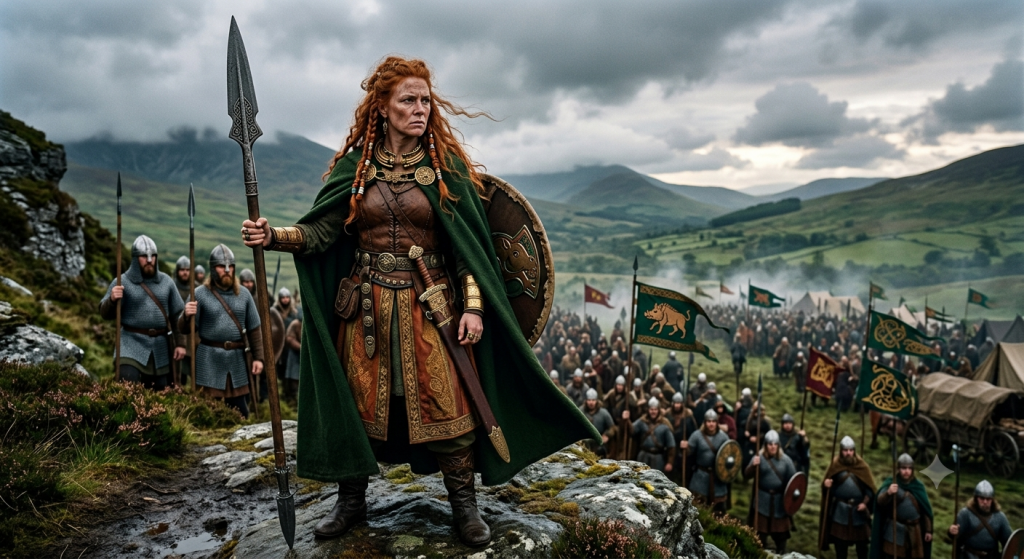
She rules from Rathcroghan in County Roscommon, the great royal site of Connacht that is still visible as a complex of earthworks and ancient monuments in the Irish landscape today. She has had multiple husbands, has rejected multiple suitors on specific grounds, maintains a standing army of fifteen hundred mercenaries and an equal number of freemen, and is described as tall and fair with long cheeks, carrying a javelin in each hand. The tradition gives her physical description, her political requirements, and her personal code with equal precision. She is one of the most fully realised characters in early Irish literature.
The Pillow Talk That Started a War
The Táin Bó Cúailnge, the Cattle Raid of Cooley, begins with a conversation in bed. Medb and her husband Ailill mac Máta are comparing their possessions, going through everything they own item by item to establish whether they entered the marriage as equals. They have the same number of jewels, the same quality of cloth, the same number of animals of every kind. Then they come to the bulls.
Ailill has the Finnbennach, the White-Horned Bull, the finest bull in Ireland. It had originally belonged to Medb’s herds, but had transferred itself to Ailill’s because it refused to be counted as the property of a woman. Medb has nothing to match it. In the accounting they have been conducting, she is the lesser party.
The reading of this moment matters enormously. The conventional reading, which much popular retelling has followed, is that Medb goes to war over a petty quarrel about possessions, risking lives for the sake of wounded pride in a competition she initiated. The more careful reading is different. Medb had specified, when she was choosing a husband, that she required a man who was without jealousy, without fear, and without meanness, because she was herself a woman of great possessions and would not be diminished by her husband’s limitations. The pillow talk comparison is not pettiness. It is Medb checking the terms of her marriage are still holding.
When she discovers she is the lesser partner in the accounting, she sets about correcting it. She sends messengers to borrow the Donn Cúailnge, the Brown Bull of Cooley in Ulster, offering generous terms. The offer is refused. She goes to war to take what the terms of her life require her to have. This is not irrational. It is entirely consistent with how the tradition has characterised her from the beginning.
Her Requirements in a Husband
Medb’s specifications for a husband, stated explicitly in the Táin’s opening, are one of the most remarkable passages in Irish literature for the clarity with which they articulate a woman’s requirements in a partner from a female perspective.
She will not have a man who is mean, because her own generosity is so great that a mean man would reflect poorly on her through the contrast. She will not have a man who is jealous, because she herself has taken and will take lovers alongside her husband, and a jealous man would be destroyed by this. She will not have a man who is fearful, because her own courage is such that a cowardly man beside her would embarrass them both.
Ailill, she says, is without jealousy, without fear, and without meanness. The comparison they conduct in bed is her checking whether this is still true. The discovery that he now has something she does not is the discovery that the terms of the marriage have shifted. Her response is to restore the balance. The tradition is entirely consistent about this. The modern reader who finds Medb’s motivation trivial is reading the surface without the framework.
The Sovereignty Goddess Beneath the Queen
Earlier generations of scholars read Medb primarily as a sovereignty goddess, a figure whose function in the mythology was to embody the land of Ireland and to confer legitimate kingship on whoever she chose as a sexual and political partner. The name Medb is connected to the Old Irish word for mead, the intoxicating drink associated with inauguration rituals in which the king drank from a cup offered by the sovereignty figure. The goddess of sovereignty, in this reading, is what Medb is beneath her literary characterisation as a Connacht queen.
More recent scholarship has been cautious about this reading, noting that the sovereignty goddess interpretation can become a way of removing Medb’s agency by treating her as a symbol rather than a character. The careful position is probably that both things are true simultaneously: Medb in the Táin is a fully realised literary character with specific motivations and a consistent personal code, and she also carries within her characterisation the older theological freight of the sovereignty figure whose favour makes kings and whose displeasure unmakes them.
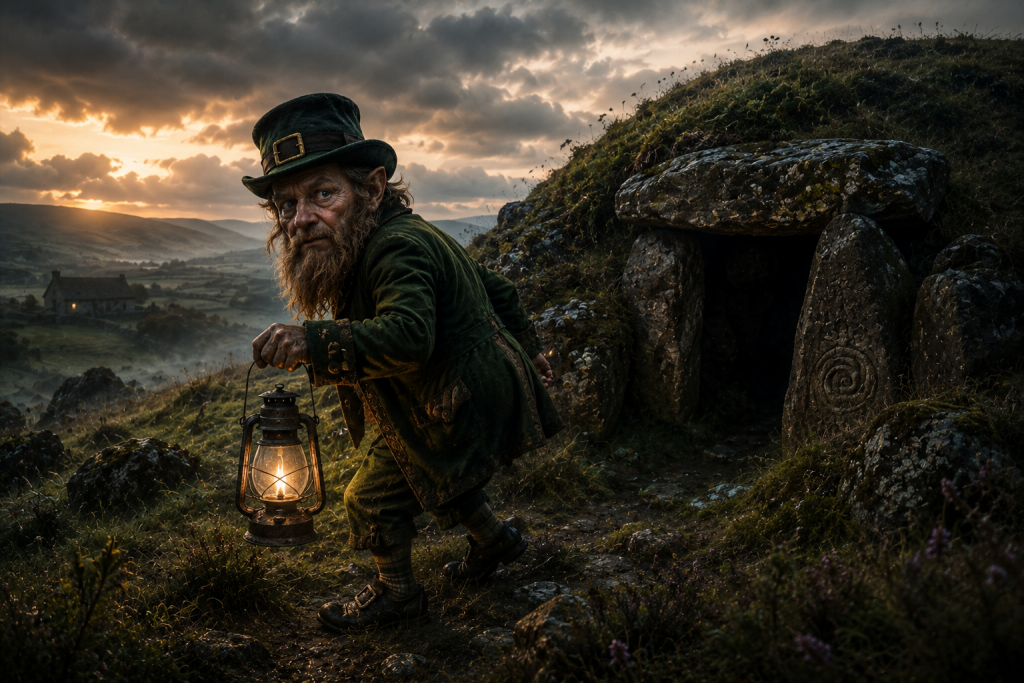
The cave at Rathcroghan, called Oweynagat or the Cave of the Cats, is directly associated with Medb and is understood in the tradition as one of the entrances to the Irish Otherworld. It is also a genuinely ancient site, a man-made souterrain with Ogham inscriptions dating to the early medieval period, and the local community has maintained its association with Medb and with the supernatural for over a thousand years of documented history. The queen and the landscape are inseparable in this tradition in a way that suggests the sovereignty goddess reading is not simply a scholarly construct.
What the Táin Actually Shows Her Doing
In the course of the Táin, Medb does things that the tradition records without apparent moral judgment: she negotiates with warriors, offers her daughter in marriage as political currency, sends champions against Cú Chulainn one by one while he is bound by the code of single combat, and eventually acquires the Donn Cúailnge. She also, at the battle’s crisis, needs Fergus mac Róich to shield her from the pursuing Cú Chulainn with his forces, and she asks him while she is urinating in the field, which is the kind of detail that the tradition includes with evident enjoyment at the contrast between the gravity of the situation and the physical indignity of the moment.
Cú Chulainn, when he catches her, does not kill her. He tells her it is not his custom to kill women. She agrees to withdraw her forces in exchange for safe passage, and the Táin ends not with Medb’s defeat but with a negotiated conclusion, the Donn Cúailnge in Connacht but dying there, the two great bulls having fought each other to mutual destruction in a combat that makes the whole war’s purpose retrospectively pointless.
The ending is one of the most deliberately deflating in early Irish literature. The war was fought for a bull. Both bulls are dead. Medb has her technical victory and nothing to show for it except the cost. The tradition does not editoralise about this. It records it, which is its own form of judgment.
Further Reading
If this article sparked your interest, these are the books worth reading next.
The Mabinogion
The foundational collection of Welsh mythology — the primary source for the Arthurian tradition, the four branches of Welsh legend, and the stories that sit at the heart of the Celtic world.
Celtic Myths and Legends
by Peter Berresford Ellis — the best single-volume introduction to the full range of Celtic mythology, covering Irish, Welsh, Scottish, Gaulish, and Breton traditions properly.
The Táin: Translated from the Old Irish Epic Táin Bó Cúailnge
The great Irish epic — Cu Chulainn, Queen Medb, and the Cattle Raid of Cooley. The closest thing the Celtic world produced to the Iliad, and considerably stranger.
For more on the tradition, the Táin Bó Cúailnge article covers the epic campaign Medb launches and its full sequence of events. The Cú Chulainn article covers the Ulster hero who is the primary obstacle to Medb’s campaign. The Ireland category has every article in the Irish mythology and folklore cluster.
Never miss a myth
Thank you for being here. The site is brand new and every subscriber genuinely means something to me. If you're here, you care about this stuff as much as I do - and that's all the reason I need to keep going. New stories, videos and dark folklore from around the world, straight to your inbox. No algorithm. Just the stories, when they're ready.