The Second Battle of Mag Tuired is the central event of Irish mythology. Everything in the mythological tradition either builds toward it or flows from it. The arrival of the Tuatha Dé Danann in Ireland, the troubled reign of Bres, the arrival of Lugh at Tara, the preparations of every divine craftsperson and warrior and healer: all of it is prelude to this battle on the plain of Mag Tuired in Connacht, where the gods of Ireland fought the forces of chaos and darkness and established, definitively and at great cost, which principle would govern the island.
The primary source is the Cath Maige Tuired, one of the most extraordinary texts in early Irish literature, found in a sixteenth century manuscript but compiled in the twelfth century from ninth century material. It is not simply a battle narrative. It is a text about what civilisation requires: proper kingship, the obligation of hospitality, the function of every craft and every skill in maintaining the community, and the necessity of each member of the divine community contributing their particular excellence to the collective effort. The battle is the frame. What the text is actually about is how a society holds together under pressure and what happens when it fails to.
The Background: Bres and the Failure That Started Everything
The Second Battle of Mag Tuired begins not with aggression but with misrule. After the First Battle of Mag Tuired, in which the Tuatha Dé Danann defeated the Fir Bolg but their king Nuada lost his arm and was disqualified from kingship, they made a fateful decision: they gave the kingship to Bres, son of Ériu of the Tuatha Dé Danann and Elatha, king of the Fomorians. A half-Fomorian king, chosen because he was beautiful and because giving him the kingship might secure the Fomorian alliance.
Bres was a disaster. The knives of the Tuatha Dé Danann’s warriors were not greased. Their breath did not smell of ale. When the poet Cairbre visited Bres seeking hospitality, he was given a small dark room with no fire, no bed, and nothing to eat but a small dry cake. He left and composed the first satire in Irish literary history: Bres’s generosity, he said, was the generosity of a man who pours ale through a strainer.
The satire worked as satire was understood to work in the Irish tradition: it caused blemishes to appear on Bres’s face, and a king with a blemish could not be king. He was deposed. Nuada had by this point been given a silver arm by the physician Dian Cecht and was restored to kingship. Bres went to his Fomorian father to ask for an army to win back the kingship by force. His father refused on the grounds that Bres had lost the kingship unjustly and reclaiming it violently would be wrong. Bres went instead to Balor of the Evil Eye, who agreed.
The Preparation
One of the most remarkable things about the Cath Maige Tuired is the extended sequence of preparation for the battle, in which Lugh goes through each member of the Tuatha Dé Danann asking what power they will bring to the conflict. The sequence reads almost like a manifesto for what a functioning society requires.
Goibniu the smith promises that every spear his hand forges will not miss its target, and every person it pierces will not taste life afterward. Dian Cecht the physician promises that every man wounded in battle, unless his head is cut off or his spinal marrow severed, will be made whole by the following morning. He will bring them to the Well of Sláine and heal them there. Credne the metalworker promises rivets for every spear, hilts for every sword, bosses and rims for every shield. The Dagda promises to do everything that all of them together have pledged.
The Dagda also, famously, goes to the Fomorian camp before the battle begins at the Fomorians’ invitation, where they give him a porridge of whole animals boiled in a cauldron, intending to humiliate him. He eats it all. Then he sleeps.
Before the battle, the Dagda meets the Morrigan at the River Unshin. She straddles the water, one foot on each bank, and they have a sexual union at the ford. She tells him the Fomorian battle plan and promises to weaken the Fomorian king Indech by taking from him the blood of his heart and the kidneys of his valour. The Dagda and the Morrigan between them are the twin pillars of the Tuatha Dé Danann’s war effort: one the embodiment of sustenance and life, the other the embodiment of fate and sovereignty.
The Battle
The battle is one of the most vividly written passages in early Irish literature, and the Cath Maige Tuired gives it a texture of genuine violence alongside its mythological significance. Spears and swords are described by name. The Fomorian and Tuatha Dé Danann forces are named individually. The dead are counted.
What sustains the Tuatha Dé Danann through the fighting is precisely the preparation described before it. Dian Cecht and his children tend the wounded each evening at the Well of Sláine, and the dead who are brought to the well are restored to fight again. The Fomorians send a spy to discover how this is happening, and when he reports back, they send men to destroy the well by filling it with stones. This is the first act of systematic destruction of an enemy’s healing capacity in Irish literature.
Goibniu’s forge runs continuously, producing replacement weapons. The smith, the leech, and the metalworker form the logistical core of a divine army in a way that is strikingly functional rather than purely symbolic. The Cath Maige Tuired understands war as a complex collective enterprise that requires support structures as much as individual heroism.
Lugh escapes from the nine men set to guard him, because the king has decided he is too valuable to risk in the battle. He goes to the front of the Tuatha Dé Danann forces anyway, and it is Lugh who holds the battle line with a chant urging the warriors to fight for their freedom, reminding them that it is better to find death protecting their homeland than to remain in bondage and under tribute.
The Death of Balor
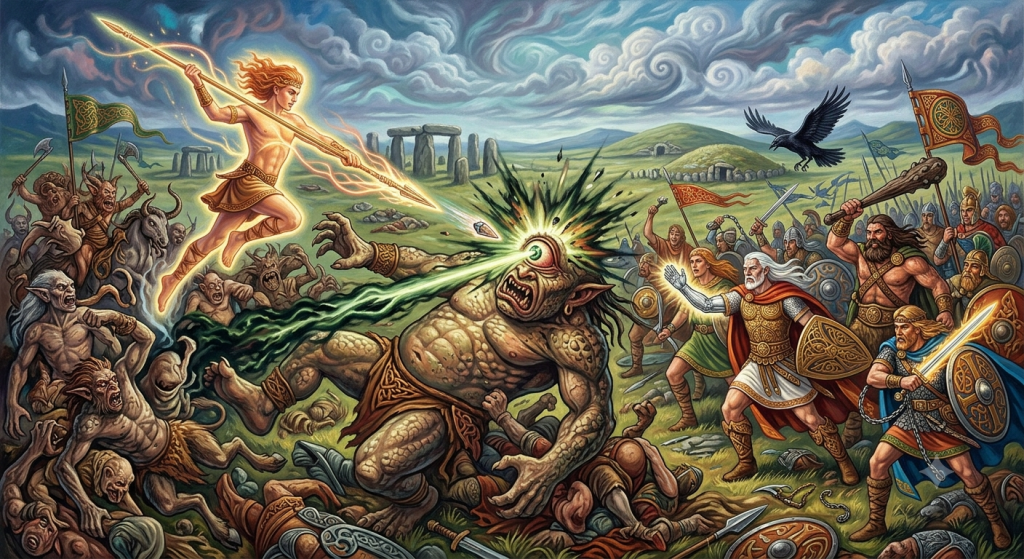
The crisis of the battle comes when Balor of the Evil Eye arrives. The four men with their hooks prepare to open his eye against the Tuatha Dé Danann forces. Lugh puts a stone from his sling through the eye as it opens, driving it backward through Balor’s skull so that it faces the Fomorian army. Whatever it looked upon died. The eye that was meant to destroy the Tuatha Dé Danann destroyed the Fomorians instead.
With Balor dead, the Fomorians broke. They were driven back to the sea. Bres was captured, and the text gives him a remarkably undignified end: he tries to bargain for his life by promising the Tuatha Dé Danann that the cows of Ireland will always be in milk, then that there will be a harvest every quarter, then various other agricultural promises. None of these satisfy. Eventually he is allowed to go free in exchange for teaching the correct times for ploughing, sowing, and reaping, which is perhaps the most practical ransom ever paid in Irish mythology.
The Morrigan’s Proclamation
At the battle’s end, the Morrigan proclaims its result, and the proclamation is one of the most extraordinary passages in the Cath Maige Tuired. She speaks in two voices simultaneously: first announcing the peace and fertility that will come now the Fomorians are defeated, the trees heavy with fruit, the sea full of fish, the land full of abundance. Then she turns and speaks a second prophecy, one of woe and decline, about a future time when summer without flowers and cattle without milk and women without virtue and men without valour will come. The scholars who have examined this dual proclamation have spent considerable effort on what it means, but the simplest reading is the most compelling: the Morrigan understands that the victory over chaos is real but not permanent, that the Fomorians will return in new forms, that the order established today requires continuous maintenance or it will erode.
Further Reading
If this article sparked your interest, these are the books worth reading next.
The Mabinogion
The foundational collection of Welsh mythology — the primary source for the Arthurian tradition, the four branches of Welsh legend, and the stories that sit at the heart of the Celtic world.
Celtic Myths and Legends
by Peter Berresford Ellis — the best single-volume introduction to the full range of Celtic mythology, covering Irish, Welsh, Scottish, Gaulish, and Breton traditions properly.
The Táin: Translated from the Old Irish Epic Táin Bó Cúailnge
The great Irish epic — Cu Chulainn, Queen Medb, and the Cattle Raid of Cooley. The closest thing the Celtic world produced to the Iliad, and considerably stranger.
For more on the tradition, the Tuatha Dé Danann article covers the divine race whose defining battle this was. The Balor article covers the Fomorian king whose death at Lugh’s hands decided the battle. The Dagda article covers the chief god whose alliance with the Morrigan before the battle shaped its outcome.
Never miss a myth
Thank you for being here. The site is brand new and every subscriber genuinely means something to me. If you're here, you care about this stuff as much as I do - and that's all the reason I need to keep going. New stories, videos and dark folklore from around the world, straight to your inbox. No algorithm. Just the stories, when they're ready.