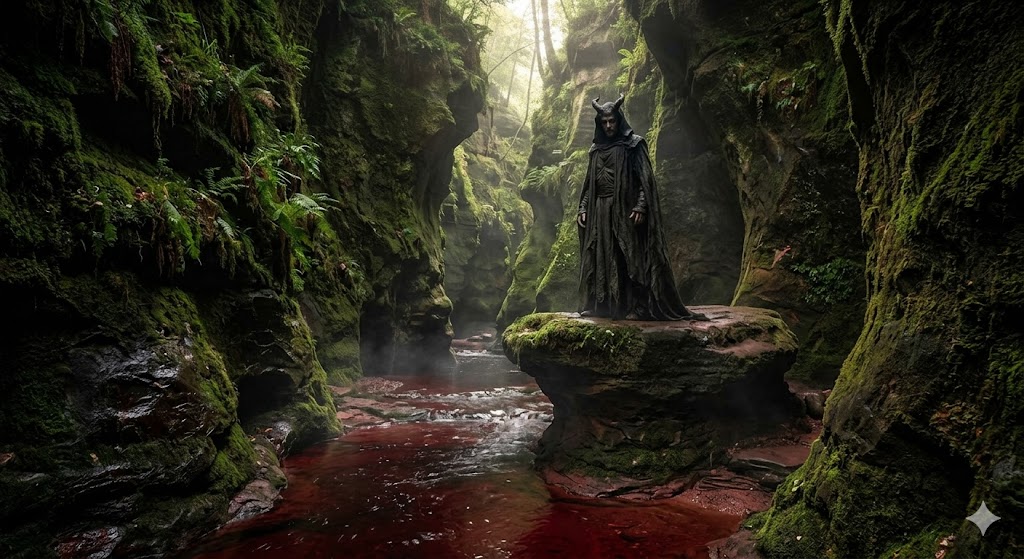
Fourteen miles north of Glasgow, just off the A809 near the village of Killearn, a burn called the Carnock has been cutting through red sandstone for millions of years. What it has produced is one of the most startling natural formations in Scotland: a narrow gorge up to a hundred feet deep, its walls thick with moss, its water running the colour of old blood from the iron-rich stone beneath. At the bottom of that gorge, half submerged in the red current, sits a mushroom-shaped rock that looks exactly like a preacher’s pulpit.
The locals called it the Devil’s Pulpit because they believed that is precisely what it was.
The folklore surrounding Finnich Glen is old enough that it appears in the First Statistical Account of Scotland, published in 1795, which describes the gorge in terms that make clear the place had been stirring unease for considerably longer than that. By the time someone thought to write it down, the association between this hidden gorge and dark ritual was already established tradition rather than recent invention. The devil, the druids, and the witches had all been there, according to the stories, and the red water was the evidence they left behind.
What the Name Actually Refers To
Most people who visit Finnich Glen today use the name Devil’s Pulpit to refer to the entire gorge, which is understandable given how thoroughly the name has attached itself to the place. The original reference is more specific. The Devil’s Pulpit is the rock at the bottom: a circular sandstone formation that protrudes from the stream, its shape genuinely resembling a church pulpit of the kind a preacher would stand at to address a congregation. The gorge itself is Finnich Glen. The rock is the pulpit.
The distinction matters because it clarifies what the folklore is actually describing. The legend is not that the devil haunts the gorge in some general sense. It is that he stood on that specific rock and preached from it, the red water swirling around his feet, his congregation assembled in the narrow space below the cliffs. The detail is precise enough that it suggests either a genuine tradition of dark gatherings at this location, or an imaginative response to a rock formation that really does look like it was designed for an infernal sermon.
What nobody disputes is that the place looks the part. When you descend the stone staircase known as Jacob’s Ladder and reach the bottom of the gorge, the walls rise steeply on both sides, moss-covered and dripping, blocking most of the sky. The light is green and diffuse. The red water moves quietly around the pulpit rock. Even on a bright summer day the gorge has a quality of enclosure, of having arrived somewhere cut off from the ordinary world above. It is easy to understand why the people who first named this place reached for the devil’s name rather than something more mundane.
The Three Traditions
The folklore of Finnich Glen draws on three distinct traditions, each placing a different group at the pulpit rock and assigning a different meaning to what happened there.
The oldest tradition, and the one most directly encoded in the name, is the devil himself. The story holds that Satan preached to his followers from the pulpit rock, his sermons delivered in the red-tinged darkness of the gorge, the water that ran past his feet turning redder as the congregation grew. The specific claim that the water’s colour results from satanic activity is one that the local community maintained alongside the perfectly accurate geological explanation: the colour comes from the red sandstone, as it always has, but the stories allowed both explanations to coexist without particular discomfort. The sandstone explained the colour. The devil explained why the sandstone was there.
The second tradition places druids at the gorge rather than the devil, conducting secret rituals hidden from Roman or Christian authorities in the natural enclosure the gorge provides. The timing attributed to this tradition varies across sources, with some placing it in the pre-Christian period and others suggesting it continued into the early medieval period. The gorge’s natural concealment makes it genuinely plausible as a ritual site: standing at the bottom, you are invisible from the surrounding landscape, audible only to those who have descended with you.
The third tradition connects the pulpit rock to witch executions. In some versions of the legend, the rock served as an execution block rather than a preaching platform, witches being killed at this location in the gorge rather than at the more conventional public spaces where Scottish witch trials usually concluded. This tradition is the hardest to verify and the most likely to be a later addition to the mythology, but it belongs to the same pattern: a striking natural feature in an isolated location, accumulated with the darkest associations available in the folk imagination.
The First Statistical Account
The First Statistical Account of Scotland, compiled by Sir John Sinclair in the 1790s from reports submitted by parish ministers across the country, contains one of the earliest written descriptions of Finnich Glen. The entry for the parish of Killearn, submitted in 1795, describes the gorge in terms that capture its character precisely: it consists of a high rock, over which the water of Carnock precipitately falls, and by the work of many ages, has cut out for itself a deep and winding passage. The projecting rocks on both sides the water are wild beyond description.
Wild beyond description from a Church of Scotland minister in 1795 is not a casual observation. The First Statistical Account is generally a sober document, full of agricultural statistics and population figures. When its contributors reach for atmospheric language, they mean it. The gorge had clearly been making an impression on visitors for long enough that the local minister felt its character worth recording alongside the parish’s more prosaic details.
The account does not record the devil folklore explicitly, which suggests either that the minister considered it beneath the dignity of the document or that the specific legends developed later, building on the gorge’s general reputation for wildness rather than preceding it. Either reading is consistent with how place legends typically develop: the atmosphere comes first, and the specific stories accumulate around it over time.
The Geology Behind the Blood
The red colour of the Carnock Burn is one of the most striking things about Finnich Glen and the element most responsible for its reputation. The explanation is straightforward: the burn flows through Old Red Sandstone, a geological formation laid down during the Devonian period roughly 360 to 420 million years ago, rich in iron oxide that leaches into the water and turns it the colour it has always been.
This is not a subtle effect. The water at the bottom of the gorge is genuinely red in the way that blood is red, dark enough that it reads as wrong to anyone who encounters it without prior knowledge of the geology. Combined with the enclosed, green-lit atmosphere of the gorge and the pulpit rock sitting in the middle of the current, the colour creates a sensory experience that requires explanation of some kind. The geological explanation and the folkloric explanation have coexisted for centuries because both are, in their own register, accurate: the sandstone is why the water is red, and the red water is why the devil was said to preach there.
Outlander and What It Did to the Place
In 2014, the first series of the television drama Outlander used Finnich Glen as a filming location. The scene depicted the gorge as St Ninian’s Spring, a magical pool whose waters compelled truth from anyone who drank them. The scene is brief, but the visual impact of the location was sufficient to send Outlander fans to the gorge in numbers that transformed a little-known local beauty spot into one of Scotland’s most visited destinations.
By recent estimates, approximately 70,000 people visit Finnich Glen annually, a figure that has created significant problems for both the location and the surrounding community. The 200-year-old stone steps of Jacob’s Ladder have been damaged by the volume of traffic. Emergency rescues have become a regular occurrence as visitors underestimate the difficulty of the descent and the slipperiness of the stone at the bottom. The narrow A809 road nearby, entirely unsuited to tourist traffic, has become a persistent source of conflict between visitors and local residents.
Plans for a visitor centre and managed access have been discussed for several years. The situation illustrates a tension that runs through many of Scotland’s most atmospheric locations: the qualities that make a place extraordinary are often precisely the qualities that mass tourism damages. Finnich Glen is extraordinary because it is remote, enclosed, and feels like a discovery. The discovery has now been made by tens of thousands of people a year.
The Place Before the Fame
It is worth remembering what Finnich Glen was before Outlander found it: a place that the local community had known about and told stories about for centuries, recorded in the Statistical Account as remarkable, named after the devil because the name felt earned. The folklore traditions attached to it, the preaching devil, the druid rituals, the witch executions, represent the accumulated imaginative responses of generations of people who encountered a landscape that demanded explanation and provided the most compelling one available to them.
The geological truth and the folkloric truth are not in competition. The sandstone is red because of iron oxide deposited millions of years ago. The water runs red because it flows over that sandstone. The name Devil’s Pulpit exists because a community of people, encountering red water flowing around a pulpit-shaped rock at the bottom of a hidden gorge, concluded that something had happened there that the ordinary world could not account for. They were, in a precise sense, right. Something extraordinary had happened at Finnich Glen. It had just happened 400 million years earlier than the devil stories suggest.
Further Reading
If this article sparked your interest, these are the books worth reading next.
Scottish Urban Legends: 50 Myths and True Stories
by Aaron Mullins — fifty Scottish urban legends including stories from Glasgow, Edinburgh, and the Highlands. The kind of tradition that Maggie Murphy belongs to, collected properly in one volume.
Scottish Urban Myths and Ancient Legends
by Grace Banks and Sheena Blackhall — vampires, werewolves, devil encounters, and the school playground legends of Scotland. A genuinely good collection of the stories Scots have been telling each other for generations.
The Lore of Scotland: A Guide to Scottish Legends
by Jennifer Westwood and Sophia Kingshill — the most comprehensive collection of Scottish legend in print, covering Glasgow to Shetland, exploring origins and historical basis. Endorsed by Terry Pratchett as the real macabre.
For more on Scotland’s dark and atmospheric locations, the Glasgow Folklore page covers the strange history and legends of the city closest to Finnich Glen. The Witches of Pollok House article covers another dark chapter in the folklore of the Glasgow area. The Scotland category has every article on Scottish folklore and mythology on this site.
Never miss a myth
Thank you for being here. The site is brand new and every subscriber genuinely means something to me. If you're here, you care about this stuff as much as I do - and that's all the reason I need to keep going. New stories, videos and dark folklore from around the world, straight to your inbox. No algorithm. Just the stories, when they're ready.