
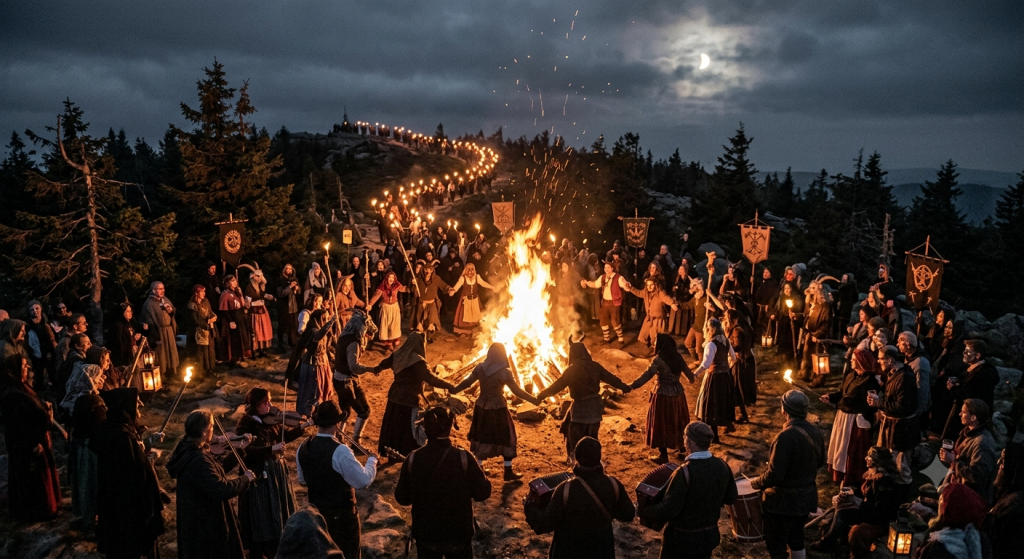
Walpurgis Night falls on the 30th of April, the eve of May Day, and it is the great nocturnal festival of German folk tradition: the night when witches were believed to gather on the Brocken, the highest peak of the Harz mountains in central Germany, to dance with the devil, celebrate the coming of summer, and perform the rites that the Christian calendar had been trying to suppress since the Church first arrived in Germanic lands. It is the spring counterpart to Hallowe’en, a night when the boundary between the ordinary world and the world of the supernatural is understood to be at its most permeable, when the witches are abroad and the protective measures that normally keep the supernatural at bay require renewal.
The night takes its name from Saint Walpurga, an English missionary nun who became abbess of Heidenheim in Bavaria in the eighth century and whose feast day falls on the 1st of May. The association between a respectable English abbess and the greatest witch gathering in German tradition is entirely accidental: the Church placed her feast on the 1st of May, which was already a significant date in the pre-Christian German calendar, and the two traditions have been awkwardly conjoined ever since.
The Brocken
The Brocken is the highest peak in the Harz mountains, rising to 1,141 metres, and its specific character made it the ideal location for the German witch tradition’s central gathering. It is frequently cloud-covered, producing the Brocken Spectre phenomenon in which a person’s shadow is projected onto the cloud below them as a vast magnified figure surrounded by a circular rainbow halo. This optical effect, genuinely uncanny when encountered unexpectedly, contributed to the Brocken’s supernatural reputation independently of any folk tradition.
The mountain is also exposed to severe weather that can change rapidly, producing storm conditions at the summit while the valleys below are calm. Early travellers who reached the summit unexpectedly found themselves in conditions that felt genuinely supernatural, and the combination of optical effects, sudden storms, and the physical exposure of the highest point in a largely flat region gave the Brocken a character that the witch tradition simply gave a narrative framework to.
Goethe’s Walpurgisnacht
The most famous literary treatment of Walpurgis Night is in Goethe’s Faust, where Mephistopheles takes Faust to the Brocken on the night of April 30th to witness the witches’ sabbath. Goethe’s Walpurgisnacht scene is a brilliant piece of literary Carnival, a grotesque celebration in which the normal order of things is inverted and the demonic presides. It is also a philosophical interlude in which Faust’s restlessness is intensified rather than satisfied by the spectacle, which is the scene’s deeper function in the structure of the play.
Goethe’s treatment influenced how subsequent generations understood Walpurgis Night, giving the tradition a literary form that both reflected genuine folk belief and shaped how educated Europeans thought about it. The witch gathering on the Brocken as Goethe described it, with its mixture of the grotesque, the erotic, and the philosophically unsettling, became the dominant image of the event in European culture.
Walpurgis Night Today
Walpurgis Night is still celebrated across Germany and Scandinavia, though the celebrations have largely shed their witch-gathering associations in favour of bonfires, fireworks, and spring festivals. In the Harz region the celebration is particularly lively, with witch-themed festivities in the villages around the Brocken and a long tradition of dressing as witches for the occasion. The East German town of Thale hosts one of the largest Walpurgis Night celebrations in Germany, using the dramatic Rosstrappe cliff and Bode valley as the backdrop for events that draw thousands of visitors annually.
For more on the folklore of Germany, the Faust article covers Goethe’s treatment of Walpurgis Night in the most famous German literary work. The Wild Hunt Germany article covers the other great nocturnal supernatural gathering of the German tradition. The Germany folklore hub page has every article in the cluster.
Never miss a myth
Thank you for being here. The site is brand new and every subscriber genuinely means something to me. If you're here, you care about this stuff as much as I do - and that's all the reason I need to keep going. New stories, videos and dark folklore from around the world, straight to your inbox. No algorithm. Just the stories, when they're ready.

