
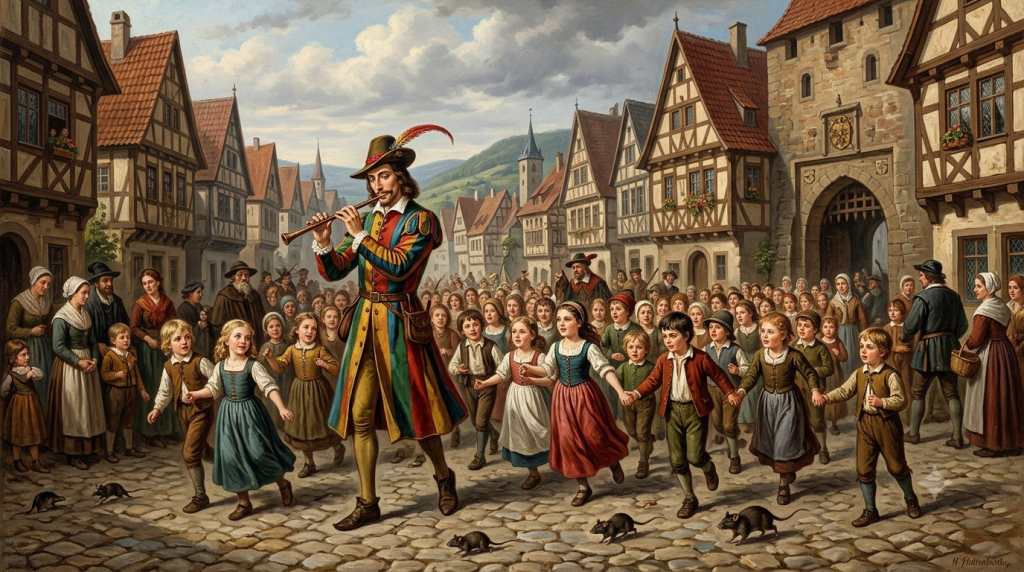
The Pied Piper of Hamelin is one of the most widely known legends in European folklore and one of the very few that appears to have a genuine historical event at its core. The story as most people know it runs like this: a piper arrives in the rat-infested town of Hamelin, offers to rid the town of rats for an agreed fee, leads the rats to the river with his music where they drown, is refused his payment by the town council, and takes revenge by leading the town’s children away with his pipe. The children follow him through a door that opens in the side of a mountain and are never seen again. Two children are left behind: one who is lame and could not keep up, one who is deaf and could not hear the music.
This story is so familiar that it is easy to miss how strange it actually is. Why would a rat-catcher be able to lead children away with a pipe? Why does the mountain open for him? Why are the children never recovered? And most pressingly: where did the rats come from in the first place? The answer to that last question is the most revealing, because the rats are not in the earliest sources for the legend. They are not there at all. The earliest accounts of what happened in Hamelin in 1284 describe only the children. The rats are a later addition, and their absence from the original record transforms the story from a fairy tale about greed and its consequences into something considerably stranger and considerably more disturbing: a genuine historical mystery about the disappearance of 130 children from a German town on a specific date that nobody has been able to explain in the seven and a half centuries since it happened.
The Historical Record
The historical record for the Hamelin event is fragmentary, as it must be for any event of the thirteenth century, but it is more substantial than the legend’s fairy tale character might suggest, and it has specific qualities that distinguish it from pure invention. The most important of these qualities is the specificity of the early accounts: they give a specific date (the 26th of June 1284), a specific number of children (130), and a specific direction of departure (out through the Ostertor, the eastern gate, and away toward the Calvarienberg). This level of specificity is characteristic of historical memory rather than of invented legend, which tends toward vagueness about precisely the details that historical memory preserves most clearly.
The earliest written reference to the Hamelin event is generally agreed to be an entry in a chronicle from the town of Lüneburg, written approximately in the 1440s, more than a century and a half after the event it describes. This gap between event and documentation is significant and requires careful handling: it means the chronicle entry is not a contemporary account but a record of a tradition that had been maintained in some form across more than a century before being committed to writing. What the chronicle preserves may be a genuine historical tradition, or it may be a legend that had already acquired the specificity of historical memory through long oral transmission. The distinction is important but cannot now be established with certainty.
The chronicle entry describes a piper dressed in multicoloured clothing who led away 130 children from Hamelin on the Day of Saints John and Paul, the 26th of June. The children went out through the Ostertor and were lost near the Calvarienberg. The account is brief, matter-of-fact in tone, and contains no explanation of why the children followed the piper or what happened to them. It simply records the event as a historical fact.
The most compelling piece of evidence for the historical reality of the Hamelin event is not a chronicle entry but an urban institution. The town of Hamelin maintained, for centuries after 1284, a street called the Bungelosenstrasse, the street without drums, on which no music or dancing was permitted, and through which no celebrations could pass. The prohibition was explicitly connected to the loss of the children: the street through which they had passed on their final journey out of the town was maintained as a place of mourning in perpetuity. You do not name a street the street without drums and prohibit music on it for centuries if the event that produced the prohibition was not understood as a genuine historical loss rather than a fictional narrative.
There is also evidence from the town’s own records. The Hamelin town chronicle, begun in the fourteenth century, mentions the event, and the date of the 26th of June was commemorated in the town for a period that extended well beyond what would be expected for a fictional story. These institutional commemorations are the strongest argument for a genuine historical event: communities do not maintain mourning practices for centuries to mark the loss of fictional characters.
A stained glass window in the Marktkirche in Hamelin, described in later written sources but no longer surviving, is often cited as the earliest reference to the Hamelin event, potentially dating from the late thirteenth or early fourteenth century. If the window existed and was as early as claimed, it would be a near-contemporary record of the event. The window’s description mentions the piper and the children but, according to the sources that describe it, does not mention rats. The absence of rats from what may be the earliest visual record of the legend is consistent with the absence of rats from the earliest written records.
The Rats: When They Arrived and Why
The rat infestation element of the Pied Piper story, which is so central to the familiar version that most people assume it was always there, does not appear in the sources until the sixteenth century, more than two hundred years after the event the legend describes. The first clear account that includes both the rats and the subsequent leading away of the children appears in a source from around 1559, and it is from sources of this period and later that the rat element becomes standard.
The addition of the rats to the legend almost certainly reflects a narrative need rather than a historical memory. The story of the children’s disappearance without any preceding event to explain the piper’s presence in Hamelin is puzzling: what was he doing there, why did the town have dealings with him, and why did he subsequently target the children? The rat plague provides an answer to all three questions. The piper was in Hamelin to rid it of rats. The town had dealings with him because they had hired him for this purpose. He targeted the children because the town broke the contract by refusing to pay him. The rats transform a mysterious event into a morally legible story about greed and its consequences.
This transformation is characteristic of how folk legends develop over time. The original event, whatever it was, was mysterious and resistant to explanation. The mystery was resolved, for the purposes of storytelling, by the addition of a preceding episode that gave the piper a motive and the town a culpability. The rats are an explanatory device, not a historical memory. They are what the tradition needed to make the story morally comprehensible, and their addition made the legend considerably more satisfying as a narrative while making it considerably less interesting as a historical puzzle.
The specific choice of rats as the problem the piper solves is not entirely arbitrary. Rat infestations were a genuine and serious problem in medieval European towns, associated with plague and with the destruction of food supplies, and a supernatural rat-catcher would have been a figure of genuine practical significance rather than simply a convenient plot device. The rats also establish the piper’s supernatural credentials before he turns them against the town: a man who can lead rats to their death with a pipe is clearly someone whose musical powers are not ordinary, which makes the subsequent leading away of the children more credible within the story’s own logic.
The Theories: What Actually Happened
The historical mystery of what happened to the children of Hamelin in 1284 has attracted scholarly attention for over a century, and multiple explanations have been proposed. None of them fully accounts for all the specific details of the earliest records, which is part of what makes the mystery so durable. The most credible theories are worth examining in detail, because each one illuminates a different aspect of the historical and social context in which the event occurred.
The Lokator theory is the most widely accepted among historians, and it connects the Hamelin event to one of the most significant demographic processes of the thirteenth century: the organised settlement of German migrants in the territories of eastern Europe. A Lokator was a professional agent employed by the lords of newly conquered or newly developing territories, particularly in what is now Poland, the Baltic states, Romania, and other areas of eastern and central Europe, to recruit settlers from German-speaking regions. These agents travelled through German towns offering land, tax concessions, and new opportunities to people willing to emigrate east, and they needed to attract attention to do so.
In this reading, the piper of Hamelin was a Lokator whose multicoloured clothing was the distinctive dress of his profession, designed to attract attention in the marketplace and at the town gate. His pipe was a tool for gathering crowds to hear his recruitment pitch. The 130 children who followed him were young people, primarily in their teens or twenties, who accepted his offer and emigrated to an eastern settlement. The direction of their departure, through the eastern gate and away toward the Calvarienberg, is geographically consistent with the route toward the east, and the fact that they were never seen again in Hamelin is precisely what you would expect of a successful emigration to a distant location with no means of regular communication.
The linguistic evidence sometimes cited in support of this theory is the presence of surnames in several eastern European communities that correspond to surnames found in medieval Hamelin records. Villages in what is now Romania, Poland, and the Czech Republic contain family names with no local etymological explanation but with plausible derivation from Hamelin or from the region around Hamelin. This evidence is suggestive but not conclusive, and the methodological difficulties of tracing surname origins across seven centuries make it impossible to establish a firm connection.
The plague theory proposes that the 1284 event was a plague, specifically one of the epidemic diseases that periodically devastated medieval European populations, that killed children disproportionately. The dancing mania theory proposes that the children were seized by one of the episodes of compulsive dancing that afflicted multiple medieval European communities, the most famous being the Dancing Plague of Strasbourg in 1518, and that they danced out of the town and to their deaths from exhaustion. The Children’s Crusade theory proposes a connection to the Children’s Crusade of 1212, in which large numbers of children across Europe were recruited for a crusade to the Holy Land with disastrous results, though the date discrepancy of seventy-two years is a significant obstacle to this interpretation.
The landslide theory proposes a natural disaster, a collapse of the hillside around the Calvarienberg that killed the children who were gathered there for some unrecorded purpose. This theory has the advantage of explaining the specific geographical detail of the Calvarienberg as the point beyond which the children disappeared, and natural disasters can produce exactly the kind of sudden, total loss of a large group that the Hamelin accounts describe. Its weakness is that a landslide would leave physical evidence and survivor accounts that should appear in the historical record if the event were of the scale the legend describes.
The most honest assessment of the historical evidence is that no single theory adequately accounts for all the specific details of the earliest accounts. The date, the number, the direction of departure, and the completeness of the disappearance are all details that any adequate theory must explain, and no proposed explanation has yet managed to explain all of them simultaneously. The mystery is genuine, and its genuineness after seven and a half centuries is itself a form of evidence about how unusual and how traumatic the original event must have been.
The Brothers Grimm and the Literary Tradition
The Pied Piper legend entered the modern literary tradition primarily through the Brothers Grimm, who included a version of the story in their Deutsche Sagen (German Legends) of 1816 to 1818. The Grimms’ version is closer to the historical record than the fully developed fairy tale version, retaining the specific date and the specific number of children while including the rat episode that had by then become standard. Their treatment is notable for its relatively straightforward narrative presentation without the moral elaboration that characterises the fairy tale versions: the Grimms present the legend as a piece of historical tradition rather than as a moral fable.
Robert Browning’s 1842 poem The Pied Piper of Hamelin is the most influential English literary treatment of the legend and the version through which most English speakers first encounter it. Browning’s poem is explicitly a children’s poem, written for the son of the actor William Macready, and its cheerful bouncing rhythm is deliberately at odds with the disturbing content it describes. The poem is funny in its depiction of the rats and the corrupt town council, and genuinely unsettling in its depiction of the children’s departure, and the combination of comic and disturbing registers is one of Browning’s most characteristic achievements.
Browning’s addition to the legend is the description of the children’s experience as they follow the piper, which the historical tradition does not contain. The children in Browning hear the piper’s music as a description of a wonderful land into which they are being led, a land of joyful abundance and sensory delight. The one lame child who cannot keep up and is left behind describes hearing the promise of this land and being excluded from it by his lameness, which is the poem’s most emotionally affecting moment. Browning invented this interior experience, but its addition transformed the legend from an external account of disappearance into a meditation on what it might have felt like to be one of the children who followed.
The Legend in Contemporary Culture
The Pied Piper has remained one of the most culturally productive legends in European tradition, appearing across an extraordinary range of contexts in contemporary culture. The phrase pied piper has entered common usage as a description of any charismatic figure who leads others, particularly the young and the credulous, toward an uncertain or dangerous destination through the power of their appeal rather than through rational argument. This usage appears in political commentary, in advertising criticism, in discussions of cult leaders, and in educational debates about the influence of charismatic teachers on their students.
The specific anxiety that the legend encodes, about the vulnerability of children to supernatural or charismatic compulsion that their parents cannot perceive or counteract, has made it a recurring reference in discussions of childhood safety, of the relationship between children and strangers, and of the limits of parental protection. The father in Goethe’s Erlkönig cannot perceive the Erlking that his child clearly sees. The parents of Hamelin cannot follow their children through the door that opens in the mountain. In both cases the adult’s inability to perceive or counter the supernatural threat makes the child’s vulnerability absolute, and this specific helplessness of the adult in the face of a threat that operates in a register the adult cannot access is one of the deepest anxieties in the European supernatural tradition.
For more on the folklore of Germany, the Rattenfänger article covers the specific historical theories about who the piper was and what he represents in the context of thirteenth century German history. The Erlking article covers the forest spirit whose targeting of children parallels the piper’s and whose legend Goethe treated in the same period as his most famous work. The Faust article covers the other great German historical legend whose mystery has attracted comparable scholarly attention and whose moral questions continue to resist resolution. The Germany folklore hub page has every article in the cluster.
Never miss a myth
Thank you for being here. The site is brand new and every subscriber genuinely means something to me. If you're here, you care about this stuff as much as I do - and that's all the reason I need to keep going. New stories, videos and dark folklore from around the world, straight to your inbox. No algorithm. Just the stories, when they're ready.

