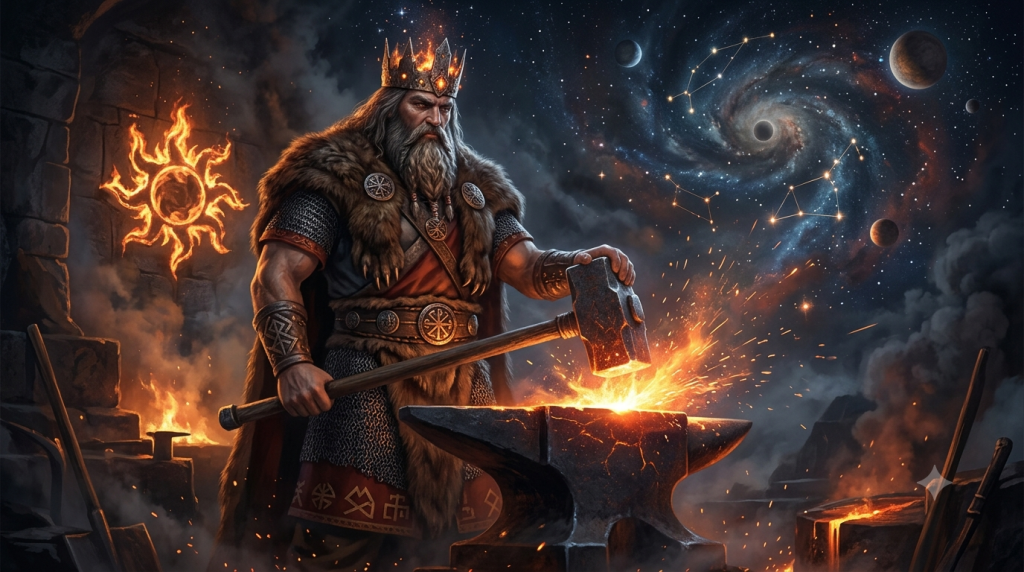
Svarog is the Slavic god of celestial fire and the sky, the divine smith whose forge produces the sun and whose fires light both the heavens above and the hearths below. His name derives from the Sanskrit svarga, meaning heaven or sky, which places him in the oldest stratum of Indo-European divine tradition alongside the other sky gods of the ancient world. He is the father of Dazbog, the sun god, and of Svarozhich, the god of earthly fire, which positions him as the origin point of divine fire in all its forms — the fire in the sky that gives light and warmth, and the fire on earth that enables civilisation.
Svarog is less prominent in the surviving Slavic sources than Perun or Veles, but his importance to the tradition is encoded in his position as the father of the most practically vital divine forces: without the sun there is no harvest, and without fire there is no metalwork, no cooking, no warmth through the Slavic winter. He is the god whose gifts make everything else possible.
The Divine Smith
The celestial smith who forges the sun and the stars is one of the oldest divine archetypes in Indo-European religion, appearing in various forms across traditions that share the Slavic world’s ancient roots. The Greek Hephaestus, the Norse Loki in his occasional craftsman role, the Vedic Tvastr: all represent different expressions of the same divine principle, the god who makes things through the application of fire and skill.
Svarog’s smith aspect connects him to the practical veneration of fire in Slavic culture. The blacksmith’s forge was understood as a sacred space, a place where divine fire was being used in a way that mimicked Svarog’s own celestial work. Blacksmiths held a specific supernatural status in many Slavic communities, both respected for their craft and treated with the kind of wary regard that is given to people who work with forces that ordinary community members cannot fully control.
Fire and the Hearth
Svarog’s connection to earthly fire through his son Svarozhich gave him a presence in every Slavic home that contained a fire, which meant every Slavic home without exception. The hearth fire was not simply a practical resource. It was a divine presence, a fragment of Svarog’s celestial fire brought into the domestic space, and it was treated with corresponding respect. Letting the hearth fire go out was a serious matter. Throwing refuse into it was an offence against the divine principle it represented.
The continuity between the celestial fire of the sun, the forge fire of the smith, and the hearth fire of the home gave Svarog’s tradition a coherence that connected the cosmic and the domestic in a way that made his worship immediately relevant to daily life. He was not a remote sky god whose concerns were too large for ordinary human engagement. He was present in the fire that cooked the meal and warmed the house, which is about as present as a god can get.
Svarog After Christianity
The Slavic Primary Chronicle identifies Svarog with Hephaestus in a passage that also describes Dazbog as equivalent to the sun god Helios, which tells us something about how the Byzantine Christian missionaries who wrote the chronicle understood the Slavic divine tradition: they mapped it onto the Greek pantheon they knew, finding structural equivalents rather than simply dismissing it as primitive.
After Christianisation, Svarog’s fire associations were distributed across several Christian saints. Saint Cosmas and Saint Damian, patron saints of blacksmiths, absorbed some of the craft and fire associations. The sacred hearth fire continued to be maintained in many Slavic households as a folk practice long after the theological framework that gave it meaning had officially been replaced.
For more on the Slavic tradition, the Perun article covers the thunder god who shares the sky domain with Svarog. The Veles article covers the underworld god whose opposition to the sky gods defines the Slavic cosmos. The Slavic Mythology hub page has every article in the cluster.
Never miss a myth
Thank you for being here. The site is brand new and every subscriber genuinely means something to me. If you're here, you care about this stuff as much as I do - and that's all the reason I need to keep going. New stories, videos and dark folklore from around the world, straight to your inbox. No algorithm. Just the stories, when they're ready.