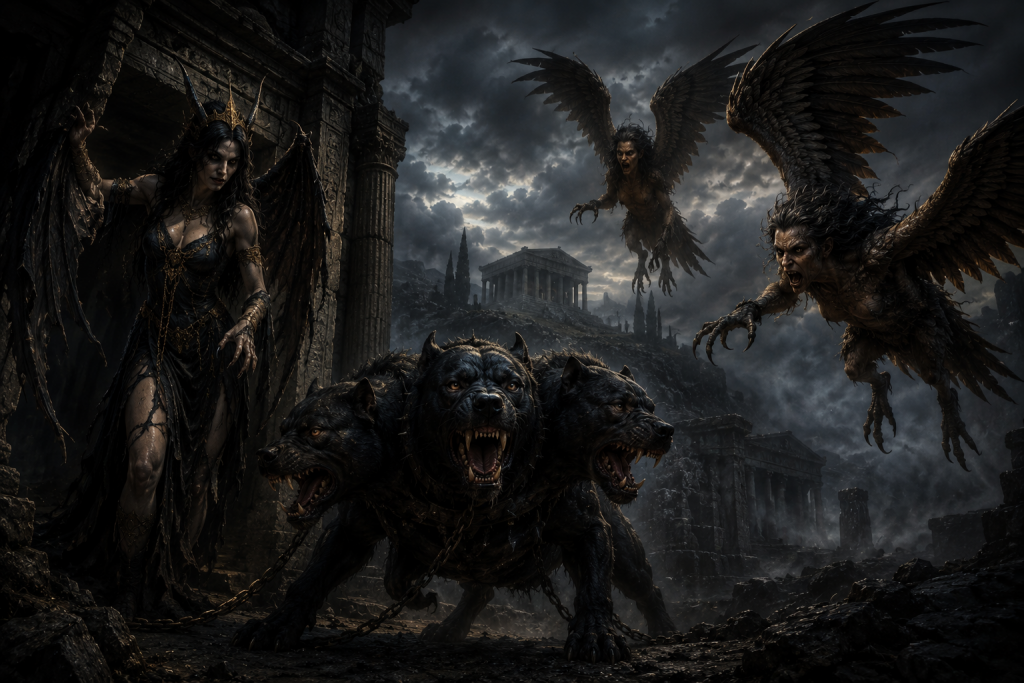
La Vouivre is a creature from the folklore of eastern France, particularly the Franche-Comté, Burgundy, and Jura regions, and she is one of the most distinctive supernatural beings in the French tradition. She is a winged serpent of enormous size, a dragon in the original sense of the word before that word was narrowed to mean the fire-breathing creature of high fantasy, and she carries a single precious stone set in her forehead that blazes with light as she flies. When she descends to water to bathe, she removes the jewel and sets it on the bank. That moment is the only moment she is vulnerable.
The Vouivre tradition is hyperlocal in a way that distinguishes it from broader mythological traditions. She is not a generic dragon. She inhabits specific valleys, specific rivers, specific caves in the limestone country of eastern France, and the communities that told stories about her attached her to real places that they knew and could point to. The cave where she sleeps. The river where she bathes. The field where she was last seen crossing at dusk. The specificity is part of the tradition’s power: she is not a creature from somewhere else. She is from here.
The Jewel
The carbuncle or precious stone that the Vouivre carries in her forehead is the central element of the tradition and the basis for most of the stories told about her. When she flies, the stone blazes and her passage through the night sky looks like a shooting star or a comet. When she lands to bathe in a river or spring, she removes it and places it on the bank, and in that moment she is blind and vulnerable.
The stories that developed around this vulnerability follow a consistent pattern. A young man learns that the Vouivre bathes at a specific location at a specific time. He goes there to steal the jewel. He succeeds in taking it while she is in the water. She cannot pursue him because without the jewel she cannot see. But the jewel burns his hands, or compels him to return it, or brings misfortune on everyone who touches it, and the young man ends up worse off than he started. The Vouivre’s vulnerability is real but exploiting it costs more than it gains.
This narrative structure, in which the seemingly vulnerable monster is actually protected by the consequences of stealing its power source, encodes a practical wisdom about the dangers of greed and of attacking forces that appear weakened. The Vouivre can be robbed, technically. But the jewel exacts its own revenge on those who take it.
Regional Distribution
The Vouivre tradition is concentrated in the eastern French regions where the landscape itself encourages it: the limestone plateaux of the Jura, with their caves and underground rivers, the wooded valleys of the Franche-Comté, the wetlands and rivers of Burgundy. These are landscapes where something large could plausibly hide, where underground water systems create unexpected springs and disappearing rivers, where the play of light on water at dusk could be mistaken for something luminous moving through the sky.
Marcel Aymé, the French author, used the Vouivre as the basis for his 1943 novel La Vouivre, in which she appears as a beautiful naked woman who carries the jewel and is accompanied by vipers, emerging from the marshes of the Franche-Comté. Aymé’s version is the most widely known literary treatment of the tradition and introduced the Vouivre to a French national audience beyond her home region.
Connection to the Wider Serpent Tradition
The Vouivre belongs to a broader European tradition of treasure-hoarding serpents and dragons whose wealth is connected to their supernatural nature. The Norse Fafnir, the dragon on the Rhine whose gold Siegfried takes, shares the basic structure of a supernatural serpent associated with wealth that can be taken but only at catastrophic cost. The jewel in the Vouivre’s forehead is her version of this hoard: concentrated, specific, and ultimately more dangerous to those who take it than to the creature who carries it.
For more on the folklore of France, the Mélusine article covers the serpent fairy queen whose tradition also comes from eastern France. The Loup-Garou article covers the French werewolf tradition. The France folklore hub page has every article in the cluster.
Never miss a myth
Thank you for being here. The site is brand new and every subscriber genuinely means something to me. If you're here, you care about this stuff as much as I do - and that's all the reason I need to keep going. New stories, videos and dark folklore from around the world, straight to your inbox. No algorithm. Just the stories, when they're ready.