
The most powerful weapon in the Norse cosmos exists because Loki cut off a goddess’s hair for no particular reason. Sif, Thor’s wife, woke one morning to find her golden hair gone. Loki had cut it off while she slept. Why he did this is not explained in the sources. He simply did it, as he occasionally did things: because he could, because it amused him, because the immediate consequences did not concern him.
The consequences turned out to concern him significantly. Thor threatened to break every bone in his body. Loki went to the dwarves of Svartalfheim to commission replacement hair, and while he was there he made a bet he nearly lost, which produced Gungnir, Skidbladnir, Draupnir, Gullinbursti, and Mjolnir: five of the greatest objects in the Norse cosmos, including the hammer that defines the god of thunder’s identity and the weapon that kills the World Serpent at Ragnarök.
All of this traces back to Loki cutting off hair he had no reason to cut off. The Norse tradition is full of chains of consequence that begin with a trivial act of mischief and end at the structural foundations of the cosmos.
The Sons of Ivaldi and the First Commission
Loki went to the Sons of Ivaldi, a group of dwarven craftsmen who lived in the caves of Svartalfheim, and commissioned replacement hair for Sif. The new hair would be made of actual gold and would grow like real hair once placed on her head. The Sons of Ivaldi produced it, along with two additional objects that Loki could use to appease the other gods: Skidbladnir, the greatest of all ships, which always finds a favourable wind and can be folded into a pocket when not in use; and Gungnir, the spear that becomes Odin’s defining weapon and that Odin throws into the host of the Vanir at the beginning of the Aesir-Vanir War.
Loki returned from the caves with three objects of extraordinary quality. Then, characteristically, he pushed further. He approached the brothers Brokkr and Eitri in their forge and told them he was certain they could not produce anything as fine as what the Sons of Ivaldi had made. He was so certain, he said, that he was willing to bet his head on it.
This was a bet he had no particular reason to make. The objects he already carried were sufficient to resolve the problem he had caused. The additional bet was pure appetite for risk, which is consistent with how the tradition presents Loki throughout the mythology: not simply mischievous but constitutionally unable to leave a situation at the level of sufficiency when excess was available.
Who Brokkr and Eitri Were
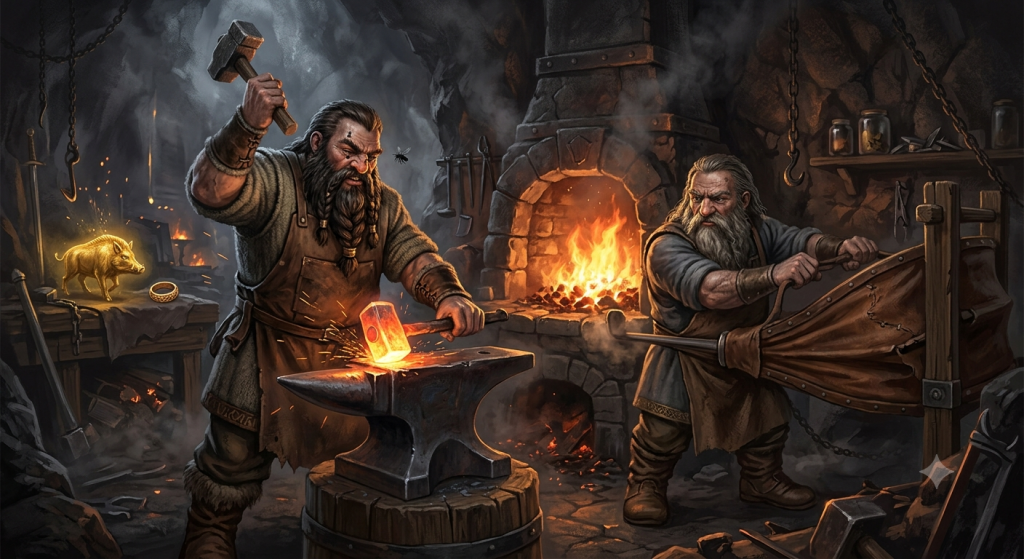
Brokkr and Eitri are brothers who live and work in Svartalfheim, the underground realm of the dwarves. Their names encode their functions: Brokkr means something like the one who works with metal fragments, connected to the word for a blacksmith’s scattered metal workings, while Eitri has been translated as metalworker or spark-sprayer, which gives Sindri as an alternative name in some sources. The two brothers divide their labour precisely: Eitri is the forger, the one who places material in the hearth and shapes it, while Brokkr works the bellows that keep the forge fire at the temperature required for the work.
Dwarves in Norse mythology are the finest craftspeople in the nine worlds. They made Gleipnir, the impossible ribbon that bound Fenrir. They made the treasures Loki commissioned from the Sons of Ivaldi. They made the Mead of Poetry from Kvasir’s blood. The underground craftsmen of Svartalfheim produce objects of supernatural quality that no being in the above-ground worlds can match, and their work is consistently central to the mythology’s most important events and objects.
Brokkr and Eitri accepted Loki’s bet without apparent hesitation. Their confidence was justified. They proceeded to produce three objects that the gods judged superior to everything the Sons of Ivaldi had made.
The Three Forgings and the Fly
Eitri placed pigskin in the hearth and told Brokkr to work the bellows without stopping regardless of what happened. The bellows had to be kept going continuously or the quality of the work would suffer. Then Eitri left to attend to other matters.
Loki, watching this proceed and realising the bet was going to be lost, transformed himself into a fly and bit Brokkr on the arm. Brokkr kept working. The boar Gullinbursti emerged from the forge: a golden pig whose bristles shine so brightly that they illuminate the darkness as it runs across land, sea, or sky. It was given to Freyr.
The second forging used gold. Loki bit Brokkr on the neck. Brokkr kept working. The ring Draupnir emerged: the gold ring that produces eight identical rings of equal weight every ninth night. It was given to Odin and placed on Baldr’s funeral pyre, from which Hermod retrieved it on his journey to Hel.
The third forging was the hammer. Eitri placed iron in the hearth and again told Brokkr not to stop. Loki bit him between the eyes. This time Brokkr stopped, just for a moment, just long enough to shake his head against the pain.
The handle came out too short.
Mjolnir emerged from the forge as the most powerful weapon in the Norse cosmos with a handle too short to be wielded with two hands. The flaw was permanent and irreparable. Despite it, the gods judged Mjolnir the greatest of all the treasures produced, because its capacity to kill giants and be thrown and return to Thor’s hand made it more valuable in practical terms than anything else they had received, whatever its handle length.
Brokkr and Eitri had won the bet. Loki owed them his head.
The Legal Argument and the Mouth
When Brokkr and Eitri arrived to collect, Loki produced an argument that is simultaneously completely absurd and technically correct. The bet, he pointed out, specified his head. It said nothing about his neck. They could not cut off his head without touching his neck, and his neck was not part of the wager.
The gods, apparently, agreed that this was a valid point. The tradition does not record anyone challenging the legal reasoning, which suggests either that the Norse tradition took oath-language extremely seriously as a matter of formal construction, or that nobody particularly wanted to see Loki decapitated and the argument gave them a way out. Possibly both.
Brokkr, unable to take the head without the neck, made the best of the situation. He took a needle and thread and sewed Loki’s mouth shut. The punishment matched the offence with a certain precision: Loki’s mouth, which had produced the bet and the mockery of their craft, was closed by the craftsmen his mockery had underestimated.
The sewing is temporary in the tradition’s narrative sequence. Loki’s mouth is not permanently closed, and he continues to speak throughout the subsequent mythology. The Skáldskaparmál records the story without specifying when or how the thread was removed. Loki simply has his mouth sewn shut and then, in later stories, does not. The tradition is comfortable with this gap.
The Snaptun stone, a carved hearthstone found in Denmark dating to around 1000 AD, depicts a face with stitched lips that is widely interpreted as Loki bearing the consequences of his wager with Brokkr and Eitri. If the identification is correct, it is one of the clearest pieces of physical archaeological evidence for a specific Norse mythological narrative, carved by someone who knew the story and found it worth preserving in stone.
What They Made and Why It Matters
The five objects produced by the two forging contests are among the most structurally important in Norse mythology, and it is worth taking them seriously rather than simply listing them.
Sif’s golden hair is the least discussed but in some ways the most interesting. The replacement for hair Loki destroyed is made of actual gold that grows like real hair, which raises questions about what Sif is and what her hair represents that the tradition does not fully answer. Her hair being golden has led some scholars to interpret her as a grain goddess or an earth figure, with the golden hair representing the ripeness of crops. Loki cutting it off and the replacement being made by dwarves would then encode something about seasonal cycles and the relationship between destruction and renewal. This interpretation is not established by the sources but it is consistent with them.
Gungnir, Odin’s spear, is the weapon he throws at the onset of the Aesir-Vanir War: the first offensive act in the first war in the world. It is also the weapon with which he is associated throughout the tradition, the defining object of the Allfather in the same way that Mjolnir is the defining object of Thor.
Skidbladnir, Freyr’s ship, always finds a favourable wind and can be folded into a pocket. Its name means something like assembled from thin pieces, and it represents the ideal of craftsmanship: an object so precisely made that it functions perfectly under any conditions and requires nothing of its user except the decision to use it.
Draupnir, Odin’s ring, produces eight identical rings every nine nights. The production of value from value, the ring that generates rings, makes it the most literally productive object in the tradition and a fitting possession for the god who accumulates resources across the entire mythology in preparation for Ragnarök.
Mjolnir’s short handle is covered in detail in the Thor article on this site. What is worth adding here is the specific mechanism of the flaw: one bite too many, one moment of pain that broke Brokkr’s concentration for just long enough. The most powerful weapon in the cosmos has its defining imperfection not from a design failure but from an act of sabotage that very nearly worked completely. Loki almost prevented Mjolnir from being made at all. What he actually did was ensure it was made with a flaw that is inseparable from the weapon’s identity.
Brokkr and Eitri in God of War
Brok and Sindri in the God of War games are based directly on Brokkr and Eitri, with Sindri being an alternative name for Eitri used in some sources. The games are broadly faithful to their mythology: two dwarven brothers with exceptional craftsmanship who made Mjolnir and who serve as the player’s primary equipment upgraders throughout both games.
The games expand them into full characters with personal histories, a complicated brotherly relationship, and significant emotional arcs across the two games, culminating in Brok’s death and Sindri’s transformation from a gentle, hygiene-obsessed craftsman into the being who ultimately destroys Odin’s soul. This goes considerably beyond what the tradition preserves about them, but the core, two dwarven brothers who made the greatest weapons in the cosmos and who had dealings with Loki that ended with Loki’s mouth being dealt with, is drawn directly from the Skáldskaparmál.
Further Reading
If this article sparked your interest, these are the books worth reading next.
Norse Mythology
by Neil Gaiman — the most accessible modern retelling of the Norse myths, written with genuine respect for the source material.
The Prose Edda (Penguin Classics)
by Snorri Sturluson — the thirteenth century Icelandic text that is the primary source for almost everything we know about Norse mythology.
The Viking Spirit
by Daniel McCoy — the best modern scholarly introduction to Norse mythology, written for general readers without being dumbed down.
For more on the objects Brokkr and Eitri produced, the Thor article covers Mjolnir in detail including what the short handle actually means and the archaeological evidence for its use as a religious symbol. The Loki article covers the figure whose appetite for risk produced the bet, and whose mouth was sewn shut when he won the argument about the neck. The Freyr article covers Gullinbursti and Skidbladnir in the context of Freyr’s full mythology.
Never miss a myth
Thank you for being here. The site is brand new and every subscriber genuinely means something to me. If you're here, you care about this stuff as much as I do - and that's all the reason I need to keep going. New stories, videos and dark folklore from around the world, straight to your inbox. No algorithm. Just the stories, when they're ready.

