
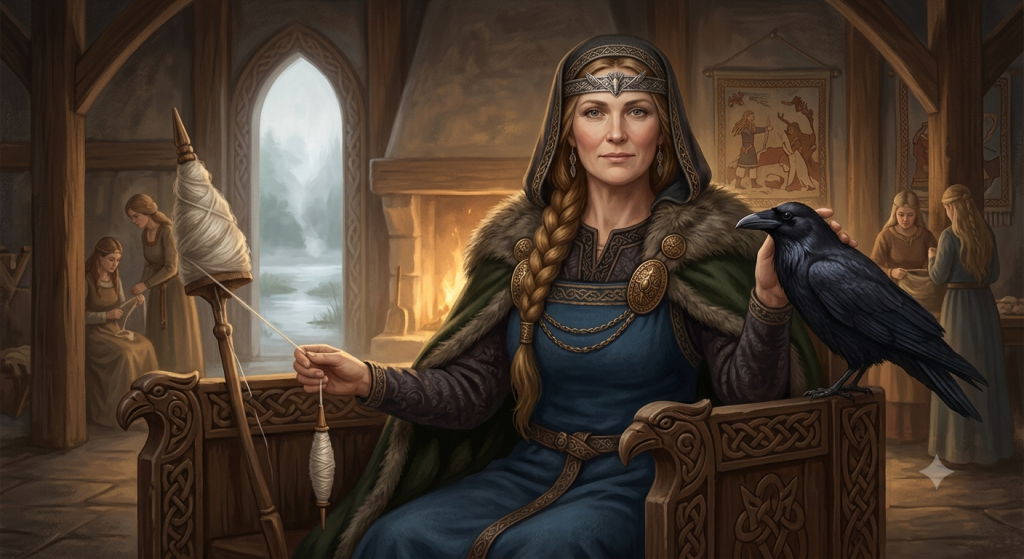
Frigg knows the fates of all beings. This is stated clearly in the sources: she possesses the gift of prophecy and knows the destiny of every god and human in the Norse cosmos. She knows what will happen to Odin at Ragnarök. She knows what will happen to Baldr before the dreams begin. She knows the outcomes of things before they have started.
And she does not say what she knows.
This silence is the most distinctive thing about Frigg and the thing that most popular treatments of her miss entirely. She is Odin’s wife and his equal in wisdom, but where Odin has spent centuries pursuing knowledge at any cost, sacrificing an eye and hanging from a tree and riding to consult the dead, Frigg simply has the knowledge and keeps it. She is the Norse cosmos’s most informed being and its most deliberately silent one, and the combination produces a character whose restraint is itself a kind of power.
The one time she breaks that restraint, in the Baldr myth, she does not simply speak the knowledge she has. She acts on it, crossing all nine worlds to extract protective oaths from every substance in existence. The action fails. Her son dies anyway. The knowledge she kept silent could not have prevented it, and the action she took could not prevent it, and the tradition’s most active myth about Frigg is the story of a mother who tried everything and lost.
Who She Was
Frigg is the wife of Odin and the highest-ranking of the Aesir goddesses, the queen of the Norse divine community in the most formal sense. Her father is Fjörgynn, a figure whose name is connected to the earth and sky and who appears in the sources primarily as Frigg’s parentage rather than as an independent character. She lives in the hall Fensalir, the fen halls or marsh halls, a wetland dwelling that places her in a liminal landscape between water and land consistent with her association with foresight and the boundary between what is known and what is revealed.
She is the mother of Baldr, the most beloved of the gods, and of Höðr, the blind god who is tricked into killing his brother. She has several divine attendants of whom the most important are Fulla, her handmaiden who carries her casket and knows her secrets, and Gná, her messenger who rides through the sky on the horse Hófvarpnir to carry Frigg’s errands across the worlds. The existence of a personal messenger suggests a goddess who communicates deliberately and indirectly rather than acting directly, which is consistent with her character more broadly.
Her domains in the tradition are marriage, motherhood, foresight, and the domestic sphere, which in the Norse context means the management of the household and the welfare of the family rather than anything diminishing. The domestic sphere in Norse culture was a domain of genuine authority and expertise, and Frigg as its divine patron represents a power that operates through those channels rather than through the combat and cosmic governance that define the male Aesir.
Friday
Friday takes its name from Frigg, from the Old English Frīgedæg, Frigg’s Day, which translates the Latin dies Veneris, the Day of Venus, in the same way that Tuesday translates the Day of Mars through Tyr and Thursday translates the Day of Jupiter through Thor. The identification of Frigg with Venus for calendar purposes connects her to the Roman goddess of love, beauty, and marriage, which is broadly consistent with Frigg’s own domains even if the identification is not precise in every detail.
Her name in Old Norse, Frigg, means beloved, from a Proto-Germanic root that also produces the modern English free and the German Friede, peace. The name is connected to love and to the condition of being cherished rather than to any specific domain or power, which is either a statement of her fundamental character or a very early layer of the tradition that does not fully capture who she became in the developed mythology.
Frigg and Freyja: The Problem
The relationship between Frigg and Freyja is the most discussed scholarly problem in Norse goddess studies, and it deserves honest treatment rather than the confident separation that most popular accounts maintain.
Frigg and Freyja share a remarkable number of characteristics. Both are associated with love and marriage. Both are associated with foresight and some form of magical knowledge. Both have connections to Odin: Frigg as his wife, Freyja as the Vanir goddess who taught him seiðr magic. Both are associated with the hawk cloak, a magical garment that allows its wearer to take hawk form. Both are associated with the domestic sphere and with spinning and weaving. Both give their names to the same day of the week in different Germanic languages, Frigg in the North Germanic tradition and a cognate of Freyja in some West Germanic traditions.
The scholarly hypothesis that the two goddesses were originally one deity, a Proto-Germanic goddess called Frija or Frijjō, who split into two distinct figures at some point in the development of the Germanic religious tradition, is supported by genuine comparative linguistic and mythological evidence. The name Frija is attested in the continental Germanic tradition and has characteristics of both the Norse Frigg and the Norse Freyja without being identical to either.
Why the split happened, if it happened, is not recoverable from the evidence. One possibility is that the Aesir-Vanir distinction in the Norse tradition required two separate goddesses, one for each divine group, and a single figure was divided to fill both roles. Another is that the two figures always existed as distinct beings in the Norse tradition and that their similarities reflect a shared cultural background rather than a common origin. The honest answer is that we do not know, and that acknowledging the genuine scholarly uncertainty is more useful than confidently asserting either a single origin or two entirely separate beings.
What is clear is that in the Viking Age Norse tradition as the Eddas preserve it, Frigg and Freyja are presented as distinct beings with distinct roles. Frigg is Odin’s wife, the queen of Asgard, and the mother of Baldr. Freyja is a Vanir goddess, the mistress of Fólkvangr, and the one who takes half the battle dead. They are not the same person in the sources, even if they may have been the same person at some earlier point in the tradition’s development.
The Grímnismál: When Frigg Won an Argument With Odin
The prose introduction to the Grímnismál, one of the poems in the Poetic Edda, contains the clearest demonstration of Frigg’s active intelligence in the entire tradition, and it is worth examining in detail because most accounts of Frigg reduce her to her role in the Baldr myth without acknowledging that she is also shown operating with considerable strategic sophistication in her own right.
Odin and Frigg are watching over two human foster sons: Agnarr, who is Frigg’s favourite, and Geirröðr, who is Odin’s favourite. Odin bets Frigg that Geirröðr will prove the better king. Frigg bets that he will not and then, without telling Odin, sends her messenger Gná to warn Geirröðr that a dangerous sorcerer is coming and that the sorcerer can be identified because no dog will attack him. When Odin arrives at Geirröðr’s hall in disguise, the dogs leave him alone and Geirröðr, warned by Frigg’s message, captures him and tortures him between two fires.
Odin eventually reveals himself and Geirröðr dies in the chaos that follows, which means Odin’s foster son has been destroyed partly as a consequence of Frigg’s intervention. She knew what Odin was planning. She countered it. She did not tell him she was countering it. She won.
The episode is characteristic of how Frigg operates: not through direct confrontation or through the use of power but through the careful deployment of information and the strategic use of her messenger network to shape events at a distance. She is the most knowledgeable being in the cosmos and she uses that knowledge with precision rather than simply holding it in silence.
The Knowledge She Kept
The most philosophically interesting thing about Frigg is the silence. She knows the fates of all beings and she does not speak them, and the tradition does not explain why. Is the silence prudential, a recognition that knowing the future and announcing it does not change it and may make things worse? Is it compassionate, a choice not to burden others with knowledge of their own ends? Is it simply the nature of the knowledge she holds, fate being the kind of thing that cannot be usefully communicated rather than simply chosen not to be?
The Baldr myth offers the most direct evidence for what the silence costs her. She knows Baldr will die. She does not announce this knowledge. Instead she acts on it, extracting the oaths that should have made him safe. But the knowledge she holds is not simply that Baldr will be killed: it is that everything the tradition values, the bright god, the beloved son, the best of the Aesir, will be taken from the cosmos before Ragnarök and will not return until after it. She is acting against what she knows cannot be stopped, in the full knowledge that it cannot be stopped, because the alternative is simply to know and do nothing.
After Baldr’s death, the Völuspá records that Frigg wept in Fensalir, her wet hall, for the second great grief of Frigg, the first being whatever loss is implied by that phrase that the tradition does not elaborate on. She is a goddess whose defining mythological moments are losses: the loss of Baldr, the failed attempt to retrieve him, the grief after. The knowledge she possesses gives her no protection from the outcomes she sees coming, and the silence she maintains means she bears that knowledge alone.
What she knows and does not say is the most powerful thing about Frigg in the tradition. Odin’s eye at the bottom of Mímir’s well is a sacrifice made for knowledge. Frigg’s silence is a sacrifice made from knowledge. The two postures toward what is known define the difference between the two most important figures in the Norse divine hierarchy.
Further Reading
If this article sparked your interest, these are the books worth reading next.
Norse Mythology
by Neil Gaiman — the most accessible modern retelling of the Norse myths, written with genuine respect for the source material.
The Prose Edda (Penguin Classics)
by Snorri Sturluson — the thirteenth century Icelandic text that is the primary source for almost everything we know about Norse mythology.
The Viking Spirit
by Daniel McCoy — the best modern scholarly introduction to Norse mythology, written for general readers without being dumbed down.
For more on the Norse tradition, the Baldr article covers the death of Frigg’s son in full, including the oath-taking campaign and what it cost. The Odin article covers her husband whose relentless pursuit of knowledge contrasts with her deliberate silence. The Norns article covers the other beings in the Norse tradition who possess knowledge of fate and whose relationship to speaking that knowledge is similarly complex.
Never miss a myth
Thank you for being here. The site is brand new and every subscriber genuinely means something to me. If you're here, you care about this stuff as much as I do - and that's all the reason I need to keep going. New stories, videos and dark folklore from around the world, straight to your inbox. No algorithm. Just the stories, when they're ready.

