
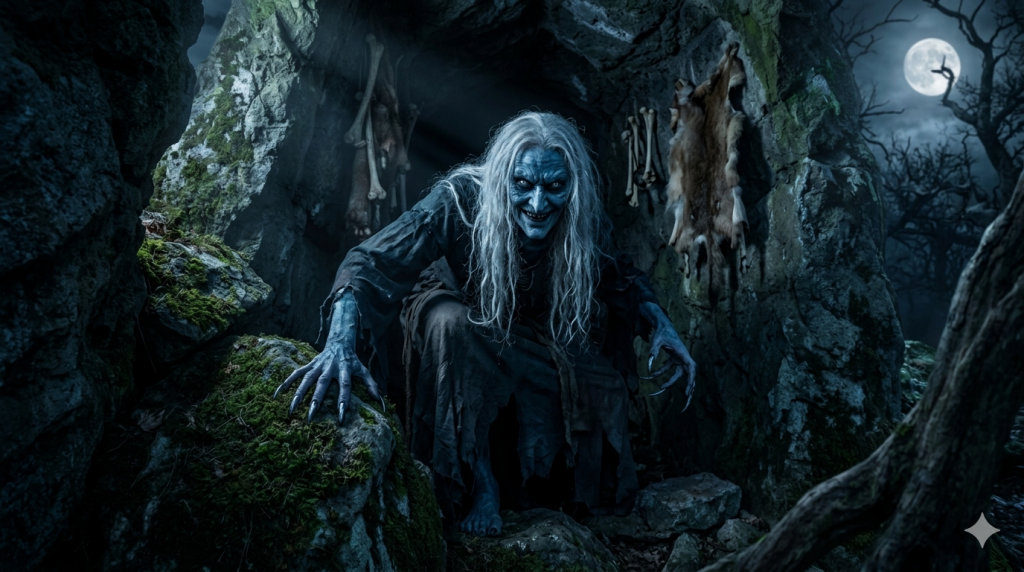
There is a cave in the Dane Hills on the western edge of Leicester that locals once refused to approach after dark. It is known as Black Annis’s Bower, and for centuries the story attached to it was consistent enough, and told with sufficient conviction, that it functioned as a genuine warning rather than mere entertainment. Something lived in that cave. Something old and blue-faced and iron-clawed, something that came out at night and took children, and adults too if they were careless, and draped their skins on the branches of a nearby oak tree when she was done with them.
Her name was Black Annis. And she is one of the most disturbing figures in English folklore.
The Dane Hills and the Cave She Dug Herself
The geographical specificity of the Black Annis tradition is one of its most striking features. She is not a vague, placeless hag. She belongs to a specific location, a specific cave, a specific tree, a specific stretch of landscape on the edge of a specific English city. That rootedness gives the legend a weight that more generalised monster stories often lack.
The cave known as Black Annis’s Bower was said to have been dug from the sandstone rock by Annis herself, using only her iron claws. Whether the cave was a natural formation, a hermit’s cell, or something else entirely has been debated by local historians for generations. What is agreed upon is that it existed, that it carried the name, and that the association was old enough by the time anyone thought to write it down that its origins had already been lost.
Near the cave stood an oak tree, ancient even by the standards of the area, in which Annis was said to hide and wait for passing children. She would crouch in the branches, concealed among the leaves, and drop on those who passed beneath. The skins of her victims she cured and dried on the branches of the same tree, a detail so specific and so horrible that it lodges in the memory with a persistence that more sanitised horror rarely achieves.
The cave and the oak are largely gone now, absorbed into the expanding city over the past two centuries. But the name persists on maps and in local tradition, and the landscape around the Dane Hills still carries something of the association, the way places that have held dark stories for long enough sometimes do.
What She Looked Like
The physical description of Black Annis is remarkably consistent across the sources that mention her, which span several centuries and include both formal antiquarian records and the kind of oral tradition that was still functioning in Leicester living memory within the last hundred years.
She was tall and gaunt, her face and hands a deep blue, her hair long and matted, her teeth iron and her claws iron, and she wore a skirt made from the skins of her victims. Her single eye, in some accounts, glowed in the dark. She was thin in the way that suggested not frailty but something closer to the opposite, a leanness that was all density and purpose, nothing wasted, everything directed toward the single aim of finding the next meal.
The blue skin is the detail that most demands attention. It appears in descriptions of other hag figures in British and Irish folklore, most notably the Cailleach, the great divine hag of Gaelic tradition whose face is described as blue or dark with extreme age and cold. The connection between blueness and the hag is old enough and widespread enough to suggest something more than coincidence. Blue was the colour of cold, of death, of things that existed at the extreme edges of the living world. A blue-faced woman in the old landscape was something that had moved beyond the ordinary categories of human existence.
Her iron claws and iron teeth are equally significant in folkloric terms. Iron is, across British and Irish tradition, the great protection against fairy and supernatural creatures. They cannot touch it, cannot abide it, flee from it. A creature made partly of iron is a creature that has taken the one thing that should repel it and incorporated it into its own body. This is not a being that can be easily warded off with a horseshoe over the door.
The Children She Took
The victims most consistently associated with Black Annis in the tradition are children, and the legend functioned in part as what folklorists call a nursery bogie, a frightening figure used by parents and nurses to keep children away from dangerous places or to ensure they were inside before dark.
Come in before night or Black Annis will have you. The precise words varied but the function was consistent. Stay away from the Dane Hills. Do not go out alone after dark. Do not let Annis hear you.
The use of monstrous figures to enforce boundaries and behaviours in children is ancient and cross-cultural, and it would be easy to dismiss Black Annis as simply a particularly vivid example of this tradition. But the persistence and specificity of the Leicester legend suggests something more than a convenient parental shorthand. The cave was real. The oak tree was real. The name was attached to actual geography in a way that implied the original storytellers were pointing at something, even if exactly what they were pointing at has become difficult to see clearly across the centuries.
Some of the accounts mention that Annis’s wailing could be heard from miles away on stormy nights, a howling carried on the wind that locals recognised and feared. This sonic element, the voice of the hag in the storm, connects her to a much wider tradition of supernatural women whose cries function as omens. The banshee of Irish tradition, the Cailleach howling through the winter winds, the various weeping women of folklore worldwide, all of them share this characteristic of making themselves known through sound before they are seen.
Easter Monday and the Drag Hunt
One of the most unexpected footnotes in the Black Annis tradition is an annual event that persisted in Leicester until the early nineteenth century, a ritual that appears to preserve, in heavily modified form, something much older than the hunt itself.
On Easter Monday, a drag hunt was held in which a dead cat soaked in aniseed was dragged from Black Annis’s Bower through the streets of Leicester to the Mayor’s house, with a pack of hounds in pursuit. The hunt was a popular local event, well attended and apparently enjoyed as a piece of civic festivity.
The symbolism embedded in this ritual is peculiar enough to reward attention. A hunt leading away from the hag’s cave, ending at the seat of civic authority. The use of a cat, an animal with its own longstanding associations with witchcraft and the supernatural in British tradition. The aniseed, which some have connected to the name Annis itself, though this etymology is disputed. The timing at Easter, the great Christian festival of death and resurrection, layered over a landscape that was already old with other associations.
What the Easter drag hunt originally commemorated, or enacted, or exorcised, is not recorded. By the time anyone thought to write it down it had already become a piece of local colour whose original meaning had been forgotten. But rituals like this rarely emerge from nothing. They are usually the residue of something older, the shell of a practice whose contents have been lost while the form persists through sheer cultural habit.
The Question of Her Origins
Where Black Annis came from, in terms of the deeper history of the figure, is a question that has generated considerable scholarly debate and no settled consensus.
The most widely discussed theory connects her to a real historical person: a fifteenth century anchoress named Agnes Scott who lived as a religious recluse in a cell in the Dane Hills. An anchoress was a woman who had herself walled into a small cell attached to a church or set into a landscape, living a life of prayer and contemplation in voluntary confinement. Agnes Scott’s cell was apparently in the area later associated with Black Annis, and some historians have argued that the folk memory of a solitary woman living in a cave-like dwelling in the Dane Hills was gradually transformed, over the generations, into something considerably less pious.
It is a plausible theory, and it has the virtue of explaining the geographical specificity of the tradition. But it does not fully account for the details, the iron claws, the blue face, the child-eating, the skins on the tree. These are not the characteristics that accrue to the memory of a holy woman, however much the passage of time distorts. They belong to a different category of figure entirely.
Other scholars have reached further back, connecting Black Annis to the Cailleach, the great hag goddess of Gaelic tradition who shaped the landscape with her hammer, who brought winter, who was older than the gods themselves in some tellings. The physical similarities are real. The blue face, the association with cold and darkness and wild places, the sense of something primordially ancient rather than merely old, all of these connect Annis to the Cailleach tradition in ways that feel more than coincidental.
There is also the possibility, which deserves more consideration than it sometimes receives, that Black Annis is not solely English at all. The hag figure appears across every culture that has dark forests and long winters in its history. She is not a local invention. She is a local expression of something far more widely distributed, a category of being that different cultures have encountered, named differently, and located in the specific dangerous landscapes of their own regions. If that is true, then the question of whether Black Annis belongs to Leicestershire specifically, or whether she or something very like her might have been at home in the ancient Caledonian pinewoods of Scotland, or the dark forests of mainland Europe, becomes considerably more interesting.
Boundaries meant nothing to the old things. They predate the maps.
A Hag for the Modern World
Black Annis has never entirely disappeared from the cultural landscape, even as the cave in the Dane Hills was swallowed by the expanding city and the oak tree came down and the Easter drag hunt faded into memory. She persists in local tradition in Leicester with a tenacity that speaks to the depth of the original impression.
She has attracted the attention of modern folklorists, pagans, and scholars of mythology who find in her one of the more uncompromised survivals of the hag tradition in English folklore. Unlike many British folk figures who have been softened or repackaged for more comfortable modern consumption, Black Annis resists domestication. She is not charming. She is not misunderstood. She does not have a sympathetic backstory that explains and excuses her. She is old and blue-faced and iron-clawed and she took children and hung their skins in a tree, and the tradition has never felt the need to apologise for any of that.
There is something clarifying about a monster that does not ask to be liked.
If you want more like this, the Tales of Myth and Magic newsletter delivers new creatures, legends, and forgotten folklore straight to your inbox.
No fixed schedule. No noise. Just the stories, when they are ready.
Sign up here →What Waits in the Dark Places
The cave in the Dane Hills is gone. The oak is gone. The city has grown over the landscape that Annis once claimed, and the children of Leicester are kept inside after dark by concerns their ancestors would have recognised in form, if not in the specific details.
But the figure herself persists, in the local tradition, in the academic literature, and in the stories people still tell about what might be out there in the wild places, in the old forests and the dark hills and the landscapes that have not yet been fully mapped and managed and made safe. Black Annis belongs to that category of thing. The thing at the edge of the firelight. The presence in the trees when the birdsong stops. The old hunger that was here before we arrived and may still be here, in some form, when we are gone.
She dug her cave with iron claws and she waited in her oak tree and she came out in the dark, and if you asked the people who told these stories whether they believed in her, they would probably have said something careful and non-committal.
But they still came in before nightfall. Every single one of them.
If you are interested in Black Annis, I believe I encountered her in the Black Wood of Rannoch, check it out here.
Never miss a myth
Thank you for being here. The site is brand new and every subscriber genuinely means something to me. If you're here, you care about this stuff as much as I do - and that's all the reason I need to keep going. New stories, videos and dark folklore from around the world, straight to your inbox. No algorithm. Just the stories, when they're ready.

Pingback: Bodach: The Old Man Who Comes in the Night - Tales of Myth and Magic