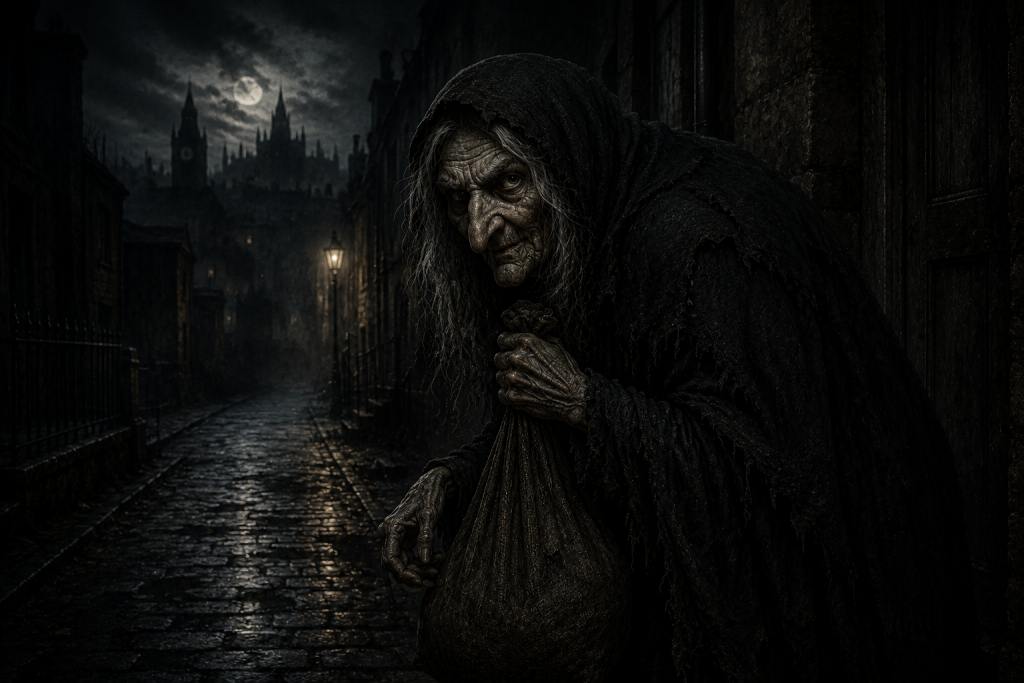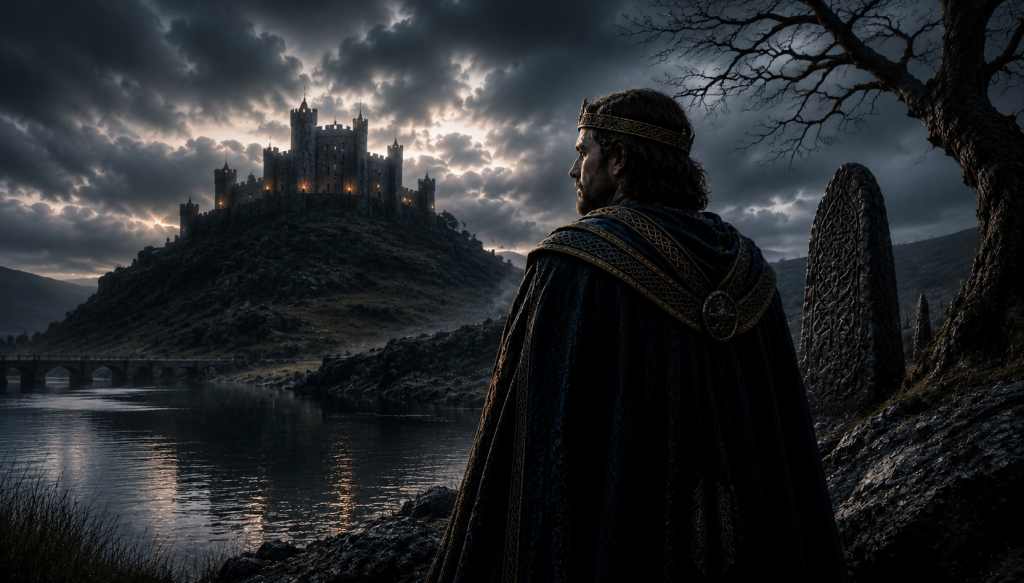
Somewhere in a field in rural Scotland, a corner was left unploughed. Not by accident. Not through laziness. By design. The farmer who owned that field knew better than to cultivate every inch of it. That small, deliberate patch of wasteland had a tenant, and the tenant was the Devil, and as long as the arrangement was honoured, the rest of the harvest would be safe.
A Nation at Home With Its Devil
Few countries have had as comfortable, as complicated, and as creatively rich a relationship with the Devil as Scotland. In much of Western Christian tradition, Satan is a figure of absolute dread, to be feared, prayed against, never named, never approached. In Scotland, particularly in its folk traditions, something considerably more ambivalent developed, a relationship built on mutual acknowledgement, careful management, and a very Scottish understanding that even the worst neighbour is easier to deal with if you know his habits and keep him at arm’s length.
Scotland’s Devil had dozens of names, and the names themselves reveal the character of the relationship. The most common was Auld Clootie, from the Scots word cloot, meaning one division of a cloven hoof, a name that acknowledged his most distinguishing physical feature with a familiarity that bordered on affection. He was also Auld Nick, Auld Hornie, the Earl o’ Hell, the Wee Man, and the obscure but perfectly satisfying Plotcock. Sometimes he was given names that veered toward the ironically respectful: the Lucky Piper, because his musicianship was undeniable, and most strikingly the Gudeman, meaning the good man of the house.
Calling the Devil the Gudeman was not an accident. It came from a specific tradition found across parts of rural Scotland in which a small corner of a field was deliberately left uncultivated, known as the Gudeman’s Croft. This patch of ground was the Devil’s portion, offered to keep him and his various supernatural associates satisfied and prevent them from ruining the crops on the rest of the land. It was not worship. It was pragmatic negotiation, the same logic that leaves a saucer of milk out for the fairy folk. You acknowledged the dangerous presence in your landscape and you gave it something, and in return it left you alone.
The Church did not approve. The Gudeman’s Croft tradition was condemned by the Scottish General Assembly in 1594, though condemnation from Edinburgh had limited influence over what a farmer in Aberdeenshire or Ayrshire decided to do with the corner of his field on a November evening. The tradition persisted for generations after it was officially forbidden, which says something important about how deeply embedded the underlying belief was, and how seriously people took the consequences of neglecting it.
A Devil Who Could Be Outmanoeuvred
The Scottish Devil was formidable but not infallible. Across the rich tradition of Scottish folk stories and legends, he is frequently outwitted, outrun, or simply talked into a bad deal, and the people who manage it are often not heroes in any conventional sense but ordinary Scots with quick wits and a healthy disrespect for authority, even diabolical authority.
The Wizard of Reay, originally a man named Donald Mackay who studied the dark arts under the Devil himself, provides one of the most satisfying examples of this. The arrangement for learning under the Devil was standard in its grim logic: the payment would be the soul of whoever was last to leave the classroom when lessons concluded. As the students made for the door at the end of their final session, Mackay realised he was at the back of the queue with no time to push to the front. His response was immediate. He shouted “De’il tak the hindmost!” and slipped out the door, leaving only his shadow behind him. The Devil, technically bound by the terms, took the shadow instead of the man. Mackay went on to practise his arts in considerably more remote and hidden corners of the Scottish landscape, where a man without a shadow would attract less comment.
In another tradition recorded across multiple Scottish counties, the Devil was known to be good at every trade and occupation except one: tailoring. The reason given for this gap in his otherwise comprehensive skills was simple. Whenever the Devil appeared among tailors, they closed their shops and refused to work until he left. The Devil therefore never had the opportunity to learn the trade. In a country where tailors served every household and their craft was woven into daily life, this small immunity was noted and evidently treasured.
The inability to disguise his feet was the Devil’s most consistent weakness across Scottish folklore. He could take any form, adopt any face, speak any language, produce any credential, but the cloven hooves remained. Wherever he walked, whatever guise he wore, the feet gave him away to anyone who knew to look at them. It is a detail that recurs with remarkable consistency across different stories in different regions, and it shaped a specific practical habit: the polite but pointed custom of looking at a stranger’s feet before trusting them with anything important.
Robert Burns and the Devil at the Kirk
No account of the Devil in Scotland could be complete without Robert Burns, who had one of the most productive and complicated literary relationships with Satan in the history of Scottish writing.
Burns’s 1785 poem Address to the De’il is partly mocking, partly grudgingly admiring, and entirely characteristic of Burns’s refusal to simply follow the line on anything. While his contemporaries were straightforwardly condemning the Devil from their pulpits, Burns was addressing him directly and with something approaching peer-to-peer frankness, pointing out the absurdity of a Scotland that blamed an invisible supernatural figure for milkless cows and impotent husbands, while simultaneously acknowledging that old Nick had been around long enough to deserve a certain historical respect.
His masterpiece on the subject is Tam o’ Shanter, published in 1791, which takes the Devil to the ruins of Alloway Kirk in Ayrshire and gives him what might be his finest moment in Scottish literature. The drunken farmer Tam, riding home through a storm, stumbles on the old ruined church lit from within, where witches and warlocks are dancing to the music of Auld Nick himself on the bagpipes. Burns places the Devil at a church, in the precise location of Christian sanctity, playing Scotland’s own national instrument with evident relish while the dead dance around him. It is an image that manages to be simultaneously terrifying and darkly funny, which is essentially the Scottish relationship with the Devil distilled into a single scene.
The poem was written at the request of the antiquarian Francis Grose, who wanted a folk tale to accompany an illustration of the ruins of Alloway Kirk. Burns drew on local Ayrshire legend and produced something that has outlasted everything else written about that church by several centuries. The ruins still exist. Burns’s Devil still plays the pipes in them.
The Witch Trials and the Devil Made Flesh
The Scottish witch trials of the sixteenth and seventeenth centuries put a very different face on the Devil than the one found in folk tradition, transforming the manageable Auld Clootie of rural negotiation into something altogether more dangerous and more formally theological.
Scotland executed more people for witchcraft per capita than any other European country, with estimates ranging from 1,500 to 4,000 executions between the Witchcraft Act of 1563 and its repeal in 1736. The trials were shaped heavily by the continental concept of the diabolical pact, the idea that witches had entered into a formal contract with Satan, marking their commitment by renouncing their baptism and receiving a physical mark from the Devil that left a patch of skin permanently insensible to pain.
The confessions extracted during these trials, frequently under torture and isolation, are full of elaborate diabolical encounters: meetings in churchyards at night, the Devil appearing in black robes or as a black dog or as a handsome man at a crossroads, the formal signing away of souls, sabbaths where the Devil presided over rituals that inverted the structure of Christian worship. These confessions were shaped as much by the expectations of the interrogators, who often led their subjects toward specific answers, as by anything the accused had actually experienced.
Isobel Gowdie’s extraordinary 1662 confessions from Auldearn, which we have explored in the article on Elf-Shot, described the Devil as a presence in the witch’s kirk, a physical being who appeared to her, conducted rituals, and oversaw the coven’s operations. Unlike many accused witches who confessed only under pressure, Gowdie appeared to speak freely across four separate confessions over six weeks, and her accounts included such specific and lurid detail that they have fascinated historians ever since. Whether she was describing genuine experiences, shared delusion, the effects of prolonged isolation and interrogation, or something stranger still, nobody has ever been able to determine with confidence.
King James VI of Scotland, before he became James I of England, was personally obsessed with witchcraft and attended the interrogations following the North Berwick witch trials of 1590, in which a group of people were accused of raising storms to sink the ship carrying James and his new Danish bride home from Denmark. James later wrote Daemonologie, a treatise on witchcraft and the Devil published in 1597, in which he argued passionately for the reality of diabolical pacts and the necessity of prosecuting witches with the full force of law. His views directly influenced legislation and the prosecution of hundreds of people across Scotland in the years that followed. The relationship between the Scottish state, the Scottish church, and the Scottish Devil reached its most deadly peak on James’s watch.
The Gorge Where Satan Preached
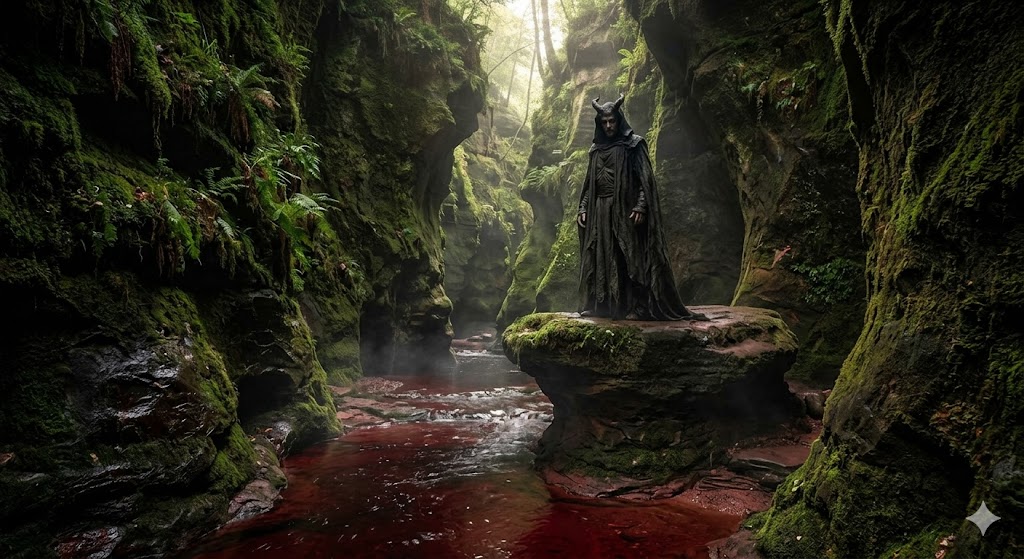
Hidden in the rolling farmland of Stirlingshire, around fourteen miles north of Glasgow and just south of the village of Drymen, a gorge cuts through the red sandstone bedrock in a way that most of the surrounding landscape gives absolutely no warning of. One moment you are crossing ordinary agricultural fields. Then the ground opens, and you are standing at the edge of a ravine that plunges anywhere from sixty to a hundred feet to the water below, its walls draped in thick moss, the narrow burn at the bottom running the colour of old blood.
This is Finnich Glen, and the specific rock formation at its deepest and most dramatic point is known as the Devil’s Pulpit.
The burn runs red because it flows through peat on its way down from the hills, staining the water with iron-rich compounds from the bog above in a way that is entirely natural and entirely explicable and does nothing whatsoever to make standing in the gorge feel any less unsettling. The walls are close enough together that the sky above is reduced to a strip of light. The moss grows so densely on the sandstone that the stone itself is barely visible, giving the rock faces a quality that is simultaneously lush and faintly suffocating. The water echoes in a way that makes it difficult to identify its direction.
The Devil’s Pulpit itself is a circular, mushroom-shaped rock formation that sits in the bed of the burn, surrounded by those blood-red waters. It resembles, with a precision that must have been immediately obvious to anyone who first named it, the raised wooden pulpit from which a preacher delivers a sermon to his congregation. The name it carries is the obvious one: legend holds that it was here that the Devil himself preached to his followers, addressing them from the rock with the red waters swirling around it, the moss-covered walls of the gorge providing a natural cathedral of stone around him.
Other traditions accumulated around the site over time. The gorge was said to have been a meeting place for Druids, who conducted rituals in its concealed depths far from any observation from the fields above. Witch burnings were associated with it in some accounts, the hidden location making it suitable for the kind of violence that preferred not to be witnessed too directly. The sheer inaccessibility of the glen for most of its history, the steep walls and the difficult descent, gave it a reputation for being a place where things happened that the surface world did not see.
The stairs cut into the rock at the northern end of the gorge, now known as the Devil’s Steps, were built around 1860, substantially after the name and the legends had already attached themselves to the site. Before those stairs existed, reaching the floor of the gorge required something more than a casual Sunday walk, which must have contributed significantly to its reputation as a place apart from ordinary life.
You can read more about the Devil’s Pulpit here!
If you want more like this, the Tales of Myth and Magic newsletter delivers new creatures, legends, and forgotten folklore straight to your inbox.
No fixed schedule. No noise. Just the stories, when they are ready.
Sign up here →Finnich Glen Today
The Devil’s Pulpit became significantly more widely known after the television series Outlander used Finnich Glen as a filming location in its first series, depicting it as a fictional spring with truth-telling properties. The episode in question, first broadcast in 2014, sent a wave of visitors to the glen that transformed a locally known curiosity into a site with international recognition almost overnight.
The resulting pressure on the site has been substantial. The access road is narrow and rural, cutting through working farmland, and the parking situation became chaotic enough to cause serious problems for local residents and the farmer whose land the glen adjoins. The descent to the gorge floor is genuinely challenging, on wet rock steps that have claimed a significant number of injuries and triggered multiple mountain rescue callouts over the years. Those who go down in trainers, rather than the waterproof footwear the terrain actually requires, do so at their own considerable risk.
The experience of standing at the bottom, if you arrive correctly equipped and at a time when the gorge is not crowded, remains something that most people find difficult to describe adequately afterwards. The containment of the walls, the colour of the water, the sound of the burn amplified by the rock around it, and the specific quality of the light that reaches the floor of the gorge create an atmosphere that justifies the legends attached to the place far more effectively than any amount of storytelling could.
Whatever the Devil was doing here, the gorge provided an appropriate venue.
What Scotland’s Devil Tells Us About Scotland
The richness and complexity of the Devil’s role in Scottish tradition reflects something specific and important about how Scotland has always navigated the relationship between the official and the unofficial, the sanctioned and the instinctive, the theology handed down from the pulpit and the practical beliefs shaped by living in a demanding landscape with dangerous neighbours, unpredictable harvests, and long dark winters.
The official Devil, the one prosecuted through the witch trials, terrified kings, and condemned from church pulpits, was an instrument of social and religious control, a figure so threatening that only the authorised channels of Church and state could properly manage him. The folk Devil, Auld Clootie, the Gudeman, the Lucky Piper, was something else entirely: a presence to be acknowledged, negotiated with, occasionally outfoxed, and given his small corner of uncultivated ground in the understanding that everyone, including the Devil, was easier to live with when their basic requirements were met.
Scotland managed both versions simultaneously, which required a considerable degree of mental flexibility and a very well-developed sense of dark humour. The Devil at Alloway Kirk playing the bagpipes while witches danced around him. The wizard who escaped with a shouted phrase and lost only his shadow. The field corner left unploughed because everyone knew better than to push their luck too far.
The gorge at Finnich Glen still holds the pulpit. The water still runs red. The legends are still there if you know to look for them, exactly where they have always been.
Further Reading
If this article sparked your interest, these are the books worth reading next.
Scottish Urban Legends: 50 Myths and True Stories
by Aaron Mullins — fifty Scottish urban legends including stories from Glasgow, Edinburgh, and the Highlands. The kind of tradition that Maggie Murphy belongs to, collected properly in one volume.
Scottish Urban Myths and Ancient Legends
by Grace Banks and Sheena Blackhall — vampires, werewolves, devil encounters, and the school playground legends of Scotland. A genuinely good collection of the stories Scots have been telling each other for generations.
The Lore of Scotland: A Guide to Scottish Legends
by Jennifer Westwood and Sophia Kingshill — the most comprehensive collection of Scottish legend in print, covering Glasgow to Shetland, exploring origins and historical basis. Endorsed by Terry Pratchett as the real macabre.
Never miss a myth
Thank you for being here. The site is brand new and every subscriber genuinely means something to me. If you're here, you care about this stuff as much as I do - and that's all the reason I need to keep going. New stories, videos and dark folklore from around the world, straight to your inbox. No algorithm. Just the stories, when they're ready.