Three barks. That is all the warning you get. The first means the Cù-Sìth has caught your scent somewhere out on the moor. The second means it is closer than you think. If you hear the third, you were never going to make it home at all.
A Dog Built From Fairy Logic, Not Nature
Scotland’s folklore is full of dangerous animals, but few are stranger than the Cù-Sìth, a creature whose entire design seems to follow rules borrowed from the fairy realm rather than from anything found in the natural world.
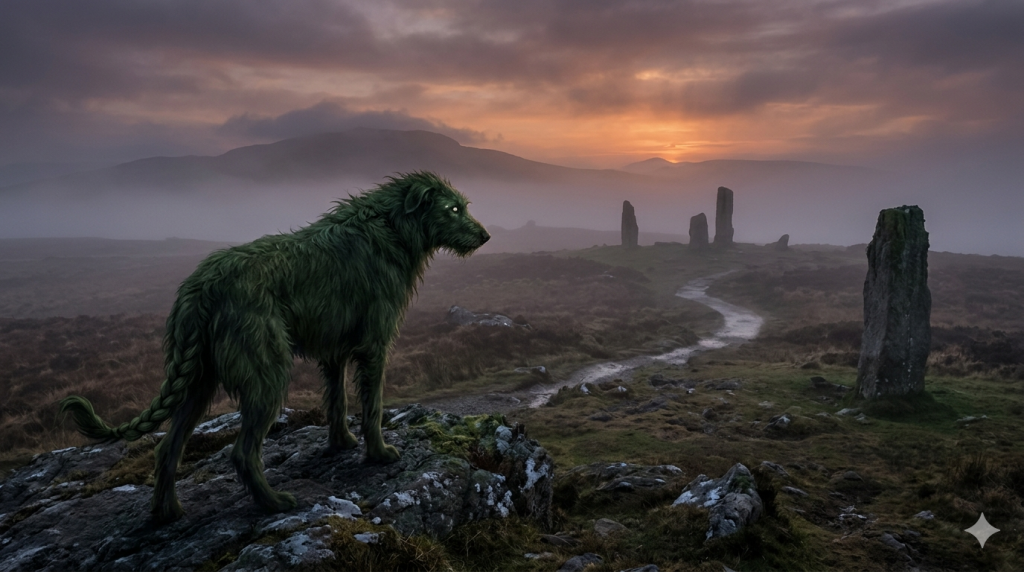
The name itself, pronounced roughly coo-shee, translates directly from Scottish Gaelic as fairy dog. According to the Reverend John Gregorson Campbell, a nineteenth century folklorist and Free Church minister who spent years collecting oral traditions from the Highlands and Islands before his death in 1891, the cù sìth was described by those who told its stories as being roughly the size of a two year old stirk, meaning a young bullock, with a coat of deep green and ears of an even deeper green, fading to a lighter shade toward its feet. Its tail, in many tellings, was long enough to be coiled or plaited on its back like a rope, and its paws were said to be as large as a grown man’s hand, leaving prints in mud or snow that anyone in the Highlands would recognise immediately and dread.
Every detail of that description matters more than it might first appear. Green, in Highland tradition, was the colour most consistently associated with the fairy realm, the world of the sìth from which the hound takes half its name. A natural animal does not come in fairy green. This was never meant to be read as an ordinary dog that happened to grow unusually large. It was something else entirely, wearing the shape of a dog because that shape served its purpose.
A Silent Hunter With One Terrible Warning
Most predators in folklore announce themselves through noise, through growling, through the crash of movement in undergrowth. The Cù-Sìth did the opposite, and that silence was precisely what made it so feared.
According to the old accounts, the hound moved across the moors and mountainsides in complete silence, gliding rather than running, covering ground in a straight, relentless line that gave its prey no warning of its approach. The only sound it ever made came not while it stalked, but once it had already locked onto a target. At that point, it would let out three loud barks, barks so powerful that sailors were said to be able to hear them from far out at sea.
The barks were not a threat. They were a countdown. Tradition held that the first bark signalled the hound had caught a scent and begun its hunt. The second meant it had drawn significantly closer. If a person heard the third bark before reaching safety, indoors, behind a locked door, within whatever boundary was believed to hold against it, their fate was already sealed. There was no fourth chance. The three bark structure turns up consistently enough across different tellings to suggest it was a genuinely held belief rather than a detail invented for dramatic effect, a piece of folklore specific enough that people who lived on the moors organised their behaviour around it.
A Death Omen With a Very Particular Appetite
Among the various spectral hounds found throughout British and Irish folklore, the Cù-Sìth occupied a particularly grim position. It was understood as a harbinger of death, but its role went further than simply predicting that someone was about to die.
In Highland tradition, when a person’s time came, it was believed something needed to carry their soul onward, whether toward the afterlife proper or into the fairy realm itself, the two often being only loosely distinguished in older Highland belief. The Cù-Sìth was that something. Where related creatures like the Cat-Sìth were said to be capable only of intercepting souls that had already departed the body, the Cù-Sìth was credited with the far more disturbing ability to pursue the souls of the living, hunting down a person before death had fully claimed them and ensuring they did not escape its passage to wherever they were meant to go.
This is also where the creature’s behaviour intersects with one of the most consistently documented fears in the wider body of Highland fairy folklore: the abduction of mothers and infants. According to Campbell’s research, an overwhelming proportion of fairy abduction tales in the Highlands centred specifically on women who had not yet fully recovered from childbirth, along with their newborns. The belief, as Campbell recorded it, held that fairy women were themselves unable to nurse their own children, creating a desperate motive to steal human mothers capable of doing so. Whenever the warning barks of a fairy hound were heard rolling across the moors at night, it was specifically women who were nursing infants who would be locked safely away indoors, the household acting on the understanding that this particular danger had a particular target.
Where the Hound Made Its Home
The Cù-Sìth was never described as a creature that simply wandered without purpose. It was understood to have a home, and that home tied it directly to the landscape features the Highlands are most famous for.
The clefts of rocks and the hollow spaces within ancient fairy mounds were where the hound was said to rest between hunts, narrow, hidden places that mirrored the broader Highland belief that such locations served as thresholds, points where the human world and the fairy realm pressed close enough together to allow passage between them. From these resting places it would emerge to roam the open moors and rocky hillsides that make up so much of the Highland landscape, territory vast and largely uninhabited enough that a creature moving in total silence could plausibly cover great distances without ever being seen directly, only heard, only tracked afterward by the enormous prints it left behind in mud, snow, or the sand of the Western Isles.
Specific locations recur often enough in the surviving folklore to suggest particular regional concentrations of belief, including the Cairngorms, the island of Tiree, where Campbell himself served as minister for many years, and areas surrounding Ruthven Castle. This regional specificity is itself a useful piece of evidence. Genuine folk belief, the kind passed down through real communities over generations, tends to attach itself to real, nameable places rather than floating free of any geography, and the Cù-Sìth’s territory maps clearly onto exactly the kind of remote, dramatic Highland landscape where such a belief would have made immediate, practical sense to anyone living there.
If you want more like this, the Tales of Myth and Magic newsletter delivers new creatures, legends, and forgotten folklore straight to your inbox.
No fixed schedule. No noise. Just the stories, when they are ready.
Sign up here →Not Quite Alone in the Dark
The Cù-Sìth belongs to a much wider family of spectral hounds found throughout the British Isles and beyond, and placing it alongside its relatives helps clarify exactly what makes it distinct.
In Irish folklore, the cú sídhe serves an almost identical role, similarly tied to the fairy realm and similarly associated with guarding sacred ground and warning of death, sharing enough features with its Scottish counterpart that the two are generally treated as direct cousins rather than separate inventions. Welsh tradition offers the Cŵn Annwn, spectral hounds described as white with red ears rather than green, who were believed to chase the souls of the dying across the sky during the Wild Hunt, their distant howls said to grow quieter rather than louder as the hounds drew closer, inverting the usual logic of approaching danger in a way that made them, if anything, even more unsettling. England contributes Black Shuck, a great black dog of East Anglian legend tied to graveyards, lonely roads, and sudden misfortune, lacking the explicitly fairy origin of its Celtic counterparts but sharing the same fundamental role as a four legged death omen.
What sets the Cù-Sìth apart within this wider canine family is specifically its colour. Every other spectral hound across these traditions tends toward black, white, or some combination involving red. Green stands alone, and that singular choice ties the Cù-Sìth more tightly and more explicitly to the fairy realm than almost any of its counterparts elsewhere in the British Isles, marking it unmistakably as a creature that belonged to the sìth before it belonged to the moors.
Further Reading
If this article sparked your interest, these are the books worth reading next.
Scottish Urban Legends: 50 Myths and True Stories
by Aaron Mullins — fifty Scottish urban legends including stories from Glasgow, Edinburgh, and the Highlands. The kind of tradition that Maggie Murphy belongs to, collected properly in one volume.
Scottish Urban Myths and Ancient Legends
by Grace Banks and Sheena Blackhall — vampires, werewolves, devil encounters, and the school playground legends of Scotland. A genuinely good collection of the stories Scots have been telling each other for generations.
The Lore of Scotland: A Guide to Scottish Legends
by Jennifer Westwood and Sophia Kingshill — the most comprehensive collection of Scottish legend in print, covering Glasgow to Shetland, exploring origins and historical basis. Endorsed by Terry Pratchett as the real macabre.
Never miss a myth
Thank you for being here. The site is brand new and every subscriber genuinely means something to me. If you're here, you care about this stuff as much as I do - and that's all the reason I need to keep going. New stories, videos and dark folklore from around the world, straight to your inbox. No algorithm. Just the stories, when they're ready.