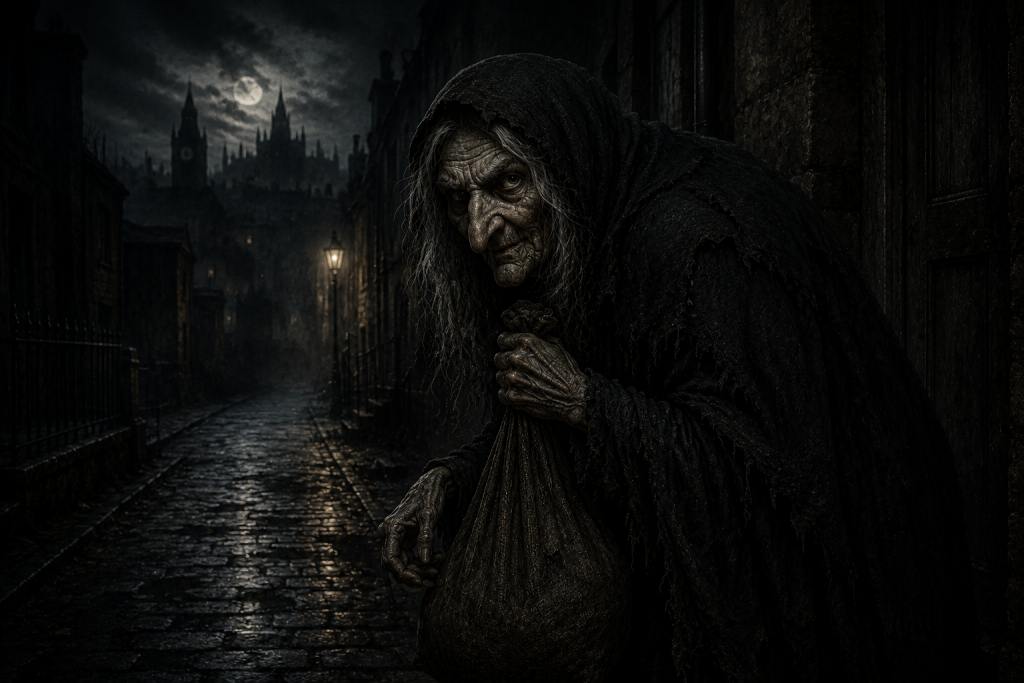
Somewhere in the ruins of a castle on the Anglo-Scottish border, something small and ancient crouches in the dark. It is watching the road. It is waiting. And its cap has begun to dry.
What is a Redcap?
Not every monster from the old stories is vast and unknowable. Some of the most unsettling creatures in folklore are the ones described in precise, specific detail, as if the people who named them had actually seen one.
The Redcap is described in Border folklore with uncomfortable clarity. Short and thickset, with the build of something that has survived centuries through sheer brutality. Its eyes are a deep, fiery red. Its fingers end in talons like an eagle’s. Its teeth are long and prominent, jutting from a face framed by wild, grisly hair. It carries a pikestaff in its left hand and wears iron-shod boots that should make it slow, cumbersome, easy to outrun.
It is not easy to outrun.
In every account, the Redcap is described as terrifyingly fast despite its iron boots, fast enough that flight is essentially pointless once it has marked you. And what it wants from you is simple. It needs your blood. Not out of hunger, not out of malice alone, but out of necessity. The cap it wears on its head is soaked in the blood of its victims, and if that blood ever dries completely, the Redcap itself will die. It must kill to survive. It must keep killing, again and again, to keep the cap wet.
In the folklore of the Scottish Borders it was also known as a Powrie or Dunter, and by the grimly straightforward name Bloody Cap. Whatever you called it, you did not want to meet one.
The Bloodiest Valley in Britain
The Redcap did not appear in pleasant, peaceful countryside. It was a creature born, almost literally, from centuries of warfare, and it haunted the places where that warfare had left its deepest marks.
The Scottish Borders were among the most violently contested stretches of land in medieval Britain. For generations, the region was caught between Scottish and English ambitions, fought over, raided, burned, and reclaimed in an endless cycle of bloodshed. The Border Reivers, the notorious raiding clans who operated across both sides of the frontier, made the area a byword for lawlessness and brutality. Author George MacDonald Fraser, writing about the Reivers, described Hermitage Castle in Roxburghshire as the guardhouse of the bloodiest valley in Britain.
It is no coincidence that the Redcap made its home in exactly these places. The ruins of castles where atrocities had been committed. Towers where prisoners had been left to die. Fortifications built on ground soaked in the blood of the defeated. The Redcap was the Border’s violence made flesh, a creature that could only exist where killing had already happened on a grand enough scale to feed its appetite.
It lurked in the broken walls and dark corners of these ruins, waiting for travellers foolish or unlucky enough to stray too close. There was no negotiation, no warning, no way to placate it. It killed because it had to, and because the land it occupied had been teaching things to kill for centuries.
Robin Redcap and the Lord of Hermitage
The most famous Redcap in Border legend did not lurk alone in an empty ruin. It had a master.
In the early fourteenth century, Hermitage Castle in Liddesdale was ruled by William de Soulis, a man so thoroughly loathed by history that he has become known simply as Bad Lord Soulis, or Terrible William. By the standards of a genuinely brutal era, de Soulis stood out. He was believed to practise the Black Arts, to steal children from local farming families for use in dark rituals at the castle, and to treat those under his authority with a cruelty that went well beyond the casual violence of the age.
According to legend, his cruelty attracted something. A Redcap appeared at Hermitage Castle, an ancient-looking creature with long fangs who called itself Robin Redcap, or sometimes Robin Sly. It made de Soulis an offer: complete protection from harm in exchange for free reign over the land around the castle and the victims who passed through it. De Soulis, being the sort of man he was, accepted without hesitation.
Robin Redcap’s protection was extensive. De Soulis could not be killed by any weapon of iron or steel. He could not be hanged. Walter Scott, collecting Border ballads in his 1802 work Minstrelsy of the Scottish Border, recorded the charm in verse:
“While thou shalt bear a charmed life, and hold that life of me, gainst lance and arrow, sword and knife, I shall thy warrant be.”
Protected by his demonic familiar, de Soulis became effectively unstoppable. Robin Redcap meanwhile killed freely, murdering travellers on the roads around Hermitage and dyeing its cap afresh in their blood.
The local population, driven beyond endurance, eventually rebelled. The protection granted by Robin Redcap covered iron, steel, and hanging, but the furious tenants of Hermitage found a way around the charm that the folklore preserves with considerable satisfaction. They wrapped de Soulis in a sheet of lead and boiled him alive in a cauldron set up at Ninestane Rig, a nearby circle of standing stones. The lead, the cauldron, and the fire were not weapons forbidden by the charm. It was, in its own way, a very Border solution to a very Border problem.
The historical record is less dramatic. William de Soulis was likely arrested for conspiring against Robert the Bruce and died in prison at Dumbarton Castle, which is considerably less poetic but probably more accurate. The boiling alive, satisfying as it is, appears to originate from a ballad probably written in the eighteenth century, possibly based on older stories about an earlier de Soulis ancestor.
After his master’s death, Robin Redcap vanished from Hermitage. But the legend persisted that the creature had accumulated a vast treasure during its time at the castle and had hidden it somewhere in the ruins before disappearing. Sightings of something small and hunched moving through the broken walls of Hermitage continued to be reported for years afterwards. People said the Redcap was coming back to search for what it had left behind.
How to Survive an Encounter
The Redcap’s one weakness, according to Border folklore, was faith.
A crucifix held up. Scripture spoken aloud with genuine conviction. The name of God invoked sincerely. Any of these would cause a Redcap to recoil, to shrink, to disappear in a shriek of rage. Some accounts describe it dissolving into smoke when confronted with a genuine expression of religious belief.
This is not simply a quirk of the legend. It tells you something about how the people of the Borders understood the creature. The Redcap was not a ghost, not a fairy in the gentle sense, not a trickster or a mischief-maker. It was a thing of active evil, and the only authority that could check active evil was spiritual rather than physical. Your sword would not help you. Your strength would not help you. Your legs certainly would not help you. The only defence was something the Redcap fundamentally could not withstand: the sacred.
It is worth noting that not every Redcap in the old stories is a murderer. A Redcap documented at Grantully Castle in Perthshire was described as a harmless old man who brought good fortune to anyone who caught a glimpse of him. Dutch folklore records creatures called Kaboutermannekin who wear red and are entirely domesticated, carrying out household tasks. In Cornwall, fairies in red hats were sometimes loosely called redcaps with no sinister implication at all.
But these gentler versions feel like distant cousins of something else entirely. The Border Redcap, the creature that prowls Hermitage and the ruins of the bloodiest valley in Britain, bears almost no resemblance to a helpful household sprite. It is a different order of thing altogether.
If you want more like this, the Tales of Myth and Magic newsletter delivers new creatures, legends, and forgotten folklore straight to your inbox.
No fixed schedule. No noise. Just the stories, when they are ready.
Sign up here →The Legend and the Land
What makes the Redcap compelling, beyond the sheer horror of the image, is how precisely it maps onto the real history of the place it comes from.
The Scottish Borders produced some of the most sustained, grinding, multigenerational violence in British history. The Border Reivers raided across both sides of the frontier for centuries, burning, stealing, and killing with a regularity that made normal life essentially impossible for those caught in their path. Castles like Hermitage were not just strategic outposts but places where terrible things happened, where prisoners starved in dungeons, where cruelty was a tool of governance.
When a community lives for generations inside that kind of violence, surrounded by ruined places where unspeakable things have occurred, it is not surprising that the ruins come to feel inhabited. That something seems to linger in them. That the imagination, looking for a way to understand what atrocity leaves behind, produces a creature that feeds on blood and cannot stop killing.
The Redcap is what centuries of war looks like when it takes a shape you can name.
Hermitage Castle still stands in Liddesdale, maintained by Historic Scotland and open to visitors. The valley around it is quiet now, green hills rolling away in every direction, the Hermitage Water running below. The atmosphere of the place is difficult to describe to anyone who has not stood in it. It feels, somehow, heavier than the landscape around it.
Maybe that is just history. Maybe it is something older.
Further Reading
If this article sparked your interest, these are the books worth reading next.
Scottish Urban Legends: 50 Myths and True Stories
by Aaron Mullins — fifty Scottish urban legends including stories from Glasgow, Edinburgh, and the Highlands. The kind of tradition that Maggie Murphy belongs to, collected properly in one volume.
Scottish Urban Myths and Ancient Legends
by Grace Banks and Sheena Blackhall — vampires, werewolves, devil encounters, and the school playground legends of Scotland. A genuinely good collection of the stories Scots have been telling each other for generations.
The Lore of Scotland: A Guide to Scottish Legends
by Jennifer Westwood and Sophia Kingshill — the most comprehensive collection of Scottish legend in print, covering Glasgow to Shetland, exploring origins and historical basis. Endorsed by Terry Pratchett as the real macabre.
Never miss a myth
Thank you for being here. The site is brand new and every subscriber genuinely means something to me. If you're here, you care about this stuff as much as I do - and that's all the reason I need to keep going. New stories, videos and dark folklore from around the world, straight to your inbox. No algorithm. Just the stories, when they're ready.