Something was in the cave on the coast of Sicily. Something enormous. And when Odysseus and his men crept inside to wait for the owner to return, they had no idea what was about to walk through that entrance.
A Name Carved from Stone
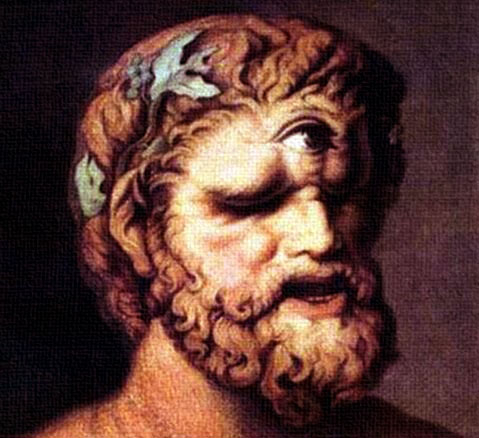
The word Cyclops comes from the ancient Greek “kuklos” meaning circle, and “ops” meaning eye. Circle-eyed. Round-eyed. The name alone conjures something wrong, something that violates the natural order of a human face. And that, perhaps, is exactly the point.
The Cyclopes were not a single creature but a race of beings, and the ancient Greeks told more than one version of their story. Depending on who was writing and when, they were primordial giants born from the earth itself, master craftsmen serving the gods, or savage cannibal shepherds living beyond the reach of civilised law. What every version agreed on was this: they were enormous, they were dangerous, and they saw the world through a single eye set in the middle of their foreheads.
For nearly three thousand years, the Cyclops has endured. Not as a fading footnote of mythology but as something that still unsettles, still captures the imagination. There may be a very good reason for that.
If you are interested in creatures from Greek Mythology, check out this page for more!
Two Generations, Two Very Different Monsters
Ancient Greek sources give us two distinct families of Cyclopes, and they could hardly be more different from one another.
The first, and older, generation appears in Hesiod’s Theogony, written around 700 BC. These were the children of Uranus, the sky, and Gaia, the earth. Their names were Brontes, Steropes, and Arges: Thunder, Lightning, and Bright Flash. They were not mindless brutes but skilled craftsmen of extraordinary ability, imprisoned by their own father in the depths of Tartarus for reasons Uranus never fully explained.
It was Zeus who freed them. In the war against the Titans, the Cyclopes forged the weapons that decided the outcome of the conflict. For Zeus they made the thunderbolt. For Poseidon they created the trident. For Hades they crafted a helmet of invisibility. Three gifts that shifted the balance of power in the cosmos. These were not savage monsters but artisans of divine skill, wronged by their father and loyal to the gods who showed them kindness.
Their fate, in later myths, was a dark one. When Zeus killed Apollo’s son Asclepius with a thunderbolt, Apollo took his revenge not on Zeus himself but on the Cyclopes who had forged the weapon. He hunted them down and killed them. The greatest craftsmen who ever lived, destroyed not for anything they had done but because a god needed someone to punish.
The second generation is a very different story.
Polyphemus: The Monster in the Cave
Homer’s Odyssey, composed around the same era as the Theogony, gives us the Cyclops most people know. Polyphemus, son of Poseidon, shepherd and cannibal, living alone in a cave on the coast of Sicily with no laws but his own appetite.
When Odysseus and his men land on the island and find the cave, they make themselves at home, helping themselves to the cheese and livestock inside. It is a decision that will cost them dearly. When Polyphemus returns and seals the entrance with a boulder so massive no human could budge it, their fate seems certain.
Polyphemus is not subtle about his intentions. He grabs two of Odysseus’s men, dashes their heads against the ground, and eats them. In the morning, he eats two more before heading out with his flock. There is no cruelty in it, no savagery performed for effect. It is simply what he does. The men are food.
What follows is one of the most celebrated episodes in all of ancient literature, and the reason is Odysseus himself. Where Polyphemus has size, strength, and the favour of Poseidon, Odysseus has something the giant entirely lacks: the ability to think several steps ahead.
He offers Polyphemus wine, undiluted and potent, and when the Cyclops asks his name, Odysseus tells him he is called Nobody. The giant, pleased enough with his dinner and his drink, promises that Nobody will be eaten last. Then he falls into a stupefied sleep.
Odysseus and his men take a sharpened stake of olivewood, heat the tip in the fire until it glows, and drive it into Polyphemus’s single eye.
The giant’s screams bring the other Cyclopes running to the cave entrance. They call through the stone: who is hurting him? Who has done this?
“Nobody,” Polyphemus howls. “Nobody is killing me.”
The other Cyclopes, entirely logically, conclude that if nobody is hurting him then he must be ill and walk away.
But Odysseus’s cleverness carries a fatal flaw. As his ships pull away from the shore, pride gets the better of him. He shouts back his real name. He cannot resist letting the blinded giant know who has beaten him. Polyphemus, screaming, calls on his father Poseidon to curse Odysseus’s journey home. Poseidon hears. The voyager who outwitted a Cyclops will spend ten years trying to get back to Ithaca.
The Builders of the Gods and the Walls That Shouldn’t Exist
There is a third tradition of the Cyclopes that sits apart from both the divine craftsmen of Hesiod and the cannibal shepherd of Homer. These are the Cyclopes as architects: the builders of walls so massive and so perfectly fitted that later Greeks refused to believe ordinary humans could have constructed them.
The walls of Mycenae, Tiryns, and Argos were built using stones of such extraordinary size that the Greeks of the classical period looked at them in genuine bewilderment. The Greek traveller Pausanias described the walls of Tiryns as consisting of stones so enormous that even pairs of mules could not budge them. The only explanation that made sense to the ancient mind was that giants had built them. And so the term “Cyclopean masonry” was born, a word still used by archaeologists today to describe the style of construction where enormous irregular stones are fitted together without mortar.
The walls are still there. You can visit them. They are, by any measure, an astonishing feat of Bronze Age engineering.
The Bones in the Caves: Where Science Meets Myth
Here is where the story becomes genuinely strange.
In 1914, a paleontologist named Othenio Abel proposed a theory that has never quite gone away. While studying the fossil record of the Mediterranean, he noticed something remarkable. The coastal caves of Sicily, Crete, Malta, Cyprus, and other Greek islands were abundant with the fossilised remains of dwarf elephants, a species of prehistoric elephant that had evolved in isolation on the islands and gone extinct long before Greek civilisation arose.
These skulls were roughly twice the size of a human skull. And at the centre of each one, where the trunk attached, was a large nasal cavity. A single, enormous hole, set in the middle of the face.
To a palaeontologist who knows what an elephant looks like, the hole is obviously a nasal cavity. But the ancient Greeks had never seen a living elephant. Not until the campaigns of Alexander the Great in the fourth century BC did Greeks encounter elephants in the flesh. Before that, a traveller who stumbled upon a dwarf elephant skull in a Sicilian cave would have seen something that appeared to be a giant humanoid skull with a single massive eye socket at the centre of its face.
The bones found alongside would have suggested a creature of enormous scale. A giant. A cave-dweller. Exactly where the stories said the Cyclopes lived.
It was not until 1688 that a scientist named Giovanni Giustino Ciampini formally demonstrated that these skulls belonged to an extinct elephant species rather than a one-eyed giant. By then the myth had been alive for well over two thousand years.
The geography is striking. The dwarf elephant fossils are most abundant in Sicily, which is precisely where Homer places Polyphemus. The alignment between the fossil record and the legend is difficult to dismiss as coincidence.
Some scholars remain cautious, pointing out that one-eyed giant figures appear in the folklore of many Indo-European cultures with no obvious connection to elephant fossils. The debate has never been fully resolved. But the possibility that a race of ancient giants was conjured from the misread bones of extinct elephants in coastal caves says something profound about the human imagination: given the right evidence and no framework to interpret it, we will always reach for a story.
If you want more like this, the Tales of Myth and Magic newsletter delivers new creatures, legends, and forgotten folklore straight to your inbox.
No fixed schedule. No noise. Just the stories, when they are ready.
Sign up here →The Cyclops as Mirror
The Cyclopes of Greek myth are not simply monsters placed in stories to give heroes something to overcome. They carry meaning.
Polyphemus represents the antithesis of everything Greek civilisation valued. He has no laws, no community, no respect for the gods. He violates xenia, the sacred Greek concept of hospitality between host and guest, by eating his visitors rather than welcoming them. He is strength without wisdom, appetite without restraint, solitude chosen over society. When Odysseus defeats him it is not just a survival story: it is reason defeating brute force, civilisation defeating savagery.
But there is something in the Cyclopes that refuses to be entirely villainous. The elder Cyclopes, imprisoned by their own father for no crime of their own and killed later for something a god decided to do with their work, are figures of genuine tragedy. They were not born monsters. They were made into weapons and then destroyed when those weapons were used.
Polyphemus himself, in later myths, becomes a figure capable of love. He falls for the sea nymph Galatea with an intensity that is almost pitiable, composing songs for her and tending to his appearance in the hope she will return his feelings. She does not. She loves a mortal named Acis, and in a jealous rage Polyphemus kills him. It is the act of a monster but also of a creature in unbearable pain.
The one-eyed giant who eats men alive was, somewhere underneath, also just trying to be seen.
The Cyclops Today
The Cyclops never really left. From ancient pottery to Renaissance painting to the marble sculptures found at the Villa of Tiberius in Sperlonga, artists have been trying to capture the creature for millennia. The blinding of Polyphemus appears on a seventh century BC amphora found at Eleusis, one of the oldest surviving narrative images in Greek art.
In our own time the figure endures in film, television, video games, and literature, always carrying that original contradiction: the terrifying giant who is also, in some fundamental way, alone.
The caves of Sicily still exist. The dwarf elephant fossils are still being studied. The Cyclopean walls of Mycenae and Tiryns still stand, the stones fitted with a precision that modern engineers quietly admire.
And somewhere in the fossil record of the Mediterranean, the bones that may have started it all are still turning up, one enormous skull at a time, that central cavity staring upward like a single ancient eye.
The Cyclopean walls of Mycenae and Tiryns are open to visitors in Greece. The dwarf elephant fossils of Sicily have been documented extensively and are held in natural history collections across Europe.
Further Reading
If this article sparked your interest, these are the books worth reading next.
The Iliad — Homer (Penguin Classics)
by Homer — the primary source for everything in this article, and still the most vivid account of the Trojan War ever written.
The Odyssey — Homer (Emily Wilson translation)
by Homer, translated by Emily Wilson — the best modern English translation, and the book that contains Odysseus’s own account of the horse.
The Trojan War: A Very Short Introduction
by Eric Cline — the clearest and most up to date account of what archaeology actually tells us about Troy and whether any of it happened.
Never miss a myth
Thank you for being here. The site is brand new and every subscriber genuinely means something to me. If you're here, you care about this stuff as much as I do - and that's all the reason I need to keep going. New stories, videos and dark folklore from around the world, straight to your inbox. No algorithm. Just the stories, when they're ready.