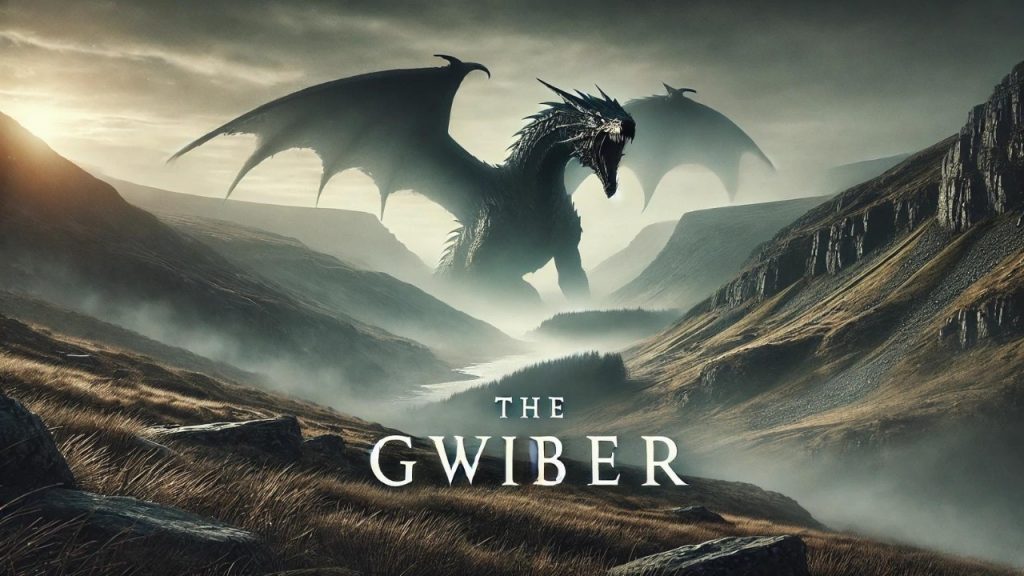
A shepherd is walking through a valley in North Wales when he notices the livestock have stopped grazing. The river has gone quiet. Then, something vast uncoils from the water.
More Than a Dragon
When most people picture a Welsh dragon, they picture Y Ddraig Goch, the great red beast on the Welsh flag, proud and heraldic and essentially noble. The Gwiber is something else entirely. Older, in some ways. More visceral. And considerably less interested in symbolism.
The word gwiber translates directly from Welsh as viper, and that plainness is telling. This is not a creature dressed up in the language of kings and prophecy. It is a predator. It kills livestock, empties rivers of fish, and turns on anyone foolish enough to try to drive it away. It is venomous in the way that makes vipers dangerous, except that its bite is always fatal, without exception, and it can fly.
The Gwiber appears more frequently in Welsh folklore than the famous dragon, particularly across Glamorgan and the mountainous regions of North Wales. It shares enough features with the dragon that the two blur together in some tellings, but the Gwiber has its own distinct character, its own body of specific local legend, and its own disturbing mythology around how it comes into being.
How a Viper Becomes a Monster
According to the Welsh folklore recorded by the Reverend Elias Owen in his 1896 work Welsh Folk-Lore, a prize-winning collection assembled from the oral traditions of North Wales, the Gwiber does not emerge from some supernatural realm. It begins as an ordinary snake.
What transforms it is contact with something it should never have encountered. A viper that drinks the milk of a woman, or laps up human milk spilled on the ground, undergoes a change. In some versions of the origin it also consumes bread consecrated for Holy Communion. Either way, the result of this profane crossing of boundaries is the same: the snake grows. It grows larger than any natural creature should. Wings emerge from its body. Its venom, already lethal in an adder, becomes something beyond medicine or cure. A bite from a Gwiber does not make you ill. It kills you.
There is something deeply unsettling about this origin story. The Gwiber is not born evil. It becomes monstrous through an act of transgression, through the violation of a boundary between the natural and the sacred, between animal and human. The milk of a woman, the bread of communion, these are things belonging to a world the viper was never meant to enter. When it crosses that line, it is changed forever into something that cannot be allowed to exist alongside ordinary life.
The Valley of Wybrnant and the Doom of Owain ap Gruffydd
The most complete and haunting Gwiber legend from North Wales comes from Wybrnant, a valley near the village of Penmachno in what is now Conwy county. The story has survived in enough detail that its geography is still traceable today.
A Gwiber had taken up residence in the valley and made itself comprehensively at home. It lived in the water and on land, which gave it a range no normal predator could match. It cleared the river of fish. It killed and ate the livestock of the surrounding farms. When the people of the area attempted to drive it away, it did not flee. It turned on them instead. Eventually, with no other option remaining, a reward was offered to anyone who could kill the beast.
The news reached a young man named Owain ap Gruffydd, who lived in the Hiraethog Mountains. He was brave, or perhaps ambitious, and he decided to make the attempt. Before setting out, he visited a local seer named Rhys Ddewin to ask whether he would succeed.
The answer was not encouraging. Rhys told him the beast would bite him and he would die.
Owain, unwilling to accept this, returned the next day in disguise and asked the same question. Rhys told him this time that he would fall onto a rock and break his neck.
A third day, a third disguise, a third visit. This time Rhys said he would drown.
At this point Owain lost patience entirely. He revealed his true identity and pointed out the obvious: a man can only die one death. Three contradictory prophecies could not all be true. Rhys, unmoved, replied only that time would tell.
Owain went to Wybrnant.
The Gwiber struck before he could reach it properly. Its teeth found his neck. The shock of the bite threw him onto a rock, breaking his neck. His body fell into the river, and he drowned.
All three prophecies were true simultaneously. The seer had not been lying or speaking in riddles. He had simply told Owain that three terrible things were going to happen, which they did, in quick succession.
When Owain’s companions learned what had happened, they went to Wybrnant themselves and shot the Gwiber with arrows until it slipped, wounded, into the water and disappeared. Whether it survived is not recorded. What is recorded is the name the valley carries to this day. Afon Wybrnant, the river of Wybrnant, is thought to derive from Gwibernant, meaning the stream of the Gwiber. The creature named the landscape, and the landscape has not forgotten it.
The Stone in the Flight Path
Not every community facing a Gwiber tried to send a hero after it. In Montgomeryshire, in the north-east of Wales, a more oblique solution was attempted.
This particular Gwiber had two lairs, both known locally as Nant-y-Wiber, one in the area of Penygarnedd and one in the parish of Llansilin. It flew between the two, and its flight path passed over a fixed point in the landscape. The people of the area, working from this knowledge, raised a stone pillar directly in the creature’s line of flight.
The pillar was then draped in scarlet cloth.
The reasoning behind this was rooted in a specific understanding of the Gwiber’s nature: scarlet was described as a colour the creature found intolerable, that sent it into a fury of uncontrolled aggression. The idea was that when the Gwiber flew between its lairs and encountered the scarlet-draped stone, it would attack the stone with enough force and abandon to destroy itself against it.
It is a remarkable piece of practical folklore. Not a hero, not a weapon, not a prayer. A stone in the right place and the right colour of cloth, deployed with an almost engineering-like understanding of the creature’s predictable behaviour. The people of Montgomeryshire had apparently studied their Gwiber carefully enough to know how to use its own instincts against it.
Gwibers Across Wales
The folklore collector Elias Owen documented Gwiber legends spread across multiple districts of Wales, suggesting the creature was not tied to a single valley or a single story but was part of a much wider tradition of winged serpent belief.
In Glamorgan in South Wales, the tradition was particularly strong, with local advice warning that nursing mothers should be especially careful, given the Gwiber’s affinity for human milk. A colony of winged serpents was said to have inhabited one area, documented by folklorist Ruth Tongue who interviewed local people and recorded their accounts. One elderly woman recalled that her grandfather had killed a Gwiber after a fierce fight, and that she had seen the preserved skin at his house as a girl. When he died, the skin was thrown away, which has understandably frustrated people interested in the subject ever since.
A Gwiber was said to guard a prehistoric burial mound in another area, a guardian of the dead in the way that serpents appear in the mythology of many cultures, coiled around something ancient and refusing to let it be disturbed.
In the Taff valley, a huge serpent was said to live at the bottom of a whirlpool, drowning people and pulling their bodies down. In the hills, a black serpent guarded buried treasure, sleeping over it until a man walking his dog discovered it, filled his pockets with gems, and fled as the beast stirred.
The Gwiber is not a single creature but a category, a type of danger that the Welsh landscape apparently generated with some regularity.
If you want more like this, the Tales of Myth and Magic newsletter delivers new creatures, legends, and forgotten folklore straight to your inbox.
No fixed schedule. No noise. Just the stories, when they are ready.
Sign up here →The Gwiber and the Welsh Dragon
It is worth pausing on the relationship between the Gwiber and the more famous Welsh dragon, because it illuminates something interesting about how mythology layers over time.
In the ancient tale of Lludd and Llefelys, preserved in the medieval collection known as the Mabinogion, Wales is troubled by a terrible shriek heard every May Eve. The source turns out to be two fighting dragons: a red one representing the native Britons and a white one representing a foreign invader. The white dragon is referred to in some versions as a Gwiber, from the Welsh word for viper, while the red dragon embodies Wales itself.
The red dragon of the Welsh flag, Y Ddraig Goch, the dragon that appears in the Historia Brittonum as early as around 828 AD, carries the weight of national identity. But underneath that heraldic layer, in the valleys and on the moorlands, the older creature persists. The Gwiber is what the dragon looks like when it is not a symbol. When it is simply hungry, and the livestock are in the field, and the river is full of fish, and someone has left a pail of milk unattended.
Why the Stories Endure
Wales is a country with an extraordinarily deep relationship with its landscape. The mountains, valleys, rivers and ancient stones are not simply scenery in Welsh tradition but part of a living map of history and story. Place names carry legends inside them. Afon Wybrnant still tells anyone who knows to listen that something once lived in its water.
The Gwiber stories, spread across different regions and different eras, all share an underlying logic. They arise in particular places, they shape those places through their presence, and they leave marks on the landscape even after they are gone. The valley still bears the creature’s name. The stone pillar stood in Montgomeryshire in the Gwiber’s flight path. The old woman’s grandfather fought one and kept its skin until his death.
These are not the stories of something imagined in the abstract. They are the stories of something that, to the people who told them, had a specific address.
Whether the Gwiber was ever real in any literal sense is a question the landscape itself refuses to answer. The adder, the ordinary viper that the Welsh still call gwiber today, is real enough. It lives in the hills and the moorlands, exactly where the old stories place its monstrous ancestor. Perhaps that proximity to something genuinely present, genuinely venomous, genuinely dangerous, is part of what has kept the legend alive.
A snake that drinks what it should not drink. A valley that still carries a name from before anyone living was born. A stone raised in a flight path with scarlet cloth, waiting.
Never miss a myth
Thank you for being here. The site is brand new and every subscriber genuinely means something to me. If you're here, you care about this stuff as much as I do - and that's all the reason I need to keep going. New stories, videos and dark folklore from around the world, straight to your inbox. No algorithm. Just the stories, when they're ready.