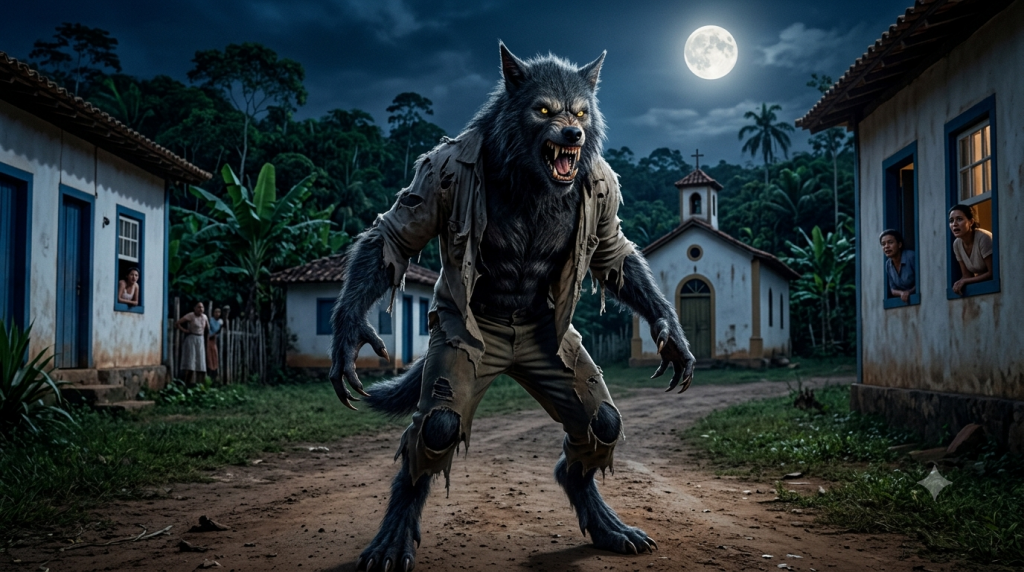
The Homem do Saco, the Sack Man, is Portugal’s primary child-threatening figure, a supernatural or semi-supernatural being who carries a large sack and fills it with children who misbehave, who are out after dark, who do not eat their food, or who otherwise fail to comply with the expectations of the adults around them. He is not unique to Portugal — variants of the Sack Man appear across Spain, Latin America, and other cultures under names including El Coco, El Sacamantecas, and the Babau — but the Portuguese Homem do Saco has specific characteristics that root him in Portuguese folk tradition.
He is described variously as an old man, a monster, a shadowy figure, or simply as a presence that carries the sack and collects the children. His appearance is deliberately vague in the tradition, which is consistent with his function: a figure whose specific appearance is too clearly defined can be rationalised away by a child who decides it is not quite scary enough. The Homem do Saco’s vagueness is a feature rather than a flaw. He is whatever the child imagines, and what the child imagines is always worse than any specific description.
The Sack and What Happens Inside It
The sack is the defining element of the figure and the source of its specific terror. The child who is taken is put in the sack and carried away. What happens then is left unspecified in most versions of the tradition, which again is more effective than any specific fate. The child disappears into the sack and is not seen again. The sack is dark and closed and the child is inside it going somewhere the family cannot follow.
Some versions specify that the Homem do Saco takes the children to eat them, placing him in the same category as the Struwwelpeter figures and the Baba Yaga. Others are vaguer, saying only that the children are taken away. The eating version is the more dramatically satisfying but the vaguer version is arguably more frightening, because an unspecified fate is harder to rationalise as something that would not actually happen.
The Figure in Contemporary Portugal
The Homem do Saco remains a figure invoked by Portuguese parents to manage children’s behaviour, though the invocations are now typically made with a degree of self-awareness that was probably absent from earlier generations’ use of the figure. The tradition is understood as a traditional child-rearing tool, a piece of cultural inheritance, rather than as a literal supernatural belief, but it continues to function as a reference point in Portuguese family culture in a way that suggests its roots are deeper than any purely rational account of child-rearing would require.
The figure also appears in Portuguese art, literature, and film, most notably in José Saramago’s early novel The Bag of Gold, and in various contexts of Portuguese popular culture that reflect how thoroughly the Sack Man has embedded himself in the cultural imagination despite, or perhaps because of, his deliberate vagueness.
The Iberian Connection
The Homem do Saco belongs to a broader Iberian tradition of child-threatening figures that includes the Spanish El Coco, whose name may be the origin of the English word boogeyman through colonial transmission, and the Latin American Cucuy. The distribution of these figures across the Spanish and Portuguese-speaking world reflects how thoroughly colonial culture transmitted European folk beliefs to new contexts, where they adapted to local conditions while maintaining the core structure of the supernatural child-taker.
For more on the folklore of Portugal, the Moura Encantada article covers the enchanted woman of the ruins. The Mula Sem Cabeça article covers the headless mule curse. The Portugal folklore hub page has every article in the cluster.
Never miss a myth
Thank you for being here. The site is brand new and every subscriber genuinely means something to me. If you're here, you care about this stuff as much as I do - and that's all the reason I need to keep going. New stories, videos and dark folklore from around the world, straight to your inbox. No algorithm. Just the stories, when they're ready.