
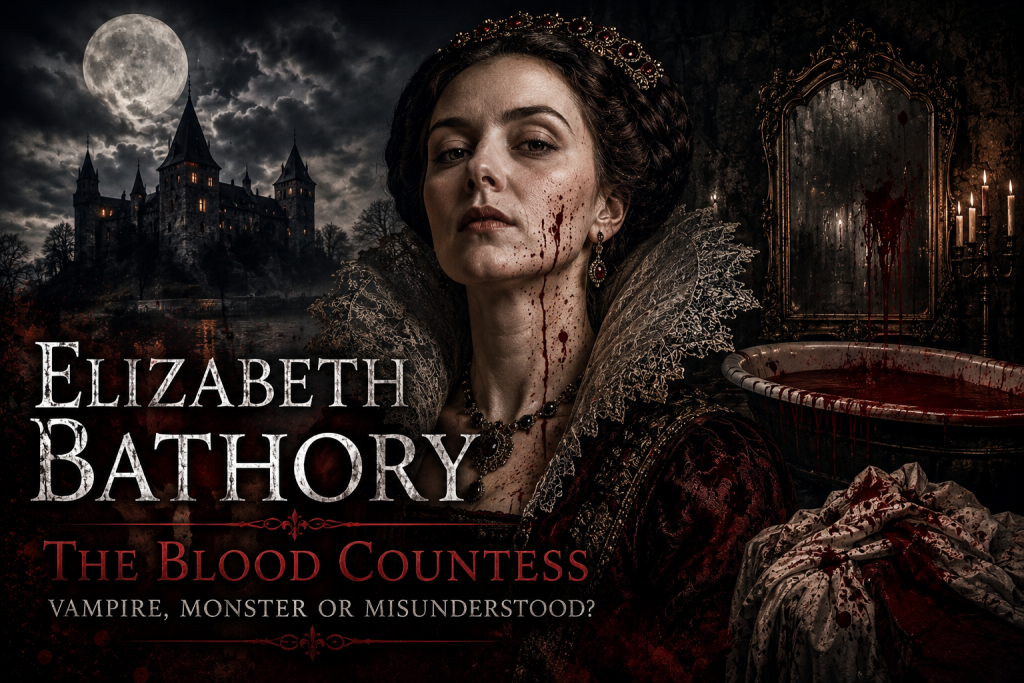
In December 1610, György Thurzó, the Palatine of Hungary, arrived at Čachtice Castle in what is now western Slovakia with a group of armed men. What he found there, or what he later claimed to have found there, would make Elizabeth Bathory one of the most infamous figures in European history. The official account describes bodies in the castle, a dying girl, and evidence of systematic torture and murder on a scale that shocked even the hardened sensibilities of early 17th century European nobility.
Elizabeth Bathory was never tried. She was placed under house arrest in a sealed room of the castle and remained there until her death in 1614. Her servants were tried in her place, convicted, and executed. The testimony they gave under torture and the threat of execution formed the basis of the charges against her, and that testimony, amplified and elaborated over the following centuries, produced the legend of the Blood Countess: a noblewoman who tortured and murdered hundreds of young women, who bathed in their blood to preserve her beauty, and who became one of the inspirations for the literary vampire tradition.
The legend is powerful and persistent. It is also, in several of its most famous elements, almost certainly false. Understanding which parts are true, which are exaggerated, and which were invented requires looking at what the evidence actually shows rather than at what the story has become.
Who She Was
Elizabeth Bathory was born in 1560 into one of the most powerful noble families in the Kingdom of Hungary. The Bathorys were not simply wealthy landowners. They were a dynasty that had produced kings of Poland and princes of Transylvania, and their political connections extended across the region in ways that made them simultaneously essential and dangerous to the royal court.
At fifteen she married Ferenc Nádasdy, a military commander whose campaigns against the Ottoman Empire earned him the nickname the Black Knight of Hungary. The marriage was an alliance between two major noble houses rather than a romantic arrangement, and it was by the standards of the time successful: they had several children and Elizabeth managed the Nádasdy estates during her husband’s long military absences, which required the kind of administrative competence and decisiveness that contemporaries described as formidable.
When Ferenc died in 1604, Elizabeth was forty-four years old, a wealthy widow controlling extensive lands at a moment when the political situation in Hungary was increasingly unstable. The Ottoman wars had left the kingdom financially strained. The royal court owed the Nádasdy family large sums of money. Elizabeth was one of the most powerful individuals in the region, and she had enemies in proportion to that power.
The Accusations
The investigation that led to the raid on Čachtice Castle began with complaints about the deaths and disappearances of young women sent to serve at Bathory’s estates. The initial complaints came from local Lutheran ministers whose parishioners were among the missing, and they reached György Thurzó through channels that also involved King Matthias II of Hungary, who had political and financial reasons of his own to be interested in Bathory’s situation.
Thurzó gathered witnesses and testimony before the raid. After it, he tried four of Bathory’s servants: Dorotya Semtész, Ilona Jó, Katarína Benická, and a man known as Ficzkó. Three were executed. The fourth, Benická, was imprisoned on the grounds that her role had been more limited. Their testimony, given under torture or the threat of it, described acts of systematic torture against servant girls: burning, cutting, biting, exposure to cold, starvation, and killing. The numbers given by witnesses varied widely. One witness mentioned a register of over 650 victims. The figure has been repeated as fact ever since.
Elizabeth Bathory herself was not permitted to testify in her own defence. She was not tried. The official reason given was that Thurzó considered a public trial of such a prominent noblewoman inappropriate and potentially destabilising. The actual reasons were almost certainly more complicated, and the decision to bypass a trial is one of the details that has attracted the most scrutiny from historians attempting to assess what actually happened.
The Blood Bath: What the Evidence Actually Says
The most famous element of the Bathory legend, that she bathed in the blood of young women to preserve her youth and beauty, does not appear in any document from her trial or from the period immediately following it. The servants’ testimony describes torture and murder. It does not describe blood baths.
The blood bath story appears to derive from a 1729 Jesuit history written by László Turóczi, more than a century after Bathory’s death. Turóczi was writing within a tradition of sensational history rather than careful documentation, and his account of Bathory incorporated elements that had accumulated in oral tradition over the preceding century without apparent concern for distinguishing them from documented fact.
By the time the story reached wider European audiences in the 18th and 19th centuries, the blood bath was the central element of the Bathory legend, and the documented trial testimony had been largely displaced by the elaborated version. This is a pattern that appears repeatedly in the history of famous crime cases: the elements that are most dramatic tend to survive and expand while the more ambiguous documentary record recedes.
The honest position is that Elizabeth Bathory was almost certainly responsible for the torture and deaths of some number of young women in her care. The specific number, the 650 figure derived from the alleged register, is almost certainly an exaggeration or a misrepresentation. The blood bath almost certainly did not happen in the form the legend describes. What happened in the space between those two positions is genuinely uncertain.
The Political Case
The argument that Bathory’s prosecution was driven at least partly by political and financial motives rather than purely by justice is not a conspiracy theory. It is a conclusion that several serious historians have reached by examining the circumstances carefully, and it deserves to be taken seriously rather than dismissed as revisionism.
At the time of her arrest, Elizabeth Bathory was a powerful widow whose lands and wealth made her one of the most significant figures in Hungarian noble politics. The royal court owed the Nádasdy family substantial sums of money borrowed to fund the Ottoman wars. Removing Bathory from power would eliminate a creditor and return significant territory to royal control or redistribute it to other noble families with better relationships with the crown.
György Thurzó, the man who led the investigation and the raid, was himself a political figure with connections to those who would benefit from Bathory’s removal. He handled the entire matter in a way that ensured no formal trial occurred, no independent examination of the evidence was possible, and the outcome was predetermined. He also personally benefited from the situation, acquiring some of the Bathory estates after her confinement.
This does not mean Bathory was innocent. The servants who testified against her had no obvious motive to fabricate the specific details they provided, and some of the testimony is consistent enough across independent witnesses to suggest a genuine basis in events. What the political context does mean is that the investigation was conducted by people who had reasons to want a particular outcome, that the evidence was filtered through a legal process designed to produce conviction rather than to establish truth, and that the final picture presented to history was shaped by those interests.
The Hungarian historian László Nagy, writing in the 1980s, made the most sustained argument for Bathory’s innocence as a victim of political conspiracy, concluding that the charges were fabricated. Most historians do not go that far, but many accept that the scale of the accusations was exaggerated and that the process was compromised.
The Vampire Connection
Elizabeth Bathory was not accused of being a vampire during her lifetime. The vampire tradition in Eastern Europe was well established by the early 17th century, but the charges against Bathory were charges of murder and torture rather than anything supernatural. The vampire connection came later, as the elaborated legend accumulated elements from the broader cultural landscape of Gothic and supernatural tradition.
The overlap is easy to understand. Bathory was an aristocratic woman associated with blood, death, isolated castles, and the nighttime. These are the atmospheric elements that the 19th century Gothic tradition associated with vampirism, and as that tradition developed and sought historical precedents, Bathory was a natural candidate for incorporation. By the time Bram Stoker was writing Dracula in the 1890s, Bathory was already part of the cultural vocabulary of supernatural aristocracy, and some scholars have argued for her influence on the novel, though the evidence for any direct connection is thin.
She is better understood as a figure who became associated with vampire mythology through cultural proximity and atmospheric overlap rather than through any direct folkloric connection. The actual vampire traditions of Eastern Europe, the Upyr, the Strigoi, the Vrykolakas, are folk traditions about the undead rather than about living aristocrats. Bathory was never dead and never supernatural. She was a powerful woman accused of extreme violence, and the distance between that and the vampire tradition was bridged by imagination and cultural association rather than by any genuine connection in the original sources.
What She Left Behind
Elizabeth Bathory died in August 1614, confined to her rooms at Čachtice Castle. She was fifty-four years old. She had been in confinement for four years. The servants who had been convicted of assisting her were already dead. The record she left behind, the trial documents, the witness statements, the subsequent histories, is fragmentary, compromised, and filtered through the interests of people who had reasons to present particular versions of events.
What she also left behind is a legend that has proven more durable than the historical record and considerably less accountable to evidence. The Blood Countess of popular culture, the woman who bathed in blood in a castle full of torture chambers, is a figure assembled over four centuries from documented events, exaggerated testimony, invented details, and the accumulated imagery of Gothic tradition. She is not the same person as the Hungarian noblewoman who died in confinement in 1614, and treating the legend as the history produces a figure who is considerably simpler and considerably less interesting than the actual situation allows.
The actual situation involves a powerful woman in a politically dangerous position, accusations that were processed through a compromised legal system, testimony extracted under duress, a documented history of violence against servants that was almost certainly real if not at the scale claimed, and a subsequent tradition that turned all of this into something that served the needs of Gothic horror rather than historical understanding. All of that is more interesting than the blood bath, and considerably more honest.
Further Reading
If this article sparked your interest, these are the books worth reading next.
The Encyclopedia of Vampires, Werewolves and Other Monsters
by Rosemary Ellen Guiley — the most comprehensive reference on the vampire tradition across world cultures.
In Search of Dracula
by Raymond McNally and Radu Florescu — the book that connected Bram Stoker’s Dracula to the historical Vlad the Impaler.
Dracula (Penguin Classics)
by Bram Stoker — if you have not read the original, it is considerably better and considerably stranger than you expect.
For more on the figures connected to the vampire tradition, the Vlad the Impaler article covers the other historical figure most associated with vampire mythology and applies the same scrutiny to the Dracula connection. The Upyr article covers the actual Slavic vampire tradition that Bathory’s legend became entangled with. The broader Vampires section has coverage of blood-drinking beings from across the world’s traditions.
Never miss a myth
Thank you for being here. The site is brand new and every subscriber genuinely means something to me. If you're here, you care about this stuff as much as I do - and that's all the reason I need to keep going. New stories, videos and dark folklore from around the world, straight to your inbox. No algorithm. Just the stories, when they're ready.
Pingback: Vlad the Impaler: The Vampire Who Inspired Dracula - Tales of Myth and Magic
Pingback: The Gorbals Vampire: The Night Glasgow's Children Marched Into a Cemetery to Hunt a Monster - Tales of Myth and Magic