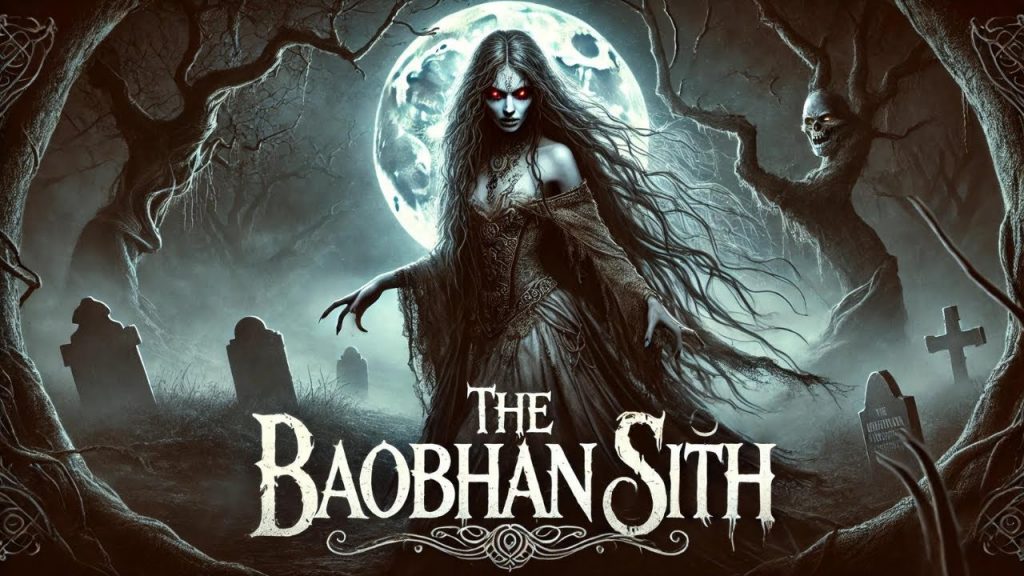
The name is pronounced baa-van shee, which places it immediately in relationship with the Irish Banshee, another supernatural woman whose name contains the Gaelic word sith, meaning fairy or spirit. The resemblance in name is not coincidental. Both figures belong to the same broad tradition of female supernatural beings in Celtic folklore who exist at the boundary between the fairy world and the human one, and whose encounters with people tend to end badly for the people involved.
The Baobhan Sith is specific to the Scottish Highlands, and she is specific in a way that matters: she is not a generic vampire figure imported from Eastern European tradition and given a Scottish name. She belongs to the Highland landscape and to the Scottish fairy tradition in ways that are distinct from the continental vampire, and understanding those distinctions is more interesting than simply treating her as a local variant of Dracula.
She appears as a beautiful woman in a green dress. She invites men to dance. She kills them while dancing. And if you look down, beneath the hem of that green dress, she has the hooves of a deer.
The Tradition She Belongs To
The Baobhan Sith is part of the Sith tradition of Scottish Gaelic folklore, the same tradition that produced the broader category of fairy beings who inhabit the hills, the glens, and the spaces between the human world and whatever lies beyond it. The Sith of Scottish tradition are not the small winged creatures of Victorian illustration. They are powerful, often dangerous beings who operate according to their own rules and whose relationship to human beings is defined by unpredictability rather than by consistent malevolence or consistent benevolence.
The Baobhan Sith sits at the darker end of this spectrum. She is associated specifically with isolated places in the Highlands: remote glens, hunting lodges far from settlement, moorland where a group of men might find themselves alone after dark without the social structures that usually provide some measure of protection against the supernatural. The isolation is part of her territory in the same way that the loch is the Kelpie’s territory: she is a creature of the spaces where the usual rules do not apply and the usual help is too far away to reach in time.
Her connection to deer is the detail that most clearly marks her as a creature of the Highland fairy tradition rather than of the vampire tradition. Deer occupy a specific and significant place in Celtic supernatural belief: they are liminal animals, associated with the boundary between the human world and the Otherworld, capable of leading travellers into fairy territory or serving as the disguised forms of supernatural beings. The Cailleach, the great hag of Scottish tradition, is sometimes associated with deer. The goddess Flidais in Irish mythology governs wild deer and cattle. The Baobhan Sith’s hidden hooves connect her to this older tradition of female supernatural beings whose animal characteristics signal their non-human nature and their connection to the wild world beyond human settlement.
The Hunting Story
The central narrative of the Baobhan Sith tradition is a story that appears in various versions across the oral tradition of the Scottish Highlands, with enough consistency in its core elements to suggest genuine deep roots rather than a single literary source.
Four hunters are travelling through the Highlands and are forced to take shelter overnight in a remote bothy or hunting lodge. They are cold, tired, and isolated. In the way of men in such situations, they wish aloud for company, specifically for the company of women. The wish is heard.
Four women appear. They are beautiful, they are willing to dance, and the hunters welcome them. The dancing begins. One hunter, for reasons the stories do not fully explain, either does not dance or steps outside, and from outside he sees something wrong: one of the women is covered in blood, or something about the dancing is not right, or he simply feels the cold dread that the tradition associates with encounters with the supernatural. He runs. He reaches the horses tethered outside and shelters among them.
The Baobhan Sith cannot approach the horses. Iron horseshoes, or the horses themselves as animals with a specific protective quality against fairy beings, form a barrier she cannot cross. She circles outside until dawn, when she must return to wherever she came from. The hunter inside the shelter do not survive the night.
In the morning the survivor finds his companions dead, their bodies drained of blood. He is alive because he was among the horses. The story ends there, without resolution or explanation, which is characteristic of the Highland folk tradition’s treatment of supernatural encounters: they happen, they are terrible, and the people who survive them are the ones who were in the right place by chance or instinct rather than by any particular wisdom or virtue.
The four to one ratio in the story is notable. Three men die and one survives, and the survivor’s escape is not heroic. He does not fight the Baobhan Sith or outwit her. He simply is not where she is when the killing happens. This is not a story about defeating the supernatural. It is a story about surviving it through proximity to the right animals at the right moment.
Is She a Vampire?
The question comes up consistently and the honest answer is: not quite, in ways that are interesting rather than pedantic.
The Baobhan Sith drinks blood, which is the defining characteristic of the vampire tradition. In this specific sense the label fits. But the mechanisms and the origins are different in ways that matter. The European vampire, particularly in its Eastern European folk tradition, is typically a revenant: a dead person who has returned and sustains itself by draining the living. The Upyr, the Strigoi, the Vrykolakas: all of these are the bodies of dead people animated by something that should not be there. They are wrong in a specific and theological sense, and the tradition’s methods of dealing with them reflect that wrongness.
The Baobhan Sith has never been human. She is not a revenant. She is a fairy being who drinks blood as a consequence of her nature rather than as the behaviour of a corpse that refuses to stay dead. This places her in a different category both theologically and practically: the protections that work against the vampire tradition, the stake through the heart, the garlic, the running water, do not appear in the Baobhan Sith tradition. What works instead is iron and horses, the standard protections of the Scottish fairy tradition.
She is better understood as a blood-drinking member of the Sith than as a Scottish variant of the Eastern European vampire, though the two traditions have clearly influenced each other in the popular imagination and the label vampire has become too well established to be dislodged at this point.
The Deer Hooves
The hidden deer hooves are the detail in the Baobhan Sith tradition that has attracted the most scholarly attention, and they deserve more space than they usually get.
In the narrative of the hunting story, the hooves function as a tell: the man who survives is sometimes the one who glimpsed them before the dancing began, or who noticed that the green dress never quite moved the way a dress should move when someone is walking on human feet. The hooves are the crack in the disguise, the moment when the supernatural being’s attempt to pass as human fails at the level of the body rather than at the level of behaviour.
This connects the Baobhan Sith to a broader tradition in Celtic and European folklore of supernatural beings who can almost perfectly replicate human appearance but whose animal characteristics betray them to those who know what to look for. The Scottish Selkie sheds a sealskin. The Kelpie can be recognised by the water weed in its hair. The Baobhan Sith wears a dress long enough to hide her hooves, but the hooves are there.
The deer connection also ties her to the Highland landscape in a specific and material way. Deer were the primary large game animal of the Scottish Highlands and the focus of the hunting activity that brings the men in the story into her territory in the first place. The hunters who come into the hills to kill deer encounter a woman with the feet of a deer, which is the kind of mythological irony that the Highland tradition handles without explanation: the thing you hunt and the thing that hunts you share a body.
Glen Lyon and the Living Tradition
Glen Lyon in Perthshire, described as Scotland’s longest and loneliest glen, is one of the locations most strongly associated with the Baobhan Sith in the oral tradition. The glen runs for thirty-two miles through increasingly remote Highland landscape, and its history is layered with folklore and dark legend in a way that is unusual even by Scottish standards.
As part of the Hunting Legends series on YouTube, I went to Glen Lyon at night to look for the Baobhan Sith. I can report that the glen at night is exactly as dark and as quiet and as isolated as the tradition suggests it should be, and that the experience of being in a long Highland glen after dark with no artificial light and very little wind produces a specific quality of attention that I understand completely why the people who lived there generated the stories they did.
Whether she was there or not is a question I will leave open. The glen certainly felt like a place where something might be watching from the treeline, which is perhaps the most honest thing you can say about an encounter with a creature whose defining characteristic is that she looks completely human until the moment she does not.
How She Compares to the Glaistig
The Baobhan Sith is frequently compared to the Glaistig, another female Highland supernatural being who is sometimes described as a vampire or blood-drinker and who also conceals hooves beneath a long dress. The two figures are closely related in the tradition and are sometimes treated as the same being under different names, though there are meaningful differences between them.
The Glaistig is considerably more ambivalent than the Baobhan Sith. She can be protective of cattle and of children, and the tradition treats her relationship with humans as genuinely complex rather than straightforwardly predatory. The Baobhan Sith is less ambiguous: she dances with you and then she drains you, and the tradition does not offer a version of her that protects or helps.
Both figures share the deer hooves, the beautiful appearance, the long green or grey dress, and the connection to the wild Highland landscape. Whether they are the same figure in different moods, or genuinely distinct beings that the tradition has partially merged, is a question the oral record does not answer cleanly.
Further Reading
If this article sparked your interest, these are the books worth reading next.
Scottish Urban Legends: 50 Myths and True Stories
by Aaron Mullins — fifty Scottish urban legends including stories from Glasgow, Edinburgh, and the Highlands. The kind of tradition that Maggie Murphy belongs to, collected properly in one volume.
Scottish Urban Myths and Ancient Legends
by Grace Banks and Sheena Blackhall — vampires, werewolves, devil encounters, and the school playground legends of Scotland. A genuinely good collection of the stories Scots have been telling each other for generations.
The Lore of Scotland: A Guide to Scottish Legends
by Jennifer Westwood and Sophia Kingshill — the most comprehensive collection of Scottish legend in print, covering Glasgow to Shetland, exploring origins and historical basis. Endorsed by Terry Pratchett as the real macabre.
The Glaistig article covers that figure in detail and is worth reading alongside this one. For more on the vampire tradition she is sometimes placed within, the Vampires section has coverage of blood-drinking beings from across the world’s traditions including the Upyr, the Strigoi, and the Abhartach. The broader Scotland category has more on the creatures and folk traditions of the Scottish Highlands.
Never miss a myth
Thank you for being here. The site is brand new and every subscriber genuinely means something to me. If you're here, you care about this stuff as much as I do - and that's all the reason I need to keep going. New stories, videos and dark folklore from around the world, straight to your inbox. No algorithm. Just the stories, when they're ready.