The quest for the Golden Fleece is one of the great adventure narratives of Greek mythology: a hero, a ship of extraordinary companions, a journey to the edge of the known world, a prize guarded by a sleepless dragon, and a return home. It has all the structural elements of the heroic quest in their most developed form. What makes it genuinely interesting is what happens after the quest succeeds, because Jason’s story does not end with the retrieval of the Fleece. It ends considerably worse than it begins, and the tradition is honest about why.
Jason succeeds because of Medea. Everything he achieves at Colchis, every task he completes, every obstacle he overcomes, he overcomes because Medea, the king’s daughter and a sorceress of extraordinary power, falls in love with him and uses her magic on his behalf. Without her he would have died in Colchis. With her he completes the quest. He then treats her in a way that makes her the most dangerous enemy he could possibly have, which she demonstrates with a thoroughness that is one of the most devastating episodes in Greek mythology.
The Background and the Ship
Jason was the rightful heir to the throne of Iolcos in Thessaly. His uncle Pelias had taken the throne and had received a prophecy warning him of a man with one sandal. Jason arrived at court having lost one sandal crossing a river, and Pelias decided to deal with the prophecy by sending Jason on the impossible quest for the Golden Fleece, which was kept in Colchis at the eastern edge of the Black Sea and guarded by a dragon that never slept.
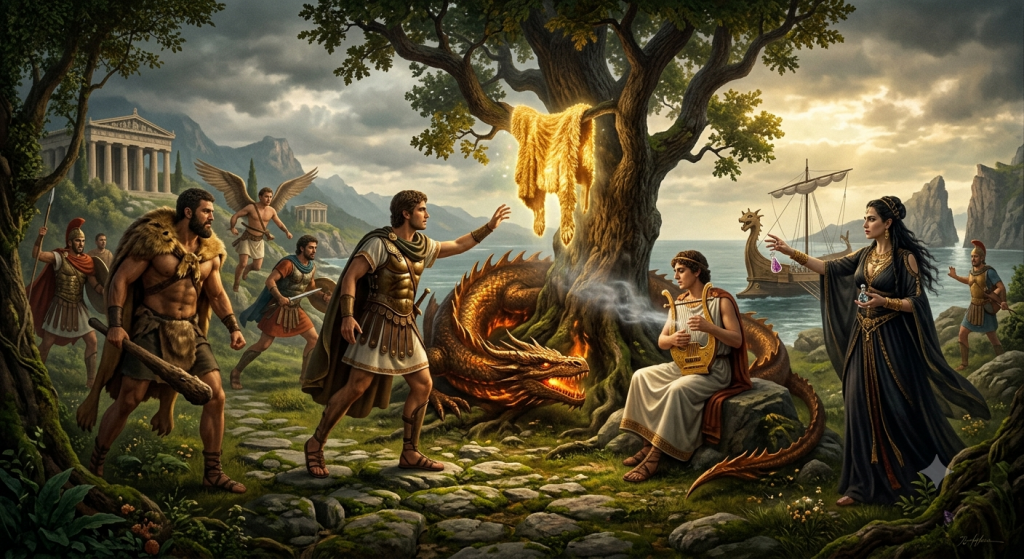
The ship Jason commissioned for the quest was the Argo, built by the craftsman Argus with timber from Dodona that included a piece of the sacred oak that could speak prophecy. The crew that assembled to sail on it, the Argonauts, included most of the great heroes of the generation before the Trojan War: Heracles, Orpheus, Castor and Pollux, Peleus, Theseus in some versions, and many others. It was the greatest assembly of heroes in Greek mythology before the Trojan War itself.
The Journey and the Obstacles
The voyage to Colchis produced its own series of episodes that the tradition elaborated extensively. The Argonauts stopped at Lemnos, where the women had killed all the men and where Jason and the crew spent time that threatened to become permanent. They encountered the Doliones, whose king they killed accidentally in a night raid, and had to perform funeral games in his honour. Heracles was left behind at Cios searching for his companion Hylas, who had been taken by water nymphs.
They passed the Clashing Rocks, the Symplegades, which crushed everything that tried to pass between them. They sent a dove through first: the rocks clashed and caught only the dove’s tail feathers. The Argo rowed through in the moment the rocks were rebounding, and Athena’s hand held the stern steady as the rocks closed on it, catching only the ornamentation at the ship’s rear. After the Argo passed, the Symplegades became fixed and never moved again.
Medea and the Fleece
Aeetes, king of Colchis, would not simply give Jason the Fleece. He set tasks: Jason must yoke two fire-breathing bulls with bronze hooves, plough a field with them, sow the field with dragon’s teeth, and then defeat the armed warriors who would spring from the teeth. This was designed to be impossible.
Medea, Aeetes’s daughter, was made to fall in love with Jason by Eros at Aphrodite’s request, and she gave him a magical ointment that made him invulnerable to the bulls’ fire and the warriors’ weapons. She also told him the secret of the warriors who would spring from the dragon’s teeth: throw a stone among them and they will fight each other rather than him. Jason completed the tasks.
Aeetes had no intention of handing over the Fleece regardless. Medea led Jason to the sacred grove where it hung, sang the sleepless dragon to sleep, and Jason took the Fleece. They fled on the Argo with Aeetes’s fleet in pursuit. Medea took her young brother Absyrtus with her, and when pursuit became too close she killed him and scattered his body parts in the sea, knowing her father would have to stop to collect them for burial. The fleet stopped. The Argo escaped.
The Return and What Followed
The return to Iolcos was as eventful as the outward journey, taking the Argonauts through the Mediterranean in a route that the tradition elaborated to include encounters with Circe, the Sirens, Scylla and Charybdis, and the Phaeacians. When they finally reached Iolcos, Pelias had no intention of giving up the throne. Medea dealt with this: she convinced Pelias’s daughters that she could rejuvenate their father by cutting him up and boiling him in a magic cauldron, demonstrating the technique on an old ram that emerged young. The daughters performed the procedure on Pelias. He did not emerge.
Jason and Medea were expelled from Iolcos for Pelias’s death and went to Corinth, where they lived for some years and had children. Then Jason decided to marry the daughter of the king of Corinth for political advantage. He told Medea she should be grateful for everything he had done for her in bringing her to Greece from the barbarous east, and that the new marriage was for the benefit of them all.
Medea sent the new bride a poisoned robe and crown. The bride died. Her father, who tried to help her, died. Medea killed her own children by Jason so that he could not have them either. She escaped in a chariot drawn by dragons. Jason was left with nothing, and the tradition records that he died years later when a rotting timber fell from the beached hull of the Argo and struck him on the head.
Medea and the Question of Blame
Euripides’s Medea, produced in 431 BCE, is the most important treatment of Medea’s actions after the return to Greece, and it remains one of the most morally complex works in the dramatic tradition precisely because it refuses to present Medea as simply a monster. The play gives her full interiority: her love for Jason, her understanding of what she has sacrificed and what he has discarded, her grief and her rage and her calculation. The audience watches her make the decision to kill her children and understands why she makes it even while finding it horrifying.
Jason’s behaviour in the play is also given full weight, and it is not flattering. He is self-serving, ungrateful, and blind to what Medea actually is and what she is capable of. He treats her as a problem to be managed rather than a person to be reckoned with, and the consequences of that misjudgment are complete and irreversible. Euripides does not excuse Medea. He also does not excuse Jason. The tragedy belongs to both of them, and to the children who had nothing to do with either.
Further Reading
If this article sparked your interest, these are the books worth reading next.
The Iliad — Homer (Penguin Classics)
by Homer — the primary source for everything in this article, and still the most vivid account of the Trojan War ever written.
The Odyssey — Homer (Emily Wilson translation)
by Homer, translated by Emily Wilson — the best modern English translation, and the book that contains Odysseus’s own account of the horse.
The Trojan War: A Very Short Introduction
by Eric Cline — the clearest and most up to date account of what archaeology actually tells us about Troy and whether any of it happened.
For more on the Greek tradition, the Sirens article covers one of the obstacles the Argonauts encountered on their return journey. The Circe article covers the sorceress who purified Jason and Medea of Absyrtus’s killing on their way home. The Greek Mythology hub page has every article in the cluster.
Never miss a myth
Thank you for being here. The site is brand new and every subscriber genuinely means something to me. If you're here, you care about this stuff as much as I do - and that's all the reason I need to keep going. New stories, videos and dark folklore from around the world, straight to your inbox. No algorithm. Just the stories, when they're ready.