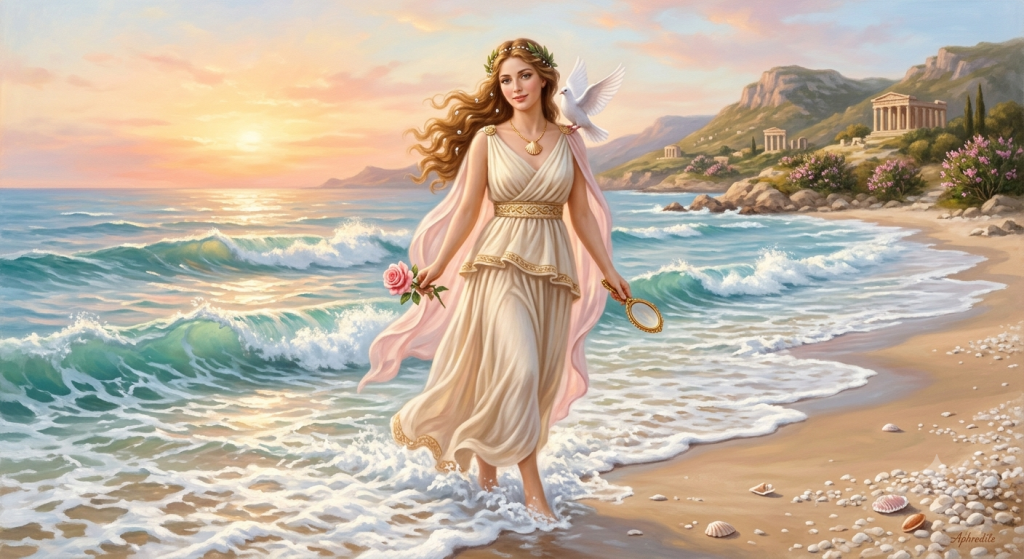
Aphrodite is the goddess of love, beauty, desire, and pleasure. She is also one of the most powerful figures in the Greek pantheon, and the tradition understands her power as genuinely dangerous rather than simply pleasant: love in the Greek mythological framework is not a benign force that produces happiness and harmony. It is a force that overrides judgment, compels behaviour against rational self-interest, starts wars, and destroys families. Aphrodite does not cause these things incidentally. She causes them because desire is what she is, and desire has never been particularly interested in consequences.
The Trojan War begins because Aphrodite bribes Paris with the most beautiful woman in the world. The most beautiful woman in the world is already married. The war that follows kills tens of thousands of people over ten years. Love, in the Greek tradition, is not what redeems the world. It is what sets the world on fire.
The Birth From the Sea
Aphrodite’s birth is one of the most striking images in Greek mythology. When Cronos castrated his father Ouranos and threw the severed genitals into the sea, they floated on the water and foam gathered around them, and from that foam Aphrodite arose. She drifted on a scallop shell to the island of Cyprus, where the Seasons dressed her and brought her to Olympus. This is the birth Hesiod describes in the Theogony, and it is the origin of Botticelli’s The Birth of Venus, the most famous visual representation of the myth.
Homer’s Iliad gives her a different parentage: she is the daughter of Zeus and the sea nymph Dione. The two traditions coexist in the ancient sources without resolution. The sea-foam birth is the more mythologically resonant: she arises from an act of violence and from the sea, which is the domain of the most primordial forces in Greek cosmology, and she embodies a power older than the Olympian order she eventually joins.
The Judgement of Paris
The contest that began the Trojan War started at a wedding. Eris, the goddess of discord, threw a golden apple inscribed for the fairest among the wedding guests of Peleus and Thetis. Hera, Athena, and Aphrodite all claimed it. Zeus refused to judge between them and appointed Paris, a Trojan prince, as judge. Each goddess offered a bribe: Hera offered political power, Athena offered wisdom and skill in battle, Aphrodite offered the most beautiful woman in the world.
Paris chose Aphrodite. The most beautiful woman in the world was Helen, wife of Menelaus of Sparta. Aphrodite arranged for Paris to visit Menelaus as a guest, and Paris took Helen when he left. This violation of hospitality, facilitated by divine promise, produced the Trojan War. Hera and Athena, their bribes refused, supported the Greeks for the duration of the war. Aphrodite supported Troy. The divine politics of a beauty contest were played out in ten years of warfare and the destruction of a city.
The Marriage to Hephaestus and the Affair with Ares
Aphrodite was married to Hephaestus, the divine craftsman, the lame god of the forge. The marriage is presented in the tradition as an obvious mismatch: the most beautiful goddess paired with the least physically graceful god, a union arranged by Zeus or by Hera depending on the version, and one that Aphrodite had no interest in honouring.
Her affair with Ares, the god of war, is the most famous episode in her mythology after the Judgement of Paris. Helios the sun, who sees everything, told Hephaestus about the affair. Hephaestus forged an invisible net of extraordinary fineness, strong enough to hold the strongest beings but invisible to the eye, and spread it over their bed. When Aphrodite and Ares were next in the bed together, the net sprang shut. Hephaestus called all the gods to come and witness their shame. The gods came and found the situation as Hephaestus had described, and then found it very funny, and the passage in the Odyssey where Homer tells this story is genuinely comic rather than solemn.
Poseidon eventually persuaded Hephaestus to release them by guaranteeing Ares would pay compensation. Hephaestus released them. Ares went to Thrace. Aphrodite went to Cyprus. The compensation was apparently never paid, and Hephaestus’s position was not improved. The tradition treats the whole episode with a lightness that distinguishes it from the darker aspects of Aphrodite’s mythology.
Pygmalion and Psyche
Aphrodite’s mythology includes several stories in which her power is deployed in the service of love rather than its disruption. Pygmalion, a sculptor who fell in love with his own statue of a perfect woman, prayed to Aphrodite and she brought the statue to life. It is one of the few episodes in her mythology where the desire she represents produces a straightforwardly good outcome rather than a catastrophic one.
The story of Psyche, told by Apuleius in the second century CE, involves Aphrodite as the antagonist: she is jealous of the mortal Psyche’s beauty and sets her impossible tasks to destroy her. The story ends with Psyche becoming immortal and marrying Eros, Aphrodite’s son, which means Aphrodite’s attempt to destroy Psyche produces a daughter-in-law she did not want. It is one of the tradition’s cleaner examples of divine plans producing outcomes opposite to what was intended.
Adonis
Aphrodite’s love for Adonis, the beautiful mortal youth who was also loved by Persephone, is one of the most discussed myths in her tradition and one of the most extensively analysed for its possible connections to older Near Eastern religious traditions. Adonis was killed by a boar, either by accident or sent by Ares in jealousy or by Artemis in revenge for a slight by Aphrodite depending on the version. He died in Aphrodite’s arms and the anemone flower sprang from his blood.
The myth of Adonis, a beautiful youth who dies young and is mourned by the goddess of love, has deep parallels in Near Eastern traditions including the Sumerian Dumuzid and the Phoenician Tammuz, and the Adonia festivals mourning his death were celebrated widely across the ancient Mediterranean world. Aphrodite’s worship drew on traditions older and wider than the Greek world in a way that distinguished her from many of the other Olympians.
Further Reading
If this article sparked your interest, these are the books worth reading next.
The Iliad — Homer (Penguin Classics)
by Homer — the primary source for everything in this article, and still the most vivid account of the Trojan War ever written.
The Odyssey — Homer (Emily Wilson translation)
by Homer, translated by Emily Wilson — the best modern English translation, and the book that contains Odysseus’s own account of the horse.
The Trojan War: A Very Short Introduction
by Eric Cline — the clearest and most up to date account of what archaeology actually tells us about Troy and whether any of it happened.
For more on the Greek tradition, the Hephaestus article covers the divine craftsman who married Aphrodite and caught her in the net. The Ares article covers the god of war whose affair with Aphrodite produced the most comic episode in the Odyssey. The Greek Mythology hub page has every article in the cluster.
Never miss a myth
Thank you for being here. The site is brand new and every subscriber genuinely means something to me. If you're here, you care about this stuff as much as I do - and that's all the reason I need to keep going. New stories, videos and dark folklore from around the world, straight to your inbox. No algorithm. Just the stories, when they're ready.