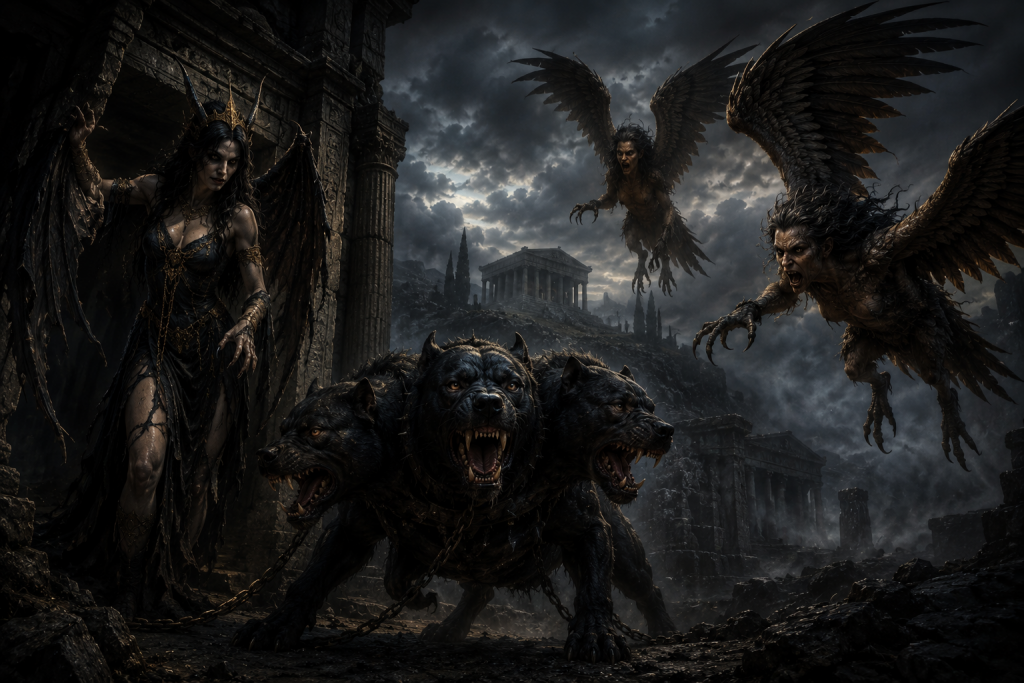
Pandora’s Box is one of the most widely referenced myths in Western culture and one of the most consistently misunderstood. The phrase has entered common usage as a shorthand for any action that releases unforeseen and catastrophic consequences, and this usage is accurate enough as far as it goes. But the specific details of the myth, what Pandora actually opens, what comes out of it, why it was given to her in the first place, and above all what it means that Hope is the last thing remaining inside when she closes the lid again, are almost always simplified in ways that strip the myth of its genuine philosophical complexity.
The first thing to establish is that it was not a box. It was a jar. The Greek word in Hesiod’s account, the earliest and most important source for the myth, is pithos, which is a large storage jar of the kind used to store grain, wine, and oil in ancient Greek households. The mistranslation of pithos as box appears to originate with the Dutch humanist Erasmus in the sixteenth century, who translated Hesiod’s Greek into Latin and rendered pithos as pyxis, meaning box, apparently confusing Pandora’s jar with a different mythological container. Erasmus’s mistranslation was so influential that box displaced jar in the European tradition almost entirely, and the correction has been available to scholars for centuries without making much impression on popular usage. The jar matters because its scale changes the imaginative register of the story: a box is a personal possession, something held and opened. A pithos is a household storage vessel, something that sits in the storeroom and contains the sustenance that keeps the household alive. Pandora is not opening a trinket box. She is opening the thing the household depends on.
The second thing to establish is that the myth is considerably darker than the popular version suggests, and that its darkness is the source of its philosophical interest. Pandora’s Box is not a story about curiosity punished. It is a story about the deliberate weaponisation of a woman against humanity by a god who wanted revenge, and the specific intelligence of the myth lies in how it handles the question of who is responsible for the evils that result.
Hesiod’s Two Accounts
The myth of Pandora appears in two places in Hesiod’s work: in the Theogony, his poem about the origins of the gods, and in the Works and Days, his didactic poem about agriculture, justice, and human life. The two accounts are not identical, and the differences between them are instructive.
In the Theogony, Pandora is created by Hephaestus at Zeus’s command as a punishment for humanity following Prometheus’s theft of fire. She is described as a beautiful evil, kalon kakon in Greek, made in the likeness of a goddess but containing the character of a thief and a liar. The account in the Theogony is specifically about the creation of the race of women, which Hesiod presents as the source of men’s troubles, and it is explicitly misogynistic in ways that reflect the specific cultural assumptions of archaic Greek society rather than anything the myth requires structurally. There is no jar in the Theogony account. The evil that women represent is simply their existence rather than anything they specifically release.
The Works and Days account is the one that contains the jar and that is the primary source for the myth as it is commonly known. Here Pandora is sent to Epimetheus, the brother of Prometheus, as a gift from the gods. Her name means all-gifted, and she is given specific gifts by each of the gods: beauty from Aphrodite, skill in crafts from Athena, speech from Hermes, along with lies and a thieving character, also from Hermes. She brings with her a large jar, and when she opens it, every kind of evil flies out into the world: illness, suffering, toil, and all the countless miseries that afflict human life. She closes the lid just in time to prevent one thing from escaping: Elpis, usually translated as Hope, which remains inside the jar when the lid is shut.
Hesiod comments that this was Zeus’s will, and that before Pandora opened the jar, human beings had lived free from toil and suffering. The opening of the jar is the moment at which the human condition becomes what it currently is: a life of labour, sickness, and inevitable death, punctuated by the unpredictable arrival of blessings amid the constant backdrop of difficulty.
Who Pandora Is and What She Represents
Pandora is the first woman in Hesiod’s account of human prehistory, which gives her a status analogous to Eve in the biblical tradition: the figure whose action introduces suffering and mortality into a world that previously knew neither. The comparison between Pandora and Eve has been made repeatedly by scholars and popular writers, and the structural parallels are genuine: both figures are female, both are blamed for the introduction of evil into the world, both act in ways that involve transgression against a prohibition, and both stories are told in traditions that have strongly patriarchal assumptions about the relationship between women and misfortune.
The differences are equally important. Eve acts from genuine agency: she is persuaded, she considers, she chooses. Pandora is specifically designed to cause the harm she causes. She is a weapon, constructed by Hephaestus at Zeus’s command, equipped by the gods with the specific qualities needed to accomplish Zeus’s purpose of punishing humanity, and sent to Epimetheus as a gift that Prometheus had explicitly warned his brother to refuse. Epimetheus accepts the gift anyway, as Hesiod somewhat wearily notes, because he forgot Prometheus’s warning, and the consequences follow.
This difference in the degree of Pandora’s agency is one of the most philosophically interesting aspects of the myth. If Pandora is a weapon deliberately constructed to cause harm, then her opening of the jar is less a free act of disobedient curiosity than the execution of the function for which she was made. The evils that come out of the jar were always going to come out, because Pandora was made to open it and given the curiosity, the lack of foresight, and the specific jar as part of the package that Zeus assembled to punish humanity. The myth is not straightforwardly about the dangers of female curiosity. It is about the way in which divine power uses human instruments to accomplish its purposes.
Prometheus and the Context of the Myth
The Pandora myth cannot be understood without understanding the mythological context in which it is embedded, which is the conflict between Prometheus and Zeus over the treatment of humanity. Prometheus is the Titan who stole fire from the gods and gave it to humanity, thereby giving human beings the capacity for civilisation, craft, warmth, and the cooking of food that distinguishes human life from animal life. Zeus punishes Prometheus for this theft by chaining him to a rock where an eagle eats his liver each day, only for the liver to regrow overnight so that the punishment can be repeated indefinitely. This is the most famous element of the Prometheus story and the one that most clearly establishes Zeus’s specific form of revenge: the punishment is calibrated to last forever, to cause maximum suffering, and to be specifically connected to the transgression in question.
Pandora is Zeus’s punishment not of Prometheus directly but of humanity. Prometheus gave fire to human beings; Zeus sends Pandora to human beings. The gift of fire was the gift that made human life better, that gave humanity the tools for civilisation and the capacity to cook food and make warmth and light. The gift of Pandora is the gift that makes human life worse, that introduces the evils and suffering that had previously been absent. The parallel between the two gifts is deliberate: Zeus is not simply punishing humanity with Pandora’s jar. He is specifically matching Prometheus’s gift of improvement with his own gift of deterioration, using the mechanism of the gift to accomplish the mechanism of punishment.
This context also clarifies why Hesiod tells the Prometheus story and the Pandora story in sequence in both the Theogony and the Works and Days. They are not separate myths that happen to be placed near each other. They are the two halves of the same story: the theft of fire and its consequences. Pandora is the consequence of Prometheus’s theft, which means she is in some sense the consequence of the best thing Prometheus did for humanity. The gift of fire created the conditions under which Zeus could send the punishment of Pandora, and Pandora’s jar contains everything that the gift of fire has now been paid for.
What Was in the Jar
The specific contents of Pandora’s jar are described by Hesiod in terms that are deliberately comprehensive rather than specific. The jar contains myria lugra, countless griefs or countless evils, which fly out and disperse across the world when the lid is opened. Hesiod does not provide a specific list of the evils, but he names some of the consequences: disease, both physical and mental, old age, toil, and the general condition of human suffering that characterises mortal life. The comprehensiveness of the description is the point: everything bad that afflicts human existence was in the jar, and when Pandora opened it, all of it was released simultaneously into a world that had previously been free of it.
The before and after implied by the myth is significant. Before Pandora’s jar was opened, human beings lived in a kind of golden age free from toil, disease, and suffering. The myth is describing the moment at which this golden age ended, which is to say the moment at which human life became recognisably what it is: difficult, painful, uncertain, and mortal. The opening of the jar is the mythological explanation for why human life is hard, which gives it a function similar to the expulsion from Eden in the biblical tradition: it is the myth that explains the human condition rather than simply telling a story about a specific event.
The specifically silent character of the evils that escape from the jar is one of Hesiod’s most unsettling details. The evils are described as flying out over the world, spreading everywhere, silent and invisible. They do not announce themselves. They simply disperse through the air and become part of the world’s fabric, settling into the landscape and the population invisibly until they manifest as illness, disaster, and suffering. The invisibility is important because it means the evils cannot be identified before they strike, cannot be avoided, and cannot be specifically targeted or defended against. They are simply present, everywhere, in everything.
Hope: The Most Discussed Detail in the Myth
The most philosophically complex element of the Pandora myth, and the one that has generated the most sustained scholarly debate, is the presence of Hope, Elpis in Greek, at the bottom of the jar, which remains inside when Pandora closes the lid. This detail has been interpreted in radically different ways, and the interpretations are not obviously convergent, which is part of what makes the myth genuinely interesting rather than simply a cautionary tale.
The most common interpretation, and the one that has generated the English phrase Pandora’s box as a reference to the dangers of releasing uncontrollable forces, treats the presence of Hope as the one consolation in an otherwise catastrophic event: all the evils have been released, but Hope remains with humanity as a counterbalance, a resource to draw on when the evils that have escaped become overwhelming. In this reading the myth ends on a note of qualified optimism: things are bad, but humanity has Hope, and Hope makes the difficult life that the jar’s opening has created bearable.
A more pessimistic interpretation treats Hope’s presence in the jar as deeply ambiguous. If everything else in the jar was evil, what does it mean that Hope is there too? Hope in this reading is itself a form of evil, the specific evil of delusion: Hope keeps human beings from accepting the reality of their situation, encourages them to persist in efforts that will ultimately fail, and prevents the clear-sighted acceptance of the human condition that would be the rational response to the world Pandora’s jar has created. On this reading, the fact that Hope remains inside when Pandora closes the lid is not a consolation but an additional punishment: humanity is afflicted not only with all the evils that escaped but with the illusion of Hope that keeps them from responding to those evils rationally.
A third interpretation focuses on the jar itself rather than on Hope’s character. If Hope remains inside the closed jar, it is not available to humanity. The evils are out in the world, dispersed everywhere, but Hope is sealed back inside a jar. This reading suggests that Hope is not a comfort provided to humanity but a possession of the jar itself, something the gods retained rather than releasing into the world along with everything else. Humanity has all the evils and none of the Hope, which is the darkest reading of the myth’s ending.
Hesiod does not resolve the ambiguity. His text says that Hope remained under the lip of the jar and did not fly out with the rest, and that this happened by the will of Zeus. Whether this is a mercy or an additional cruelty, whether Hope is a gift retained for humanity or a possibility withheld from them, is left for the reader to determine. The openness of the question is not a failure of the myth’s construction. It is the myth’s most sophisticated element: it presents the human situation in all its genuine ambiguity without resolving it into either consolation or despair.
Pandora in the Later Tradition
The Pandora myth has been one of the most culturally productive in the Greek tradition, generating responses across art, literature, and philosophy from antiquity through the present. The specifically misogynistic reading of the myth, in which Pandora represents the dangers of female curiosity and the source of all human misery, was dominant in ancient commentary and in much of the European tradition that drew on those commentaries. The feminist reading, which emphasises the degree to which Pandora is a constructed weapon rather than a free agent and which therefore transfers moral responsibility from Pandora to Zeus, has been more prominent in modern scholarship and in creative responses to the myth from the twentieth century onward.
The visual tradition of Pandora is extensive and varied. Greek vase paintings from the fifth century BCE show Pandora as a figure of beauty being presented to Epimetheus, consistent with Hesiod’s description of her as kalon kakon, the beautiful evil. The Renaissance tradition emphasised her beauty and her transgression, typically showing her in the act of opening the box rather than before or after. Victorian painting produced some of the most elaborate treatments of the myth, including John William Waterhouse’s two paintings of Pandora from 1896 and 1898 that show her with the jar in a state of intrigued anticipation rather than transgressive disobedience, which is a significantly different emotional register from the ancient tradition.
The phrase Pandora’s box has entered everyday language in ways that separate it almost entirely from the myth that produced it. It is used to describe any action that releases unforeseen and uncontrollable consequences, from political decisions to scientific discoveries to personal revelations, and the specific content of the myth, the jar, the evils, the Hope, the divine vengeance, are typically not present in the usage. This separation of the phrase from its mythological source is itself a form of the myth’s transformation over time, and it is not entirely unfaithful to the myth’s deepest implication: that there are some things, once released, that cannot be recalled, and that the human condition as we know it is the result of exactly such a release.
Further Reading
If this article sparked your interest, these are the books worth reading next.
The Iliad — Homer (Penguin Classics)
by Homer — the primary source for everything in this article, and still the most vivid account of the Trojan War ever written.
The Odyssey — Homer (Emily Wilson translation)
by Homer, translated by Emily Wilson — the best modern English translation, and the book that contains Odysseus’s own account of the horse.
The Trojan War: A Very Short Introduction
by Eric Cline — the clearest and most up to date account of what archaeology actually tells us about Troy and whether any of it happened.
For more on Greek mythology, the Prometheus article covers the Titan whose theft of fire set the Pandora story in motion. The Zeus article covers the god whose revenge on humanity produced Pandora and her jar. The Hephaestus article covers the divine craftsman who built Pandora at Zeus’s command. The Greek Mythology hub page has every article in the cluster.
Never miss a myth
Thank you for being here. The site is brand new and every subscriber genuinely means something to me. If you're here, you care about this stuff as much as I do - and that's all the reason I need to keep going. New stories, videos and dark folklore from around the world, straight to your inbox. No algorithm. Just the stories, when they're ready.