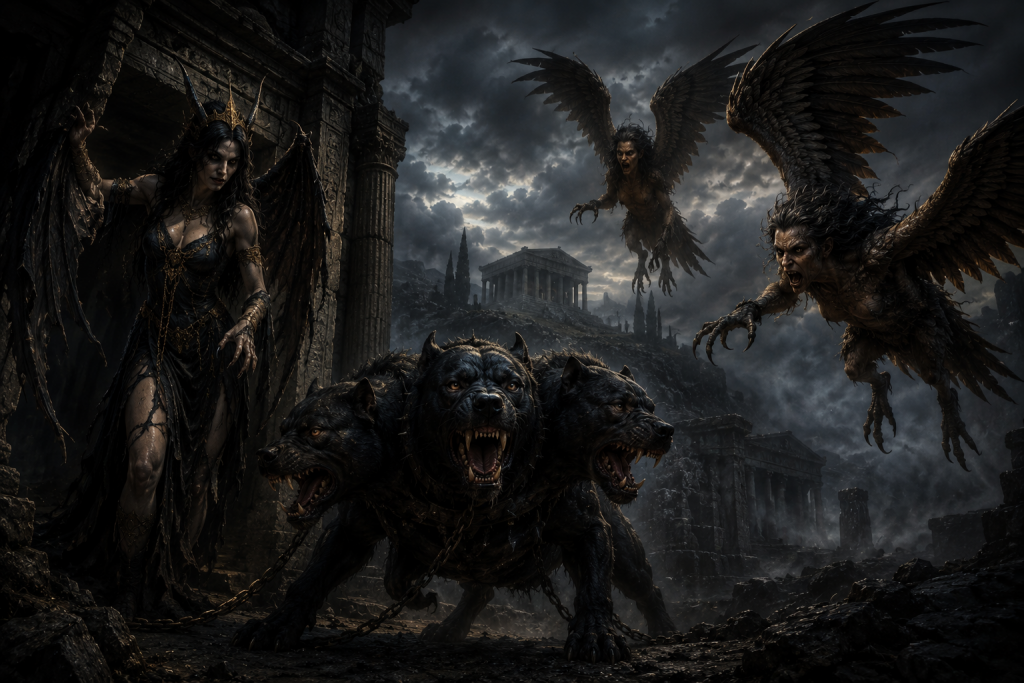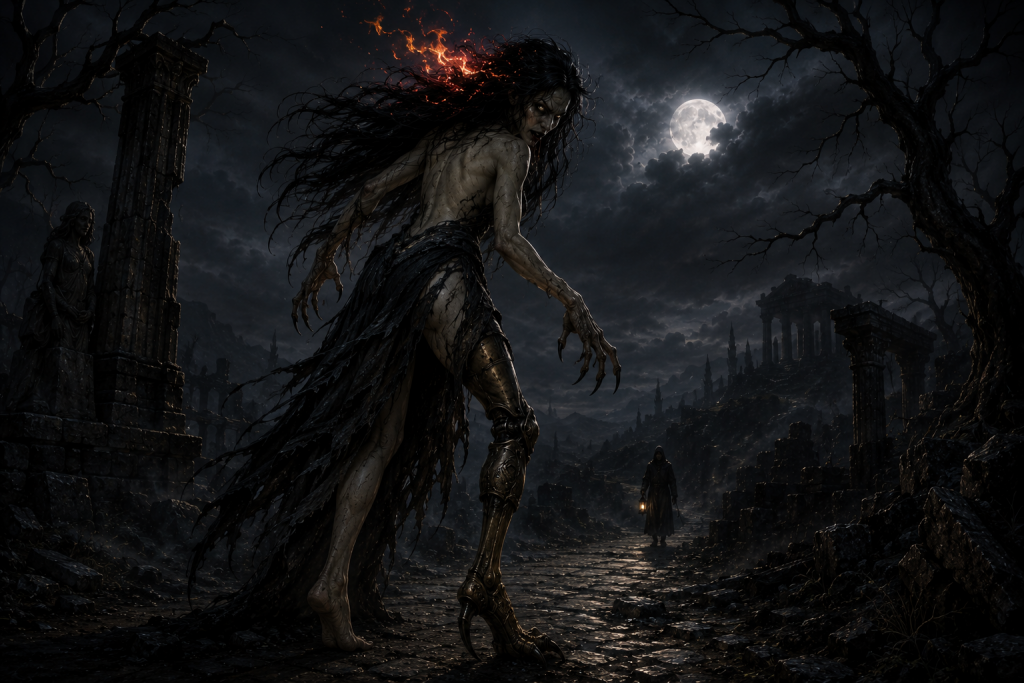
Medusa is one of the most recognisable figures in Greek mythology and one of the most consistently misrepresented. The popular image is simple: a monster with snakes for hair whose gaze turns people to stone, killed by Perseus with a mirrored shield. The tradition is considerably more complex and considerably more sympathetic, and understanding it requires going back further than Perseus’s quest to ask how Medusa became what she was.
She was not always a monster. She was a mortal woman, the only mortal of the three Gorgon sisters, and she was beautiful. What happened to her was done to her rather than chosen by her, and the tradition’s various accounts of it range from straightforwardly unjust to deeply uncomfortable about where the justice actually lies.
The Transformation
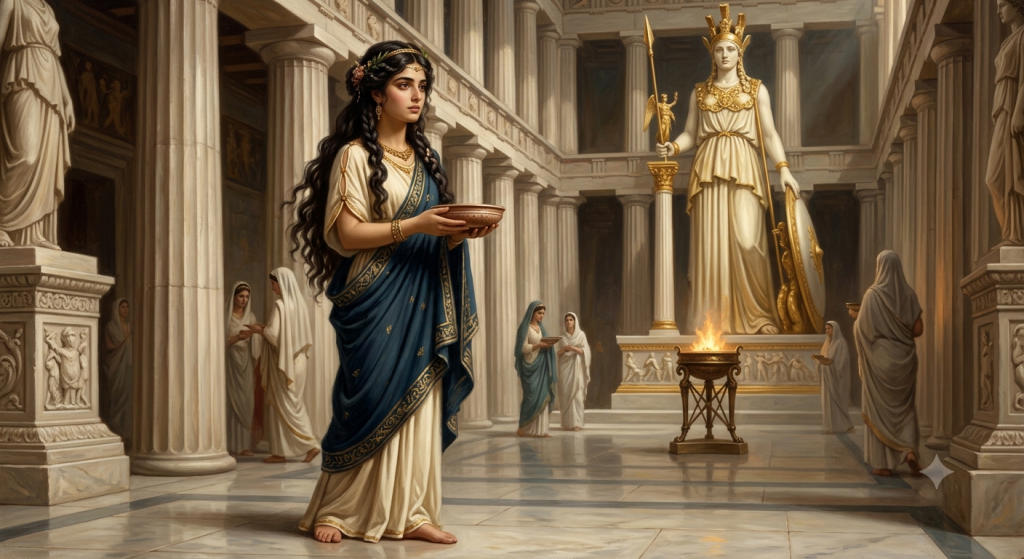
The most detailed account of Medusa’s transformation appears in Ovid’s Metamorphoses, written in the first century BCE, which is a Roman rather than a Greek source but draws on Greek mythological tradition. Ovid describes Medusa as a beautiful woman whose hair was her most celebrated feature, and who was desired by Poseidon. Poseidon assaulted her in the temple of Athena. Athena, outraged by the violation of her sacred space, transformed Medusa: her hair became the snakes that are her defining feature, and her face became the gaze that kills.
Athena’s response is the element that most disturbs modern readers and most requires honest engagement. She punished the victim rather than the perpetrator. Poseidon faced no consequence. Medusa was transformed into a monster. The injustice is visible and the tradition does not hide it: Ovid’s account makes clear that Medusa had done nothing to deserve what happened to her, and that the punishment was for the violation of Athena’s space rather than for anything Medusa had chosen to do.
Earlier Greek sources are less explicit about the cause of the transformation, and some present Medusa simply as one of the Gorgons without explaining the origin of their monstrous form. Hesiod’s Theogony describes the Gorgons as daughters of sea deities, monstrous from birth, without the transformation narrative. The two traditions, Medusa as originally mortal and beautiful versus Medusa as always a monster, coexist in the ancient sources without resolution, which is characteristic of Greek mythology’s tolerance for multiple incompatible accounts.
What the Gaze Actually Was
Medusa’s gaze that turns people to stone is one of the most widely known elements of Greek mythology and one of the most symbolically rich. The most common interpretation treats it as a straightforward monster attribute: she is dangerous, the danger is in her gaze, do not look at her. Perseus solves this by using a mirror.
A more sustained reading notices that the petrifying gaze is specifically feminine in the Greek tradition, associated with the female divine in its most dangerous aspect. The Gorgoneion, the image of a gorgon face used as a protective device on armour, shields, and temple architecture throughout the Greek world, functions as an apotropaic symbol: the terrifying female face that drives away evil by its very appearance. Athena carries the Gorgoneion on her aegis after Perseus gives her Medusa’s head. The goddess of wisdom and war uses the most dangerous female face in the tradition as her protective device.
This is not simple. The monster made from a violated woman becomes the protective power of the goddess who punished her. The tradition holds this without comment.
Perseus and the Mirrored Shield
The mechanics of Perseus’s killing of Medusa are among the most discussed in the heroic tradition. He approaches while she sleeps, using his polished shield as a mirror to see her reflection rather than looking directly at her. He cuts off her head without looking at it. He places the head in a bag that prevents its power from affecting anyone who does not open it.
The mirrored shield is the detail that makes the story function as a story about intelligence rather than simply about strength. Perseus cannot match Medusa in a direct confrontation. He uses the reflection of her own power as the mechanism for avoiding it. This is the same structural principle that appears in the labours of Heracles: the hero succeeds not through superior force but through finding the specific weakness in the obstacle that force alone cannot overcome.
From Medusa’s severed neck spring two beings: Chrysaor, a warrior, and Pegasus, the winged horse. Both are children of Poseidon, conceived during the assault that led to Medusa’s transformation. They have been growing inside her for however long she has existed in her monstrous form, waiting to be released by the decapitation. The tradition is again entirely serious about this: the Gorgon was pregnant for the entire duration of her existence as a monster.
The Gorgoneion and Its Afterlife
After Perseus uses Medusa’s head as a weapon at the wedding feast and gives it to Athena, it becomes the Gorgoneion: the terrifying female face that appears on the central boss of Athena’s aegis, on Greek temple pediments, on soldiers’ shields, on coins, on pottery, on architectural decoration throughout the Greek and Roman world for centuries. It is one of the most widely distributed protective symbols in ancient Mediterranean culture.
The Gorgoneion is Medusa’s face detached from her body and repurposed as a protective device by the goddess who punished her for something that was done to her. Whether this is justice, irony, or simply the tradition’s indifference to the moral complexity of what it is describing is a question every reader of the mythology has to answer for themselves. The tradition does not help.
Further Reading
If this article sparked your interest, these are the books worth reading next.
The Iliad — Homer (Penguin Classics)
by Homer — the primary source for everything in this article, and still the most vivid account of the Trojan War ever written.
The Odyssey — Homer (Emily Wilson translation)
by Homer, translated by Emily Wilson — the best modern English translation, and the book that contains Odysseus’s own account of the horse.
The Trojan War: A Very Short Introduction
by Eric Cline — the clearest and most up to date account of what archaeology actually tells us about Troy and whether any of it happened.
For more on the Greek tradition, the Perseus article covers the hero who kills Medusa and what he does with her head afterward. The Athena article covers the goddess who punishes Medusa and then carries her face as her most powerful protective device. The Greek Mythology hub page has every article in the cluster.
Never miss a myth
Thank you for being here. The site is brand new and every subscriber genuinely means something to me. If you're here, you care about this stuff as much as I do - and that's all the reason I need to keep going. New stories, videos and dark folklore from around the world, straight to your inbox. No algorithm. Just the stories, when they're ready.