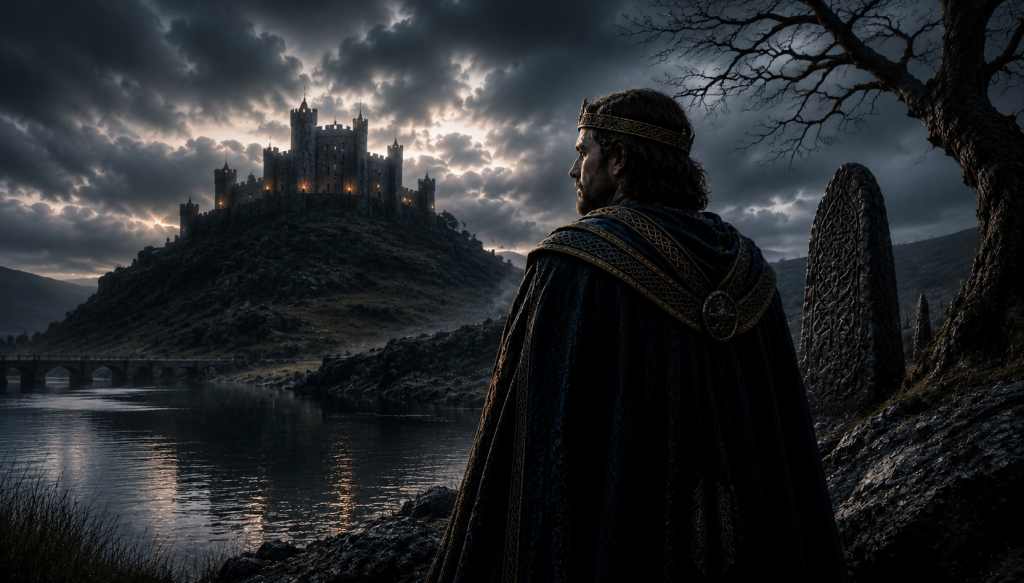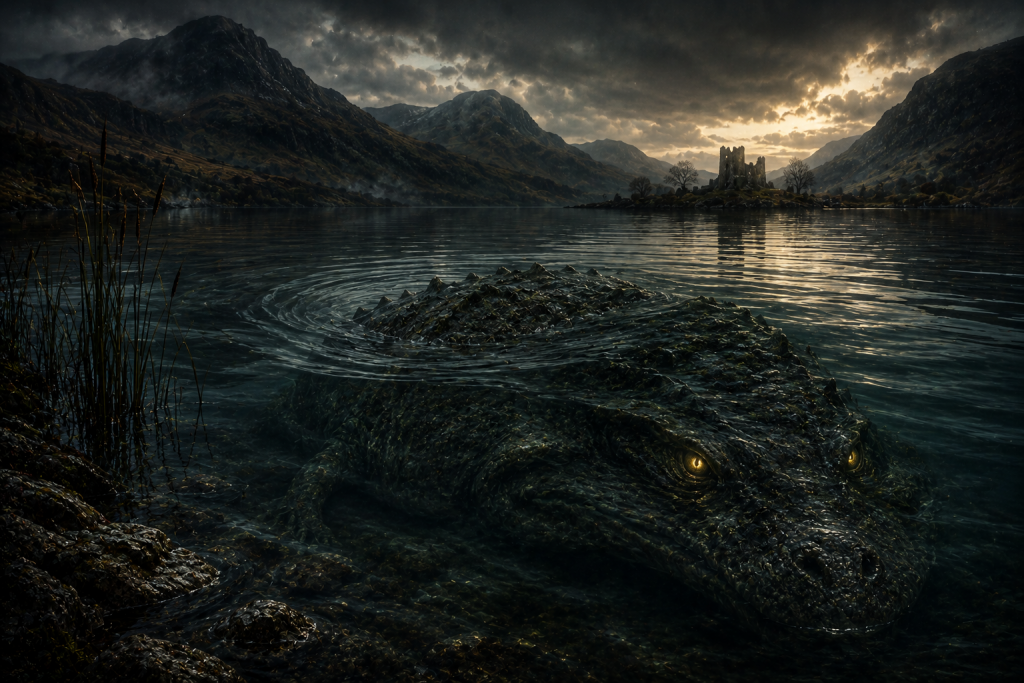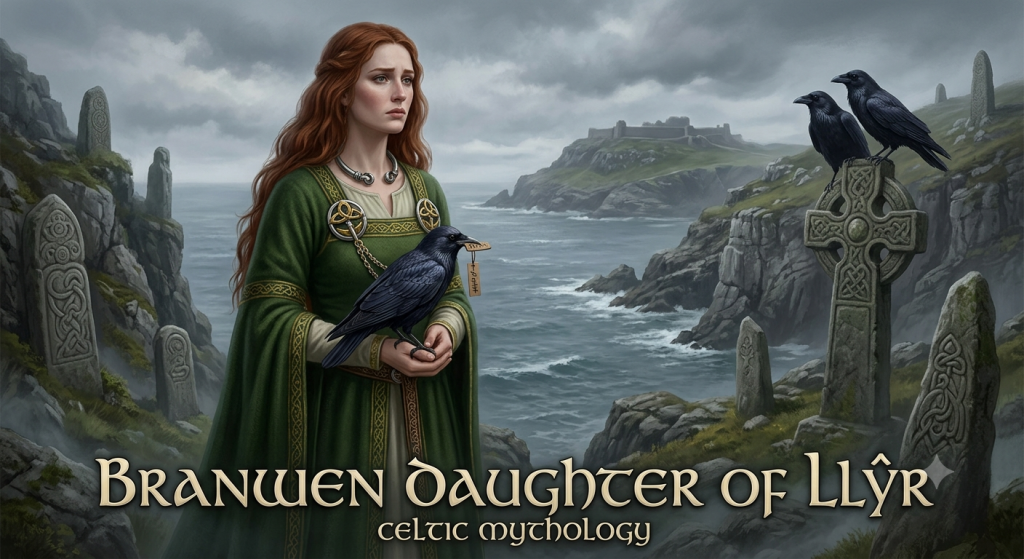
The Second Branch of the Mabinogi is the most devastating story in Welsh mythology. It begins with a marriage and ends with two islands emptied of almost everyone who lived in them. In between, a woman is degraded in a foreign court, a giant is killed by the weapon he gave as a gift, a cauldron of rebirth is destroyed from the inside by a man willing to die to destroy it, five pregnant women survive to repopulate Ireland, and seven men survive to bring the severed but still-speaking head of their king back to Britain. Only seven. From both islands combined. Everyone else is dead.
Branwen, Daughter of Llŷr, is a story about the consequences of insult and the inadequacy of the systems that are supposed to prevent those consequences from spiralling beyond control. It is also, more quietly, a story about a woman who is the cause of everything without having any power over any of it, who suffers the worst of what happens without having made any of the decisions that brought it about, and who dies of grief on a riverbank in Wales looking at Ireland across the water, having seen two kingdoms destroyed on her account.
The Marriage and the Mutilation
Matholwch, king of Ireland, came to Wales to ask for Branwen, sister of Brân the Blessed, king of Britain, in marriage. The marriage was agreed. The wedding feast began. Then Efnisien, Branwen’s half-brother, arrived and found that nobody had asked his permission before giving his sister in marriage, and he responded to this slight by mutilating the Irish king’s horses, cutting off their lips and ears and tails and eyelids.
This act of mutilation is the pivot on which everything in the Second Branch turns. Efnisien’s grievance is real by the standards of the tradition: a man’s female kin should not be disposed of without his involvement. His response is catastrophically disproportionate. Matholwch is insulted in his person through his horses, which in the symbolic vocabulary of the period amounts to an attack on his dignity and his sovereignty. He prepares to leave.
Brân has not done this. He had no idea it was going to happen. But he is the king of Britain and Efnisien is his half-brother, and the insult was committed at his feast, and he must make it good. He offers Matholwch compensation: a sound horse for every damaged one, a staff of silver as tall as Matholwch himself, a plate of gold as broad as Matholwch’s face, and a cauldron of rebirth: if a man is killed today and thrown into it, tomorrow he will be alive again, though without the power of speech.
Matholwch accepts. The marriage proceeds. He takes Branwen back to Ireland.
What Happened in Ireland
For a year, Branwen was well treated in Ireland, and she bore Matholwch a son, Gwern. Then the Irish nobles, who had been brooding on the mutilation of the horses, pressed Matholwch to take revenge. He could not take revenge on Britain directly without renewing the conflict. He took it on Branwen instead.
He put her out of the royal chamber and into the kitchen. He had the court butcher strike her on the ear every day. He prevented any message from leaving Ireland for three years so that Brân could not know what was happening and come to her aid.
Branwen trained a starling to recognise her brother, tied a letter under its wing describing her situation, and taught it to find Brân. The starling found him. Brân read the letter and gathered the armies of Britain and crossed to Ireland.
The starling is one of the most specific and most memorable details in the Four Branches: a woman who has no messengers and no freedom using three years of patient work to train a bird, because a bird cannot be prevented from crossing the sea. It is exactly the kind of ingenuity that operates within extreme constraint, and it is the only moment in the Second Branch where Branwen takes any action of her own.
The War and the Cauldron
Brân was so large that no ship could contain him. He waded across the Irish Sea. The Irish, seeing the British fleet approaching and a giant walking beside it, asked Matholwch to negotiate rather than fight. He agreed to build a house large enough to contain Brân, something that had never been done before, and to give the kingship of Ireland to Gwern, Branwen’s son.
Efnisien was at the feast that followed. He looked at Gwern, his nephew, and without provocation threw the boy into the fire.
The war that followed was almost a war that the British were winning, except for the cauldron. Every Irishman killed in battle was thrown into the cauldron of rebirth and restored to fighting condition by the next morning, silent but alive and armed. The British could not match this. No matter how many they killed, the dead were returned to the Irish forces.
Efnisien, who had caused everything, ended it. He disguised himself as an Irish corpse and was thrown into the cauldron. Inside it he stretched himself out and broke the cauldron into four pieces, and his heart broke with it. He died inside the cauldron he had destroyed, which is both the act that saves the British from the cauldron and an irony that the text does not underline but does not need to.
What Was Left
Of the Irish, five pregnant women survived in a cave in Ireland. They gave birth, and those children became the ancestors of the subsequent Irish population. Of the British, seven men survived: Pryderi, Manawydan, Taliesin the poet, and four others. They carried with them the severed but still-speaking head of Brân, who had been wounded in the foot by a poisoned spear and asked his companions to cut off his head rather than let him linger.
The head remained alive and companionable for eighty-seven years: seven years feasting at Harlech, eighty years at Gwales in Pembrokeshire. For all that time it spoke, and provided company, and the eighty years at Gwales were described as the most pleasant and joyful time any of the seven had known, despite everything that had preceded it. Then someone opened a door that was not supposed to be opened, and the grief and the memory of all the dead came flooding back, and they had to complete their mission and bury the head in London.
Branwen was on the ship going back to Wales. She looked at Ireland and she looked at Wales and she thought of all the men who had died on both islands because of her, and she died of grief on the bank of the River Alaw in Anglesey. A four-sided grave was made for her there.
The tradition records this without comment. She had done nothing wrong. Everything that happened happened because of Efnisien’s act at the wedding feast, and because of the systems of honour and obligation and counter-obligation that the act set in motion. Branwen was the occasion of all of it and the agent of none of it, and she died alone on a riverbank looking at two islands she had helped to empty.
Further Reading
If this article sparked your interest, these are the books worth reading next.
The Mabinogion
The foundational collection of Welsh mythology — the primary source for the Arthurian tradition, the four branches of Welsh legend, and the stories that sit at the heart of the Celtic world.
Celtic Myths and Legends
by Peter Berresford Ellis — the best single-volume introduction to the full range of Celtic mythology, covering Irish, Welsh, Scottish, Gaulish, and Breton traditions properly.
The Táin: Translated from the Old Irish Epic Táin Bó Cúailnge
The great Irish epic — Cu Chulainn, Queen Medb, and the Cattle Raid of Cooley. The closest thing the Celtic world produced to the Iliad, and considerably stranger.
For more on the Welsh mythology tradition, the Mabinogion article covers the full collection and its place in Welsh literature. The Arianrhod and Lleu article covers the Fourth Branch, the strangest and most mythologically dense of the four. The Wales category has every article in the Welsh mythology and folklore cluster.
Never miss a myth
Thank you for being here. The site is brand new and every subscriber genuinely means something to me. If you're here, you care about this stuff as much as I do - and that's all the reason I need to keep going. New stories, videos and dark folklore from around the world, straight to your inbox. No algorithm. Just the stories, when they're ready.