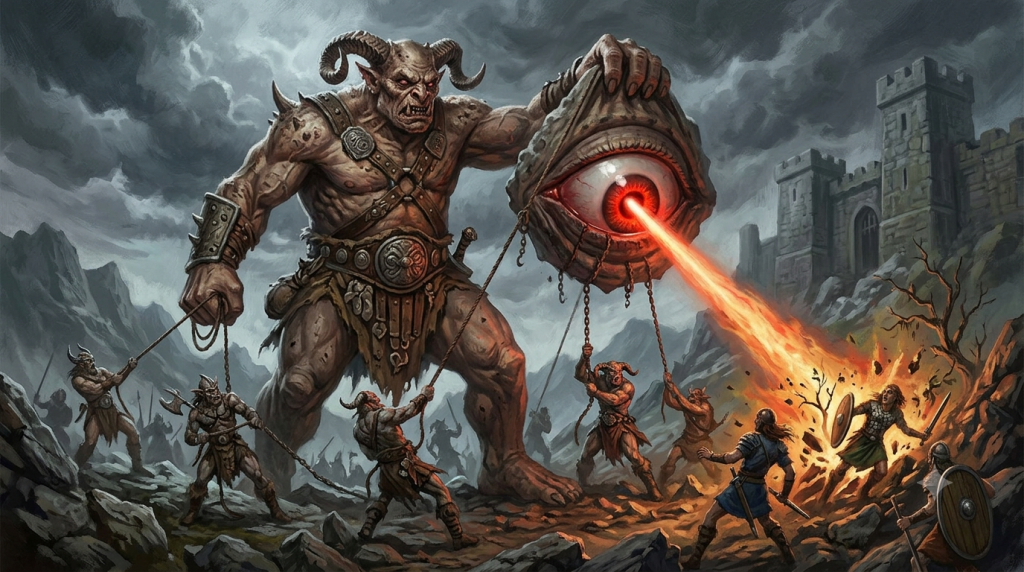
Balor of the Evil Eye was the greatest king of the Fomorians and the most feared being in Irish mythology. His eye could kill an army when it was fully opened. It took four men with iron hooks to lift the eyelid, because the eye had grown so heavy with its destructive power, and when they managed to open it, whatever it looked upon died. He had used it to turn the tide of battles before. He planned to use it to destroy the Tuatha Dé Danann at the Second Battle of Mag Tuired and settle the question of who ruled Ireland permanently in the Fomorians’ favour.
He was killed by his own grandson. The killing was done with a sling stone. And the killing had been prophesied before his grandson was born, which is why he had locked his daughter in a glass tower on Tory Island, and why the locking of his daughter in a glass tower on Tory Island was precisely what produced the grandson who killed him.
Irish mythology is not kind to people who try to prevent prophecies.
The Eye and How It Became What It Was
The origin of Balor’s evil eye is told in a story that is characteristic of how Irish mythology explains its most dangerous forces: not as things that came from outside the world but as things that the world produced through accident and carelessness.
As a boy, Balor looked through the window of a druidic hut where his father’s druids were preparing a poison potion. The fumes of the potion entered his eye and settled there, transforming the eye into a weapon. The destructive power of the poison was concentrated into his gaze, and from that moment it could not be directed at anything without killing it.
The detail that the eye had to be kept closed to prevent it from killing everything around him is one of the most practically specific in the mythology: Balor lived among his own people, who were presumably not his enemies, and the eye needed to be controlled at all times rather than simply deployed against the appropriate target. This made him simultaneously the Fomorians’ greatest weapon and a figure who required constant careful management, a walking catastrophe that his own people had to navigate around.
The Glass Tower and the Prophecy
A druid told Balor that he would be killed by his own grandson. Balor’s response was to lock his only daughter, Ethniu, in a glass tower on Tory Island off the coast of Donegal, attended only by women, so that she would never encounter a man and would therefore never have children and he would therefore never have grandchildren.
Cian of the Tuatha Dé Danann had a magical cow, and Balor stole it. To retrieve it, Cian enlisted the help of a druidess named Biróg, who used magic to transport him to the glass tower disguised as a woman. He and Ethniu met, and she conceived. She gave birth to three boys.
Balor’s immediate response to the birth of grandchildren was to order them all drowned. They were wrapped in a sheet and sent to be disposed of. On the way, the sheet was pierced, and one child fell into a harbour and was rescued by Biróg, who brought him to his father Cian. Cian gave the child to Manannán mac Lir to foster.
That child was Lugh.
The extraordinary specificity of how the prophecy came true is characteristic of the Irish mythological tradition’s treatment of fate: Balor’s actions to prevent the prophecy created exactly the conditions for its fulfilment. He ensured Lugh would have no knowledge of his Fomorian grandfather’s vulnerability to change his mind about attacking. He ensured Lugh would be fostered by the best foster father in Irish mythology and trained to the highest possible level of excellence. He ensured Lugh would arrive at the court of the Tuatha Dé Danann without any personal loyalty to the Fomorians that might have restrained him. Every precaution created a new condition for the prophecy’s success.
Tory Island
Tory Island, where Balor kept his daughter imprisoned, is a real place: a small island off the northwest coast of Donegal, inhabited today by a small community that has maintained a continuous presence there for thousands of years. The name in Irish is Toraigh, from Tor, a tower or rocky peak. The island’s landscape, rocky, dramatic, exposed to the full force of the Atlantic, is exactly the kind of place that the mythology imagines as appropriate for the Fomorians: at the extreme western edge of Ireland, at the point where the land ends and the sea the Fomorians were associated with begins.
The island retains a Fomorian association in Irish tradition and in the local consciousness of the community that lives there. It has been inhabited since the Neolithic period, and its geology suggests why it attracted mythological associations: Tory Island is made of the oldest rocks in Ireland, Precambrian quartzite and granite that predate the rest of the island’s geology by hundreds of millions of years. It is literally made of older material than the land around it, which is exactly what the mythology of the Fomorians as primordial forces suggests.
The Second Battle of Mag Tuired
Balor arrived at the Second Battle of Mag Tuired as the Fomorians’ decisive weapon. The battle had been going against the Fomorians, and Balor’s presence was intended to reverse that. The four men with their iron hooks prepared to open his eye against the Tuatha Dé Danann forces.
The Cath Maige Tuired gives two slightly different accounts of what happened next. In both, Lugh is involved. In one, he puts a stone from his sling through the eye as it opens, driving it backward through Balor’s head so that its gaze falls on the Fomorian forces behind him instead of the Tuatha Dé Danann before him. In another version, he throws a spear. The sling stone version is the more commonly cited and has a specific elegance to it: the eye that killed by looking is defeated by something it never saw coming, a stone from a sling operated by the grandson it never met until the moment of the battle.
The prophecy was fulfilled completely. Balor was killed by his grandson. The eye that killed armies killed his own army as it died. The Fomorians were routed. The precautions against the prophecy had produced exactly the outcome the precautions were meant to prevent, with the additional irony that Balor’s own eye became the instrument of his people’s defeat.
Further Reading
If this article sparked your interest, these are the books worth reading next.
The Mabinogion
The foundational collection of Welsh mythology — the primary source for the Arthurian tradition, the four branches of Welsh legend, and the stories that sit at the heart of the Celtic world.
Celtic Myths and Legends
by Peter Berresford Ellis — the best single-volume introduction to the full range of Celtic mythology, covering Irish, Welsh, Scottish, Gaulish, and Breton traditions properly.
The Táin: Translated from the Old Irish Epic Táin Bó Cúailnge
The great Irish epic — Cu Chulainn, Queen Medb, and the Cattle Raid of Cooley. The closest thing the Celtic world produced to the Iliad, and considerably stranger.
For more on the tradition, the Lugh article covers the grandson who fulfilled the prophecy and became the Tuatha Dé Danann’s greatest champion. The Fomorians article covers the people Balor led and the ancient forces they represented. The Second Battle of Mag Tuired article covers the conflict in full, including the moments before and after the sling stone.
Never miss a myth
Thank you for being here. The site is brand new and every subscriber genuinely means something to me. If you're here, you care about this stuff as much as I do - and that's all the reason I need to keep going. New stories, videos and dark folklore from around the world, straight to your inbox. No algorithm. Just the stories, when they're ready.